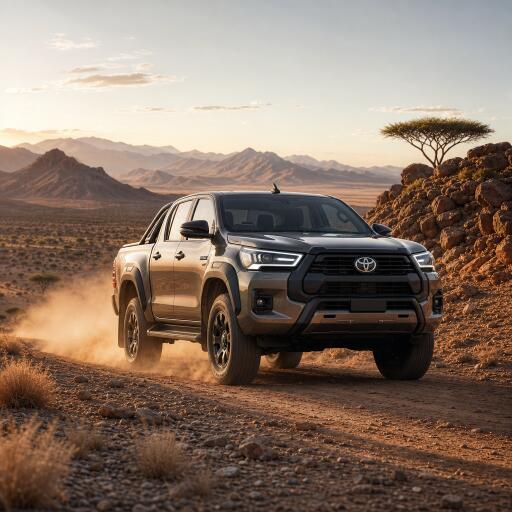
FIRST DRIVE | Testing the 2026 Toyota Hilux through Namibia
Namibia can feel uncannily familiar to South Africans: wide horizons, flat scrubland, and crisp, well-marked highways. Out of Windhoek, the landscape could pass for the Free State—until the immaculate roads, near-absence of litter, and regular military checkpoints remind you you’re elsewhere. In this setting, the Toyota Hilux is so common it blends into the scenery; yet a convoy of brand-new 2026 models in black, grey, and orange still turns heads among drivers of trusty white workhorses.
Design and cabin
The ninth-generation Hilux is more a comprehensive facelift than a clean-sheet redo—very much in keeping with Toyota’s tradition of steady evolution. Look closer and the updates feel substantial. The front adopts a “cyber-sumo” theme: tough and futuristic, with a broader stance, bolder grille treatment, larger rear clusters, and pronounced haunches. The tailgate now carries chunky Toyota lettering pressed into the metal. The passenger cell is familiar, but the overall effect is distinctly new and more assertive.
Inside, the dashboard, screens, and steering wheel draw from the latest Land Cruiser Prado playbook. Seats are redesigned for better ergonomics, and the materials elevate the ambience beyond the hard, plasticky feel of before. It finally looks and feels like a modern dual-purpose bakkie—capable at work, pleasant for family duty.
On the road—and far off it
Our test, from Windhoek to Walvis Bay and beyond, ran over 1,000km of smooth asphalt, brutal corrugations, and soft sand. The range-topping Legend 4×4 double-cab (R999,900) impressed most where the old Hilux often faltered: ride comfort and refinement. Toyota openly acknowledged past criticism about jittery suspension; the new model responds with a strengthened frame, extra damping measures to curb vibration, and suspension tuning biased more toward comfort—without dulling control.
The result is a marked step forward, narrowing the refinement gap to the Ford Ranger. On gravel at reduced tyre pressures (2.0 bar), the Hilux tracked straight and stable, maintaining confident pace at near freeway speeds. Electric power steering appears here for the first time, delivering a lighter, more precise feel and making the vehicle notably more maneuverable on dirt. Even lane-keep assist had a go at following the “lanes” formed by tyre tracks on gravel; we eventually switched it off to enjoy unfiltered steering on a rally-like lodge road approach. With 4H engaged, traction control and quick hands kept the back end tidy without drama—and without calling on the seven airbags.
Noise suppression is another leap. The characteristic diesel thrum is subdued, leaving only a faint wind rustle at speed. That noise seemed linked to an external CB aerial cable on our test units rather than build quality. One quirk: the two-pin plug socket in the centre console didn’t work on two separate vehicles—minor, but noted.
Powertrain and efficiency
The familiar 2.8-litre four-cylinder turbodiesel remains, delivering 150kW and 500Nm through a six-speed automatic. Outputs are unchanged, but the overall calibration and sound insulation make the drivetrain feel smoother and more relaxed. After two days of hard driving across mixed surfaces, the trip computer showed 11l/100km—credible given the pace and terrain.
The 2.4-litre diesel returns to the lineup next year. Interestingly, the outgoing-generation Hilux with the 2.4 will continue to be sold until then, offering buyers a bridge option.
Tech, safety, and security
The Legend grade introduces mild-hybrid assistance, though power figures mirror those of SRX and Raider models. Driver assistance systems include lane-keep assist and other active safety aids. Given the Hilux’s desirability, theft resistance is a hot topic; a standard smartphone app allows remote vehicle shutdown across the new range, making this iteration harder to steal even if it remains a popular target.
Verdict
Hilux loyalists might suspect the changes are skin deep, but the 2026 update transforms the everyday experience: a calmer ride, sharper steering, reduced noise, and a cabin that finally feels premium enough for family life. It’s still the resolute, do-it-all Hilux at heart—just better at almost everything that matters.
Model range and pricing (ZA)
New Hilux Double-Cab:
- 2.8 GD-6 SRX 4×2 automatic: R658,500
- 2.8 GD-6 SRX 4×4 automatic: R746,100
- 2.8 GD-6 Raider 4×4 automatic: R892,900
- 2.8 GD-6 Legend 4×2 automatic: R945,500
- 2.8 GD-6 Legend 4×4 automatic: R999,900
New Hilux Xtra Cab:
- 2.8 GD-6 Raider X 4×2 automatic: R751,800
- 2.8 GD-6 Raider X 4×4 automatic: R842,200
Launched in 1968 and locally produced since 1972, the Hilux’s legacy is long. Generation nine doesn’t rewrite the script—but it makes a compelling case that thoughtful, targeted improvements are exactly what this icon needed.