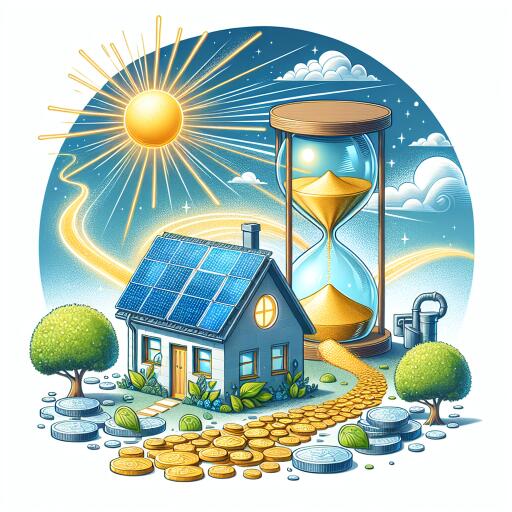
How long will it take for my solar panels to pay for themselves?
Solar panels have become far more efficient and affordable over the past few decades, making them a practical way to cut electricity bills and carbon emissions. The key to a fast payback is not just the price you pay upfront, but how much of your own clean electricity you use, when you use it, and how you store excess energy. This guide explains what drives payback time, how to estimate it, and the smartest ways to speed it up.
What determines your payback time?
- System cost: Panels, inverter, mounting, wiring, labor, and optional battery or hot water diverter.
- Incentives: Grants, rebates, and tax credits reduce upfront cost (availability varies by location).
- Electricity prices: The higher your retail rate, the more you save by self-consuming solar.
- Self-consumption rate: The percentage of solar you use directly at home versus exporting to the grid.
- Export tariff: What you earn for surplus electricity sent to the grid (usually lower than retail).
- Roof orientation and shading: South-facing (in the northern hemisphere) with minimal shade yields more energy.
- Storage and smart controls: Batteries, EV charging, and hot water diverters help soak up excess solar.
- Maintenance, lifespan, and degradation: Panels typically degrade ~0.5–1% per year; inverters and batteries have shorter lifespans than panels.
- Financing: Interest costs extend payback; paying upfront shortens it.
The simple payback formula
Simple Payback (years) = Net Installed Cost / Annual Savings
Annual Savings = (Self-consumed kWh × retail price) + (Exported kWh × export price) − annual maintenance
Example (illustrative only): A 4 kW system costs €8,000 after incentives. In a temperate climate, assume ~900 kWh per kW per year, so generation ≈ 3,600 kWh/year. If you self-consume 60% (2,160 kWh) at €0.30/kWh, that’s €648 in avoided purchases. Exporting 1,440 kWh at €0.15/kWh adds €216. Total annual savings ≈ €864. Simple payback ≈ €8,000 / €864 ≈ 9.3 years.
Change any variable and payback shifts. Higher self-consumption (say 75%), higher retail prices, or better orientation improves savings. Adding a battery increases self-consumption but also raises upfront cost—whether it shortens payback depends on your usage patterns and tariffs.
How to reduce your payback time
- Time your loads: Run washing machines, dishwashers, and tumble dryers during sunny periods rather than all at once. Avoid exceeding your real-time solar output to minimize buying from the grid.
- Use storage wisely:
- Battery: Stores daytime solar for evening use; boosts self-consumption.
- Hot water diverter: Treat your cylinder like a “thermal battery” by heating water when solar is abundant.
- EV smart charging: Prioritize charging your car during midday generation.
- Upgrade efficiency: LEDs, efficient appliances, and good insulation reduce overall consumption, leaving more of your solar to cover essential loads.
- Right-size the system: Match system size to your daytime demand and realistic storage capacity for optimal value.
- Leverage smart controls: Set priorities such as household load first, then battery or hot water, then EV. Adjust seasonally as needs change.
- Maintain your system: Keep panels free of heavy dirt or debris and ensure the inverter operates within spec to preserve output.
- Adapt routines: If possible, work from home or shift chores to daylight hours to take advantage of production peaks.
Realistic expectations
- Generation varies: Solar produces in daylight only, with seasonal swings and weather effects.
- Typical lifespans: Panels often last 25–30 years; inverters 10–15 years; batteries 7–15 years, depending on chemistry and usage.
- Long-term value: Even after payback, you’ll still have standing charges, fees, and taxes on your bill, but your energy usage portion can drop substantially.
- Typical payback range: Many homes see 6–12 years, depending on local prices, incentives, self-consumption, and system design.
Get a personalized estimate in 7 steps
- Collect 12 months of electricity usage and costs to find your average kWh and retail rate.
- Estimate annual generation: Use local benchmarks (e.g., 800–1,200 kWh per kW per year in cooler, cloudier climates; more in sunnier regions) and adjust for orientation/shade.
- Choose a system size aligned with your roof, budget, and daytime demand.
- Estimate self-consumption: Without storage, 30–60% is common; with a battery, hot water diverter, or EV charging, 60–85% may be achievable.
- Apply tariffs: Multiply self-consumed kWh by your retail price and exported kWh by your export price.
- Account for maintenance, inverter replacement (once over 10–15 years), and panel degradation (~0.5–1%/year).
- Compute net cost after incentives and divide by annual savings; run best/typical/worst-case scenarios to see the range.
Bottom line: Payback depends more on how you use and store your solar than on panel efficiency alone. Prioritize self-consumption with smart scheduling and storage, size the system to your needs, and verify realistic generation and tariff assumptions. Do that, and you’ll maximize savings and shorten the time to “free” solar power.