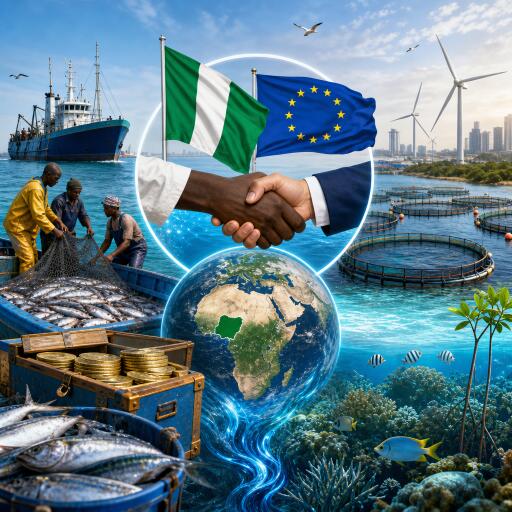
Nigeria Taps €59 Million Eu Ocean Fund To Protect Fisheries And Expand Blue Economy
Nigeria is moving to leverage a €59 million European Union–backed ocean governance programme to bolster maritime surveillance, curb illegal, unreported and unregulated (IUU) fishing, and strengthen a blue economy increasingly seen as a driver of jobs, food security and non-oil growth. The West Africa Sustainable Ocean Programme (WASOP), discussed by Minister of Marine and Blue Economy Adegboyega Oyetola during a meeting with the European Union Ambassador to Nigeria, Gautier Mignot, is expected to provide technical and financial support for fisheries monitoring, maritime enforcement and sustainable resource management.
Why It Matters: The Market Angle
Illegal fishing is a persistent drain on Nigeria’s maritime economy. Beyond environmental costs, IUU activity undermines government revenue, weakens domestic fishing fleets, depletes fish stocks and threatens millions of livelihoods tied to coastal communities. The effects are increasingly visible in the broader economy, intersecting with:
- Food inflation, as depleted stocks and supply disruptions pressure prices.
- Supply-chain resilience, with irregular landings and quality losses straining cold-chain logistics.
- Diversification goals, as uncertainty deters private investment in fisheries and aquaculture.
Despite being one of Africa’s largest fish-consuming markets, Nigeria’s local production struggles to meet demand, resulting in significant seafood imports. By tightening surveillance and enforcement, authorities aim to rebuild stocks, stabilize supply and create conditions for greater private-sector participation across fisheries, aquaculture, cold storage, processing and maritime services.
Blue Economy Emerges as a Growth Frontier
The anti-IUU push aligns with Nigeria’s National Policy on Marine and Blue Economy, which targets ocean-based industries as a major contributor to GDP. Priority areas include:
- Maritime transport and port logistics
- Fisheries and aquaculture
- Coastal and marine tourism
- Offshore energy and related services
- Marine biotechnology and value-added processing
Recent reforms to improve port efficiency, expand infrastructure and enhance security along key shipping routes have reinforced the investment case. Given the Gulf of Guinea’s role as a pivotal maritime corridor for regional trade and energy shipments, stronger governance could deliver spillover benefits—from lowering logistics costs to improving trade competitiveness—well beyond the fisheries sector.
What the EU-Backed Programme Brings
WASOP is designed to deepen cooperation among West African coastal states, improve fisheries management and support integrated ocean governance. For Nigeria, the programme is expected to unlock capabilities that would be costly to deploy alone, including:
- Advanced surveillance tools such as satellite monitoring, vessel-tracking systems and electronic observer technologies.
- Stronger at-sea and port-based enforcement, backed by better data sharing and coordinated patrols.
- Capacity building for agencies overseeing fisheries, customs, ports and maritime security.
- Support for modern legal and regulatory frameworks aligned with international best practices.
These measures aim to curb illicit activity, boost compliance and lay the groundwork for sustainable stock management—critical prerequisites for scaling domestic production and attracting long-term investment.
Strategic Implications
The broader significance of the initiative lies in converting marine resources into a resilient, high-value asset. While diversification efforts have historically centered on agriculture, manufacturing and technology, the blue economy is increasingly recognized as an engine for inclusive growth—spanning coastal communities, SMEs and large-scale investors.
Success will hinge on execution. Priorities include:
- Consistent enforcement with transparent data on catches, landings and sanctions.
- Science-based stock assessments to calibrate quotas and seasonal closures.
- Investment in cold-chain and processing capacity to reduce post-harvest losses.
- Community engagement and alternative livelihoods to align conservation with local income needs.
- Regional coordination to prevent displacement of IUU operators from one jurisdiction to another.
If effectively implemented, the €59 million programme can do more than protect ecosystems—it can anchor a virtuous cycle in which better governance attracts capital, drives innovation and creates quality jobs, while healthier fish stocks stabilize prices and reduce import dependence.
Outlook
Nigeria’s access to international capital and technical expertise through WASOP marks a practical step toward linking environmental stewardship with economic opportunity. With clearer rules, smarter monitoring and stronger institutions, the country can narrow the gap between seafood demand and domestic supply, elevate export potential and reinforce the Gulf of Guinea’s role in regional trade. Ultimately, the test will be whether coordinated enforcement and targeted investment can translate the ocean’s natural wealth into durable, broad-based value for Nigeria and West Africa.