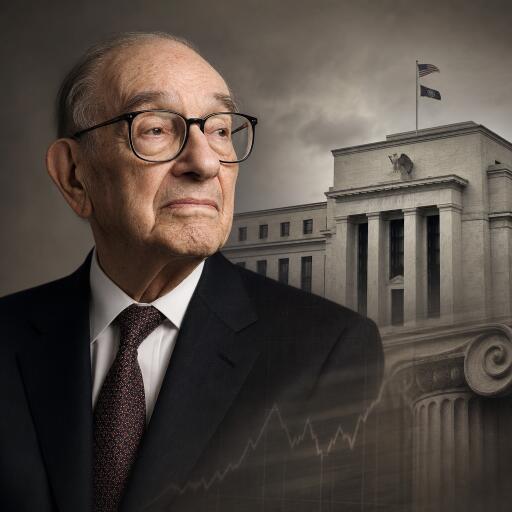
Former Federal Reserve Chairman Alan Greenspan dies at 100
Alan Greenspan, the influential economist who led the U.S. Federal Reserve for 18½ years, died Monday at age 100 from complications of Parkinson’s disease, his wife Andrea Mitchell said. “He had ‘irrational exuberance’ for baseball, the Washington Commanders, tennis, golf, and music, especially jazz,” she said, remembering both his brilliance and kindness.
A towering, polarizing figure at the Fed
Greenspan steered the central bank from 1987 to 2006 through a period of remarkable growth and comparatively low inflation, including the record expansion from 1991 to 2001. His pronouncements were parsed by investors worldwide, earning him reverential nicknames such as “Maestro” and “Oracle.” Fed-watchers even coined the “Briefcase Indicator,” guessing his policy intentions by how stuffed his papers appeared when he entered meetings.
His influence was on display in December 1996 when two words—“irrational exuberance”—shook markets by hinting that stock prices might be overheated. Mindful of his power to move markets, Greenspan often spoke in deliberately opaque terms. He once joked to Congress: “I know you believe you understand what you think I said, but I am not sure you realize that what you heard is not what I meant.”
Early tests and global crises
Appointed by President Ronald Reagan in 1987, Greenspan confronted his first trial just two months into the job. On “Black Monday,” Oct. 19, 1987, U.S. stocks suffered their largest one-day percentage drop on record. The Fed quickly pledged ample liquidity, helping restore calm and preventing broader economic damage.
He faced more turmoil during the Asian financial crisis of 1997–1998, when the Fed helped coordinate emergency measures, including support for Thailand and urging U.S. banks to extend credit to a vulnerable South Korea. At home, unemployment briefly fell below 4% in 2000, while inflation remained muted—a combination many economists once thought unlikely to sustain.
Housing bubble, crisis, and a shaken legacy
Greenspan’s standing eroded soon after his 2006 departure. U.S. housing prices began to fall, triggering a global financial crisis that culminated in the Great Recession of 2007–2009. Critics argued that his low interest rates and trust in lightly regulated markets helped inflate a dangerous housing bubble and encouraged excessive risk-taking, including in opaque derivatives that later magnified losses. The near-collapse of major institutions, including the bailout of American International Group, became emblematic of those risks.
Greenspan later acknowledged shortcomings, saying he had “made a mistake” in assuming banks could largely police themselves. Investigations into the crisis concluded that decades of deregulation and reliance on self-regulation had stripped away safeguards that might have mitigated the disaster.
Ideas, methods, and a distinctive style
Greenspan delighted in the data trenches, analyzing everything from boxcar loadings to steel output to gauge the economy’s pulse. Mornings reportedly began with a long soak and a stack of memos. During the 1990s boom, he championed the view that technological advances boosted productivity enough to let the economy run hotter—supporting lower unemployment without reigniting inflation—and shaped policy with that thesis in mind.
From jazz clarinet to central banking
Born in Manhattan’s Washington Heights, Greenspan showed early mathematical prowess. He attended the Juilliard School before leaving to perform as a professional musician, playing clarinet and saxophone alongside the future jazz great Stan Getz—an experience that nudged him toward economics. He earned undergraduate and graduate degrees, including a Ph.D., at New York University and built a prominent consulting practice.
In the 1950s he became a disciple of Ayn Rand, who nicknamed him “the Undertaker” for his somber attire. He later served as President Gerald Ford’s chief economic adviser before Reagan selected him to lead the Fed. Colleagues and markets alike came to regard him with a mix of awe and apprehension—admiring his steady hand while fretting over the day he would depart.
Personal life
Greenspan’s personal life sometimes crossed into the public eye. He once dated journalist Barbara Walters and later married Andrea Mitchell after a long courtship. The couple had no children. Friends described him as intensely private, with a wry sense of humor and an abiding love of music.
After the chairmanship
Following his 2006 retirement, Greenspan founded Greenspan Associates, advising financial firms and remaining a prolific commentator. He wrote a memoir and additional books, including “The Map and the Territory” (2013), in which he argued that traditional models struggled to account for the psychology of bubbles: “Bubbles go up very slowly as euphoria builds. Then fear hits, and it comes down very sharply.”
He also joined public statements defending the Federal Reserve’s independence, including in 2026 when he criticized efforts to pressure or investigate central bank leaders. His nearly 19-year tenure as chair was one of the longest in Fed history, just shy of William McChesney Martin’s record from 1951 to 1970.
A complex legacy
Greenspan’s imprint on the modern U.S. economy is indelible. Admirers point to his steady crisis management and a decade-long expansion with low inflation; detractors cite policies and a deregulatory philosophy that, in their view, helped set the stage for the 2008 collapse. Both narratives endure. What is clear is that for nearly two decades, the Maestro’s words and decisions helped define the rhythm of global finance—and his legacy will be debated for years to come.