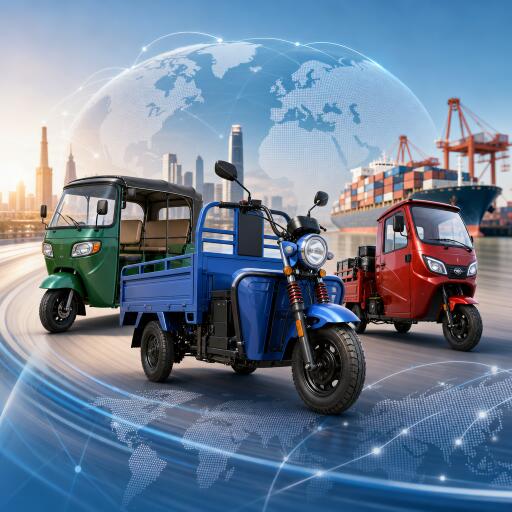
Chinese motor tricycles glide into international markets with innovation, customized services
Sturdy, nimble, and able to haul just about anything, Chinese motor tricycles have become a global hit—boosted by social media buzz and, increasingly, by made-to-order features. A new wave of customer-focused design and services is helping manufacturers move beyond simple exports to forge deeper, more responsive ties with local markets worldwide.
Customization-powered growth in Henan
In Yanshi District of Luoyang, Henan Province, factories are turning out new motor tricycles at a rapid clip—one vehicle rolling off automated lines roughly every 15 minutes. Buyers can specify features down to bilingual parking warnings in Chinese and English, while additional options are tailored for work, tourism, and daily transport across different regions.
According to factory staff, sightseeing and passenger-focused models with upgraded comfort and distinctive styling are popular with customers from destinations such as Egypt and the United Arab Emirates. In Central Asia and Africa, where tricycles more often serve as hard-working haulers, manufacturers tune cargo-box dimensions and fuel-tank capacity to match local loads and routes.
The ecosystem behind these bespoke builds is both dense and fast. Yanshi hosts 15 complete-vehicle makers and more than 270 supporting parts companies, employing around 12,000 people and accounting for over one-third of China’s motor tricycle production capacity, local authorities report. A “half-hour parts supply circle” keeps assembly lines responsive, with most components—apart from engines, tires, carburetors, and lighting—sourced locally for speed and flexibility.
Production momentum has been strong. In 2025, Yanshi produced and sold about 300,000 motor tricycles, including 98,000 exports. In the first half of 2026, exports reached 55,000 units, and the full-year tally is expected to climb to roughly 110,000.
Electric versatility wins fans in Africa
In Fengxian County, Jiangsu Province—another major hub with some 1,400 related manufacturers—electric tricycles are gaining traction with a different mix of strengths: low operating costs, reliable performance, and easy maintenance.
Local producer Meizida began distributing to Cape Verde in 2020. What started with one or two containers a year has grown to about five, with annual sales now topping 200 vehicles. Compared with fuel-powered options, electric trikes reduce energy costs and simplify upkeep. Compared with ordinary motorcycles, they carry more, handle diverse tasks, and feel steadier—advantages that matter to small and micro businesses.
In many African communities, a single electric tricycle can haul goods in the morning, serve as a commuter in the afternoon, and transform into a mobile stall at night. Reflecting this rising demand, Fengxian’s electric tricycle exports reached 390 million yuan in the first five months of 2026, up 99.3 percent year on year, according to local statistics.
From exporting goods to building ecosystems
For an increasing number of manufacturers, shipping finished vehicles abroad is just the beginning. In Yanshi, companies are teaming up with overseas partners to build warehouses and after-sales service outlets, combining order-based exports with on-the-ground support. Elsewhere, tricycle makers are setting up production bases and direct-sales stores across several countries, knitting together localized manufacturing and distribution networks in Africa and South America.
This playbook—customize for local needs, back it with quick parts supply, and support it with service close to customers—helps products adapt to real-world conditions while strengthening long-term market presence.
Faster iteration, better value
Behind these advances lies a broader shift in China’s manufacturing approach. Well-coordinated, large-scale supply chains are compressing the cycle from design and production to restocking and logistics, enabling faster product iteration and more flexible, data-driven development. As Li Kai, an associate professor at Xiamen University’s School of Economics, notes, the result for overseas buyers is access to newer, more reliable products and services—often at competitive prices.
Policy priorities reinforce this direction. China’s 15th Five-Year Plan (2026–2030) emphasizes trade innovation, quality and efficiency improvements, and diversified markets—encouraging companies to upgrade product value, deepen service capabilities, and respond swiftly to shifting global demand.
Everyday mobility, shared stories
The impact of these three-wheelers shows up not just in export figures but in daily life. On social platforms, users from different countries swap tips, repairs, and memories—from childhood school runs on a family trike to practical advice on using a vehicle for gardening, farm chores, or teaching new drivers in a safer, more stable format than a tractor.
By blending rugged utility with modern customization, Chinese motor tricycles offer a down-to-earth view of innovation: technology and services tuned to everyday needs. Whether zipping tourists along scenic routes, powering a market stall, or hauling produce on village roads, they are quietly reshaping local mobility—and building lasting connections between manufacturers and communities worldwide.