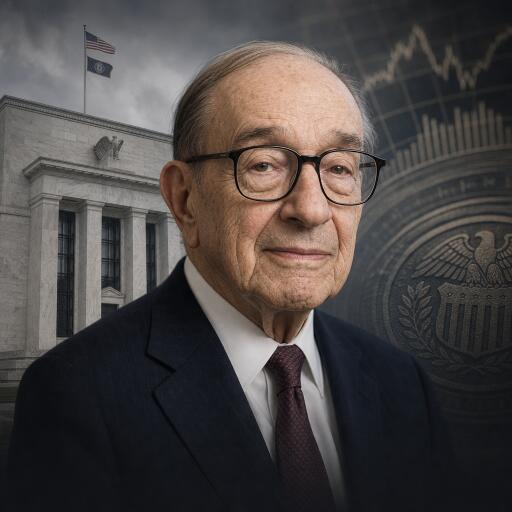
Alan Greenspan, long-time US Federal Reserve, chairman dies at 100
Alan Greenspan, the Federal Reserve chairman long credited with steering a record U.S. economic expansion in the 1990s before facing sharp criticism after the 2008 financial crisis, has died at 100. He passed away on Monday at his home due to complications of Parkinson’s disease, according to his wife, Andrea Mitchell.
Serving from 1987 to early 2006, Greenspan presided over a period marked by a stock market boom, sustained growth, and low unemployment. Roger Ferguson, Fed vice chair from 1999 to 2006, called him “one of the great central bankers of the second half of the 20th century,” praising his early recognition of technology-driven productivity gains.
Greenspan’s careful, sometimes Delphic, public remarks could move global markets. His 1996 musing about “irrational exuberance” became a cultural touchstone, as did the notion of a “Greenspan put”—the belief that the Fed would cushion major market declines—which some critics said encouraged excessive risk-taking.
His tenure spanned the steadiest growth since the Fed’s founding, including a 10-year expansion from 1991 to 2001. The S&P 500 rose nearly fourfold, GDP averaged about 3.5% growth, and unemployment averaged 5.5%, touching 3.8% in April 2000, the lowest since 1969 at the time.
But strains mounted late in his term as subprime lending surged, homeowners tapped equity, and Wall Street sliced mortgages into complex securities. While Fed officials flagged housing risks in 2005, Greenspan said the “froth” seemed to be containing itself as mortgage rates rose. When bank lending froze in 2007, the cascade led to the 2008 crisis.
Greenspan’s hands-off stance toward financial regulation and asset bubbles drew intense scrutiny. He later conceded that reliance on banks’ self-interest had been misplaced, telling Congress in 2008 that he was in “a state of shocked disbelief.” He would say he was right “70% of the time,” wrong “30%.”
Post-crisis assessments faulted decades of deregulation and self-regulation, which they argued eroded safeguards. Greenspan defended his approach in a 2010 paper, arguing that using interest rates to burst bubbles would crush prosperity: “Any bubble can be crushed, but the state of prosperity will be an inevitable victim.”
Born March 6, 1926, in New York City’s Washington Heights, Greenspan’s early passions for baseball statistics and music led him to Juilliard and a stint as a jazz musician before pivoting to economics. He earned bachelor’s and master’s degrees from New York University and completed a PhD there later, after studies at Columbia under Arthur Burns.
He married Joan Mitchell in 1952; the marriage ended after a year. In 1997 he married Andrea Mitchell. An associate of Ayn Rand in the 1950s and 1960s, Greenspan said her ideas sharpened his attention to how fear, euphoria, and herd behavior shape economies.
In 1953 he co-founded the consultancy Townsend-Greenspan, building a reputation on granular data and timely calls, including anticipating the 1958 recession. He advised Richard Nixon’s 1968 campaign, then served as chair of the Council of Economic Advisers under Presidents Nixon and Ford. He later led a bipartisan commission that forged 1983 reforms to shore up Social Security.
Appointed Fed chair by President Ronald Reagan in 1987, Greenspan navigated crises with swift interventions: supplying liquidity after the October 1987 crash; pausing rate hikes amid Asia’s 1997 turmoil; cutting rates after Russia’s 1998 default; and helping orchestrate a rescue of Long-Term Capital Management. Inflation averaged about 3% on his watch, down from 4.4% when he began.
Presidents George H.W. Bush, Bill Clinton, and George W. Bush each reappointed him. Notably, Greenspan made the Fed more transparent: beginning in 1994, policy decisions were announced the day of meetings, with explanations that offered guidance on future moves.
His central analytic insight of the 1990s was that technology was lifting productivity enough to let the economy run faster without igniting inflation. He allowed growth to continue as others urged preemptive tightening, then engineered a rare “soft landing” by raising rates into 1994 and cutting them in 1995—cooling inflation without causing a recession, which he called one of the Fed’s “proudest accomplishments.”
Greenspan’s dominance defined an era. Former Vice Chair Alan Blinder and others later reflected on the “personalization” of policy under him—an “imperial” chairmanship that his successor, Ben Bernanke, would consciously rebalance with formal inflation targeting and clearer forward guidance.
Greenspan’s legacy remains two-sided: a maestro of the 1990s boom who reshaped central banking transparency and recognized the digital economy’s potential, and a symbol, to his critics, of market faith taken too far as financial excesses swelled. His influence on monetary policy and economic debate endures well beyond his long tenure.