Ras Al Khaimah-Developed Arabic Literacy Program Helps Young Learns Make Significant Progress in Reading – Middle East Business News and Information – mid-east.info
Ras Al Khaimah, UAE — May 2026: A major independent evaluation has found that IQRA, an early Arabic literacy program developed by the Sheikh Saud bin Saqr Al Qasimi Foundation for Policy Research, produced reading gains for young learners equivalent to an additional 25% of a school year.
The randomized controlled trial, conducted by J-PAL MENA during the 2024–2025 academic year, covered 83 classrooms across 26 schools in Ras Al Khaimah—one of the largest evaluations of its kind for Arabic early literacy in the UAE. The results offer a practical, scalable way to help children transition from the Arabic they speak at home to the Modern Standard Arabic (MSA) used in classrooms and textbooks.
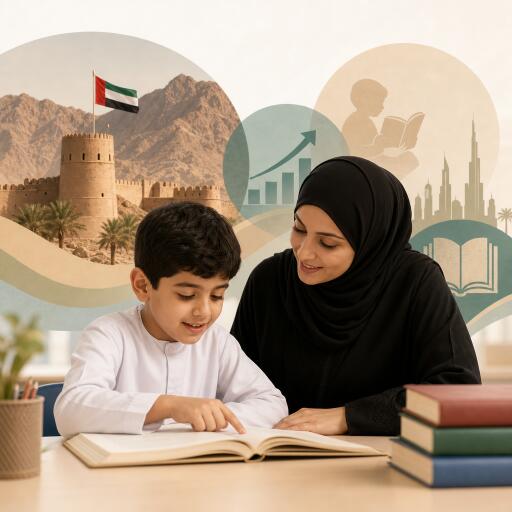
Individual guidance and evidence-based instruction help young learners build confidence and strengthen foundational Arabic reading skills through the IQRA program.
Evidence from a landmark trial
In the evaluation, 41 classrooms were randomly assigned to implement IQRA while 42 classrooms continued with the standard Arabic curriculum. Students in IQRA classrooms achieved statistically significant improvements in key literacy skills, including letter identification, word reading, and reading fluency, compared to their peers.
Crucially, these gains were achieved without adding extra school hours or introducing costly technology. Most schools integrated IQRA within their existing timetable, requiring only a few days of teacher training.
Following the successful results, IQRA will be introduced across all private schools in Ras Al Khaimah from September 2026.
Closing the gap between home Arabic and school Arabic
IQRA was designed to tackle diglossia—the well-known gap between spoken Arabic at home and the formal MSA used in schools. For many children, early reading in Arabic can mean learning new letters, sounds, vocabulary, and a more formal register of the language all at once. IQRA breaks this challenge into structured, manageable steps that build automaticity and confidence from the earliest grades.
Developed in collaboration with cognitive psychologist and education specialist Dr. Helen Abadzi, the program applies evidence from cognitive science to Arabic literacy instruction. It emphasizes phonics, letter recognition, decoding, word reading, and fluency before moving toward more demanding comprehension tasks. The approach is designed for KG1 to Grade 1 learners and aligns with the UAE Ministry of Education’s Arabic curriculum, strengthening existing instruction rather than replacing it.
What changed in classrooms
Teachers using IQRA followed structured lessons and used large-font workbooks with carefully sequenced letter introduction. Classroom activities such as paired reading, echo reading, and choral reading built practice and fluency. These techniques helped children quickly recognize letters, decode accurately, and read with greater ease.
The program’s practicality was a key advantage. In 21 of the 26 schools participating in the trial, IQRA was fully integrated within regular curriculum hours—demonstrating that meaningful improvements in learning can be achieved without burdening timetables or requiring significant new resources.
Education leaders involved in the program emphasized that improved instruction—rather than additional technology or extended hours—was the driver of progress. They highlighted that when Arabic is taught in ways that reflect how children actually learn to read, improvement can be rapid, measurable, and achievable at scale. The evaluation also underscored that strong pedagogy benefits both native and non-native Arabic speakers.
Scaling up and regional relevance
The Ras Al Khaimah results position IQRA as a practical model for Arabic-speaking education systems seeking to strengthen foundational literacy. By directly addressing the gap between home Arabic and school Arabic, and by grounding instruction in evidence-based reading science, the program supports skills that are strong predictors of future academic success.
Beyond Ras Al Khaimah, IQRA has been piloted in classrooms in Morocco, Egypt, and Jordan, and has shown promise for older students experiencing reading difficulties. As systems across the region aim to improve literacy outcomes, IQRA offers a clear, scalable approach that can be implemented within existing structures.
With the planned rollout to private schools in Ras Al Khaimah from September 2026, the Emirate is taking a significant step toward ensuring that children master essential reading skills early—reducing learning gaps that can persist throughout schooling and strengthening long-term educational and social outcomes.
About the Sheikh Saud bin Saqr Al Qasimi Foundation for Policy Research
The Sheikh Saud bin Saqr Al Qasimi Foundation for Policy Research is a Ras Al Khaimah–based institution dedicated to advancing education, public policy, culture, and quality of life in the UAE and the wider region. Established in 2009, the Foundation promotes evidence-informed policymaking through research, programs, evaluation, and community engagement.
About J-PAL MENA
J-PAL Middle East and North Africa is the regional office of the Abdul Latif Jameel Poverty Action Lab. Based at the American University in Cairo, it collaborates with governments, NGOs, and practitioners to conduct rigorous impact evaluations and support evidence-based policy across the region.
About Ras Al Khaimah
Ras Al Khaimah (RAK), the UAE’s fourth largest emirate, is known for its natural beauty, rich heritage, and forward-looking vision under the leadership of HH Sheikh Saud bin Saqr Al Qasimi. With a diversified economy, a business-friendly environment, and strong credit ratings, RAK attracts investors and professionals from around the world. The emirate offers high quality of life, a dynamic hospitality sector, and major developments that are reshaping its commercial and residential landscape.