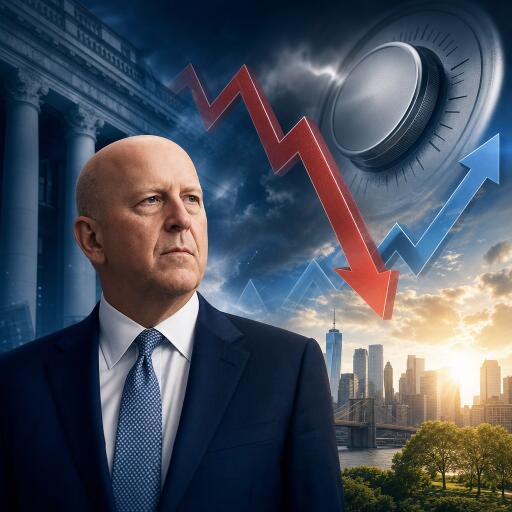
Goldman CEO David Solomon Warns ‘Abrupt Moves’ in Interest Rates Create Headwinds, But ‘Underlying Economy’ Remains Strong
Goldman Sachs reported higher year-over-year revenue in the third quarter as CEO David Solomon cautioned that sharp shifts in interest rates are pressuring markets. Even so, he underscored the strength of the U.S. economy, solid corporate earnings, and a resilient labor market supporting continued activity in capital markets.
Navigating Market Volatility
On the company’s earnings call, Solomon pointed to the impact of a rapid 75-basis-point swing in the 10-year Treasury yield. He said sudden, “very, very abrupt moves” tend to create headwinds for risk assets and liquidity. Despite that, he characterized the broader backdrop as robust, citing durable consumer and business fundamentals and what he called an “extraordinary tech super cycle.”
Solomon also noted a normalization in transaction volumes from the peak levels seen earlier this year. He described the current environment as moving from a “top decile” period for activity to a “top quartile” one—still historically strong when viewed over longer time frames.
Revenue Drivers and Business Mix
Goldman reported net revenue of $18.68 billion and earnings of $17.01 per share, topping consensus expectations. Performance was led by the Global Banking & Markets division, where equities revenue jumped 72% to $6.44 billion. Management attributed the surge to strength in derivatives intermediation and financing, reflecting healthy client engagement and sustained demand for risk transfer and balance sheet solutions.
Assets Under Supervision and Backlog
Total assets under supervision reached a record $4.10 trillion, highlighting the firm’s scale across wealth and asset management. Solomon said the investment banking backlog remains solid, even after strong revenue realizations during the quarter. That pipeline, combined with constructive—if volatile—markets, supports ongoing dealmaking and financing opportunities.
AI Infrastructure: A Multi-Trillion-Dollar Build-Out
Looking ahead, Solomon highlighted accelerating investment needs tied to artificial intelligence. He estimated that the U.S. data center build-out for AI could require “north of $10 trillion of investment through 2032,” spanning compute capacity, power generation, grid upgrades, cooling, and real estate. With client demand for compute currently outstripping supply, he suggested Goldman is well positioned to finance and advise on large-scale infrastructure projects underpinning AI adoption.
Leadership and Strategic Focus
Addressing media speculation, Solomon said there is no succession transition or timeline underway at the firm. He emphasized continued execution on Goldman’s core strengths—global banking, markets, and asset and wealth management—while leaning into secular growth areas such as AI infrastructure and capital formation.
Stock Performance Snapshot
In premarket trading on Wednesday, Goldman Sachs shares were down 1.31%. Over the past year, the stock was up 15.72%, up 1.47% year-to-date, and down roughly 10% over the past month. Management’s commentary suggests investors are weighing near-term rate volatility against resilient economic data, strong client activity, and a constructive pipeline.
Key Takeaways
- Rapid rate moves are creating market headwinds, but the underlying U.S. economy remains resilient.
- Q3 net revenue of $18.68 billion and EPS of $17.01 exceeded expectations.
- Equities revenue rose 72% to $6.44 billion on derivatives intermediation and financing strength.
- Assets under supervision hit a record $4.10 trillion; the investment banking backlog remains healthy.
- AI data center infrastructure could require more than $10 trillion of investment through 2032, presenting financing opportunities.
- No leadership succession plan is in motion, according to Solomon.
Bottom line: While abrupt interest rate shifts are unsettling markets in the short run, Goldman sees durable underpinnings in the economy and multiple secular growth avenues—particularly around AI infrastructure—supporting sustained client activity across banking, markets, and asset management.