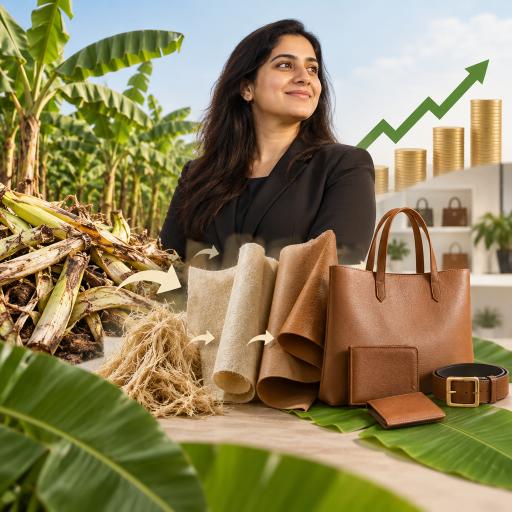
From banana waste to Rs 2-crore leather business: How Jinali Mody built Banofi from something people throw away
Banana stems are typically discarded, left to decompose or burned after the fruit is harvested. Kolkata-based entrepreneur Jinali Mody saw a different possibility: turning this agricultural waste into a plant-based material that could replace conventional leather.
That idea led to Banofi, a startup founded in 2022 and legally registered as Atma Innovation Private Limited. The company manufactures leather-like sheets for use in handbags, fashion accessories, lifestyle products and automotive applications. After moving beyond the product-development stage, Banofi reported revenue of about Rs 1.63 crore in FY25.
From environmental research to entrepreneurship
Mody studied biochemistry at St Xavier’s College in Mumbai before working as a business analyst at McKinsey & Company from 2018 to 2021. She also gained experience at a plastic-recycling startup.
The idea for Banofi began taking shape while she was pursuing a master’s degree in Environmental Management at Yale University. Her research focused on whether agricultural waste could become a raw material for sustainable alternatives to leather.
Mody initially considered several types of waste, including rice straw, wheat husk and mango residue. Banana stems eventually emerged as the preferred option because they are rich in cellulose and widely available as a byproduct of farming.
How banana stems become leather-like sheets
Once a banana plant bears fruit, farmers cut its stem so that a new plant can grow. These stems usually have little commercial value, making them an accessible source of raw material.
Banofi extracts cellulose-rich fibres from the discarded stems. The fibres are blended with natural binders and starches before being pressed into sheets. Further processing gives the material the texture, flexibility and appearance associated with leather.
The process avoids conventional tanning, which may use chromium and other chemicals while generating significant industrial wastewater. Banofi says its material can use about 93 percent less water and produce up to 97 percent less carbon dioxide than conventional leather.
The sourcing model also creates economic activity around the collection, handling and transportation of agricultural waste. The startup works with approximately 100 smallholder banana farmers, giving waste stems a potential commercial use.
Competitions helped fund early development
Banofi’s initial growth was supported by entrepreneurship competitions. In April 2022, Mody won a $25,000 sustainable venture prize after presenting the idea at a university startup competition. The funding helped finance early research and product development.
The company’s first order was for notebooks made using its banana-based material. In 2023, Banofi won the $1 million Hult Prize, providing further funding and international visibility. It also received $30,000 through another circular-economy competition.
These achievements allowed the startup to expand beyond material designed for rigid leather goods. It began developing softer and more flexible versions suitable for handbags, accessories and other fashion products.
Trials with fashion and automotive brands
Banofi says it has piloted its material with more than 150 brands operating across the fashion, lifestyle and automotive sectors. It has also made the material available in the United States and Europe.
The startup has received additional recognition, funding and mentoring through environmental awards and climate-technology incubation programmes. During one six-month period, it reportedly upcycled more than 14,600 kg of organic waste.
Revenue growth accompanied by widening losses
Banofi’s revenue rose sharply during its early years. It increased from approximately Rs 30.2 lakh in FY23 to Rs 1.58 crore in FY24. Revenue reached around Rs 1.63 crore in FY25, representing growth of roughly 4 percent over the previous financial year.
However, the cost of scaling the business also increased. Total expenses climbed from Rs 2.11 crore in FY24 to Rs 3.20 crore in FY25. As a result, the company’s net loss widened from around Rs 39.6 lakh to Rs 1.87 crore. It also recorded negative EBITDA of approximately Rs 1.47 crore in FY25.
At the same time, Banofi’s total assets increased from Rs 2.88 crore in FY24 to Rs 3.59 crore in FY25, reflecting continued investment in operations and growth.
Banofi’s journey highlights how an overlooked agricultural byproduct can be transformed into a commercial material. While the startup still faces the challenge of controlling expenses and achieving profitability, its progress demonstrates the growing business potential of converting farm waste into lower-impact alternatives for established industries.