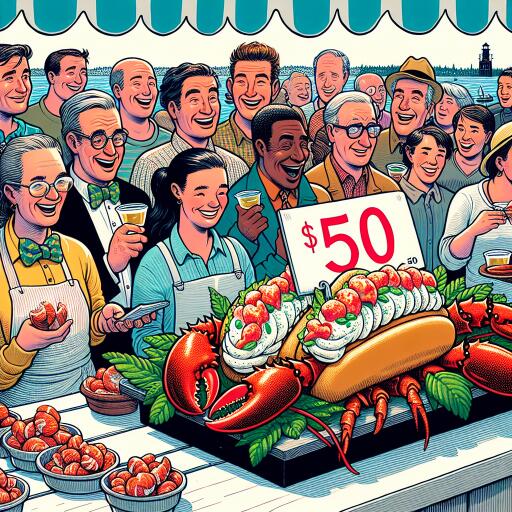
$50 for a lobster roll? Skyrocketing prices aren’t hurting demand for the New England delicacy
Lobster roll prices are climbing fast across New England—often approaching $50 per roll—yet the appetite for the region’s most iconic sandwich remains strong. For now, diners are still ordering, even as restaurants grapple with steep costs and shrinking margins.
Several forces are pushing prices higher. Maine’s lobstering industry—responsible for the vast majority of U.S. landings—has seen its haul decline for multiple years in a row. Warmer ocean temperatures have nudged lobsters farther north, business costs have surged with inflation, and tariffs have injected more uncertainty into the market. While lobsters remain available at restaurants and seafood counters, they’re coming at a premium.
At the dock, lobster prices that commonly hovered between $3 and $5 per pound in the 2010s have moved higher in recent years, topping $6 at times. Last year’s average dock price was $5.85 per pound. On the plate, those incremental increases compound quickly—especially considering how much raw lobster it takes to make a single roll. Many chefs say it can take the meat from about six lobsters to fill just one generous sandwich, particularly the overstuffed versions that coastal tourists expect.
Restaurant owners say there’s only so much they can pass on to customers before it feels unreasonable. “There is a ceiling,” said Jeremy Sewall of Row 34. “When you get over 50 bucks, I have a little twinge of guilt that we’re charging so much for food, even though it’s the correct price.” Still, the lobster roll’s status as a must-have New England experience keeps demand steady. “Eating a great lobster roll in Boston is one of those quintessential New England experiences,” said Kathy Sidell of Saltie Girl. “Say Boston. Say lobster roll.”
State regulators report that Maine’s total lobster landings have fallen each year since 2021. In 2025, the fishery brought in 78.8 million pounds, down from more than 110 million pounds in 2021—the lowest annual total since 2008. Fewer trips on the water have compounded the slowdown: there were more than 21,000 fewer fishing trips than in 2024, a drop attributed to inflation-driven costs, a delayed start to the busy season, and global market headwinds.
Even with the downturn, lobster remains one of the most valuable commercial fisheries in the United States. The catch at Maine docks alone is often worth more than $500 million annually; last year’s value exceeded $461 million. Lobsters are also trapped in other New England states, but Maine’s cold, rocky gulf has long anchored the industry—and shaped the identity of countless coastal towns whose economies rise and fall with each season’s catch.
For restaurants, the challenge is balancing tradition, quality, and price. Some are experimenting with portion sizes, offering different styles (butter-poached versus mayo-dressed), or featuring market pricing during peak volatility. Others are doubling down on premium rolls, arguing that if a guest is going to splurge, the roll had better be unforgettable.
For now, customers appear willing to pay. The lobster roll isn’t just a sandwich; it’s a summer ritual, a postcard from the coast, and a taste of place that visitors and locals alike are reluctant to give up—even at $50 a bite. Whether that resilience holds through another season of high costs will depend on what the boats bring in, how global markets shake out, and just how high that invisible “ceiling” can rise before diners finally say enough.