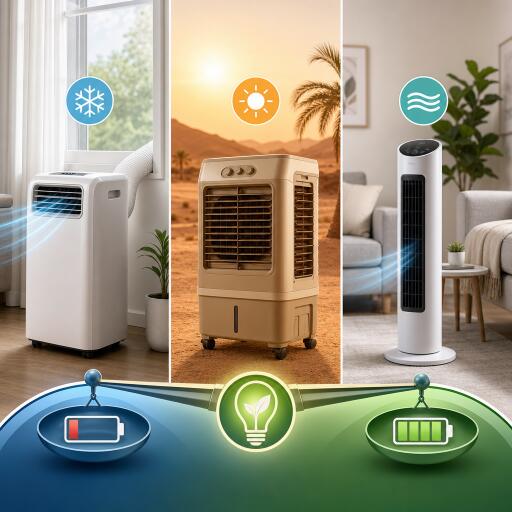
Portable AC vs Desert vs Tower Air Coolers: Which one takes less electricity and is more practical for your home
Indian summers are getting harsher, and with longer cooling hours, electricity bills climb fast. If installing a split or window AC isn’t possible, you still have solid options: a portable AC, a desert air cooler, or a tower air cooler. Each works differently, suits different spaces and climates, and costs differently to buy and run. Here’s a clear, no-nonsense guide to help you pick the best fit for your home.
How they work
- Portable AC: Uses a compressor and refrigerant to remove heat from indoor air and push it outdoors through an exhaust duct. It actively lowers temperature and reduces humidity, regardless of outside conditions.
- Desert and tower coolers: Use evaporative cooling. Warm air passes through water-soaked pads; evaporation cools the air and increases humidity. They need some ventilation (a slightly open window/door) to prevent the room from feeling damp and stuffy.
Power consumption: what uses less electricity
- Portable AC: Typically 900–1,500 W
- Desert cooler: About 150–250 W
- Tower cooler: About 50–150 W
Desert and tower coolers can use roughly 80–90% less electricity than a portable AC under similar usage. Over a month of daily use, this difference can translate to a substantially lower bill if your climate and room setup suit an air cooler.
Cooling performance and climate fit
- Hot, dry climates: Air coolers (desert and tower) work very well in dry heat. They deliver comfortable airflow while using a fraction of the power of an AC.
- Humid or monsoon conditions: Coolers add moisture, which can make rooms feel clammy and uncomfortable. A portable AC is the practical choice when humidity is high because it dehumidifies while cooling.
- Room sealing vs ventilation: Portable ACs work best in closed rooms with proper ducting and minimal air leaks. Evaporative coolers need some fresh-air circulation for best results.
Space, price, and practicality
- Tower air coolers
– Best for bedrooms and small to medium living rooms
– Compact, easy to place in a corner; lighter water tanks; low maintenance
– Typical price: Rs 6,500–11,000 - Desert air coolers
– High airflow for large rooms, halls, or semi-open areas with good cross-ventilation
– Large tanks (often 50–90 L), bigger footprint; may be noisy for small rooms
– Typical price: Rs 8,000–15,000 - Portable ACs
– Works in closed rooms; effective in both dry and humid weather
– Requires a window/vent for the exhaust duct; can be bulky and louder than split ACs
– Highest upfront and running costs
– Typical price: Rs 30,000–55,000
Pros and cons at a glance
- Portable AC
+ Cools and dehumidifies in any season
+ Precise temperature control in a closed room
– Highest electricity use and upfront cost
– Needs proper ducting and window access - Desert cooler
+ Strong airflow for big, ventilated spaces
+ Far lower power draw than AC
– Adds humidity; unsuitable in monsoon/humid areas
– Bulky; frequent water refills - Tower cooler
+ Compact, quieter, and energy-efficient for small/medium rooms
+ Affordable to buy and run in dry months
– Limited effect in humid conditions
– Less powerful airflow than desert coolers
Which one should you buy?
- Urban apartments in dry summer months: Start with a tower air cooler. It’s compact, affordable, and sips power.
- Large, well-ventilated rooms or semi-open areas: Choose a desert cooler for stronger airflow and broader coverage.
- Humid climates or monsoon season, or if you need closed-room comfort: Go for a portable AC. It’s the only option here that won’t make the room feel damp.
Quick decision checklist
- Climate: Dry = cooler; Humid = portable AC
- Room size: Small/medium = tower cooler; Large/semi-open = desert cooler
- Ventilation available? Yes = cooler can work; No (closed room) = portable AC
- Bill sensitivity: Prioritize coolers for lowest electricity use
- Upfront budget: Tower < Desert < Portable AC
Tips to maximize comfort and savings
- For coolers: ensure cross-ventilation, keep pads clean, and use chilled or clean water for better performance.
- For portable ACs: seal gaps, insulate the exhaust hose from heat, and keep filters clean to cut power use.
- For all: shade windows, draw curtains in peak sun, and close unnecessary heat sources to reduce load.
Bottom line: If your summers are mostly hot and dry, a tower cooler is the most practical and economical for typical rooms; choose a desert cooler for larger, well-ventilated spaces. In humid weather—or whenever you need reliable cooling in a closed room—a portable AC is the only solution that both cools and dehumidifies, albeit at a higher cost.