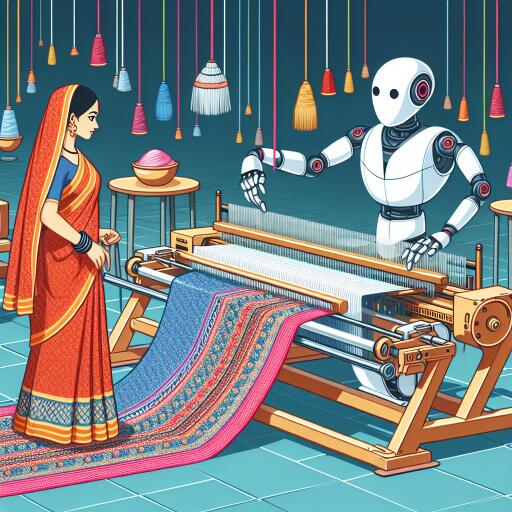
Will Sewing Robots Take Away Textile Jobs In India?
In early April 2026, a cascade of first-person videos spread across Indian social media: factory workers hunched over sewing machines, tiny cameras strapped to their foreheads, every stitch and wrist-flick recorded in intimate detail. Viewers feared the footage was destined to train robots that could one day replace these very hands. No official confirmation tied those specific clips to an AI program, but the theory resonated because it mirrors a real, fast-growing trend elsewhere.
From human hands to robot skills
Globally, startups now pay thousands of people to film themselves performing manual tasks with head-mounted smartphones, amassing hundreds of thousands of hours of “egocentric” video each month. That data is sold to robotics companies training machines through imitation learning. Participants in India reportedly earn a modest premium over standard textile wages, often interviewed by automated agents and seldom told which firms will buy their footage or how it will be used.
This raises stark ethical questions. Workers perform tough, low-paid labor while their hard-won dexterity is harvested as training data—without any share of the long-term value. Privacy risks are real too: home scenes and routine details can be inadvertently captured, while data protection and value-sharing mechanisms lag far behind the pace of collection.
Sewing’s last frontier is cracking
For decades, sewing resisted automation because fabric stretches, slips, and bunches—behaviors that defeated rigid robots. That barrier is finally giving way. New worklines use high-speed computer vision to guide cloth in real time; others stiffen textiles temporarily so standard robots can handle them; still others simulate fabric physics to predict how material will behave before the robot touches it. Startups claim dramatic throughput gains and cost drops, with some projecting labor costs for a basic T-shirt falling toward pennies.
Not everything scales overnight. A high-profile attempt to automate shoe production in rich countries shut down within a few years, with equipment ultimately moving to established supplier ecosystems in Asia. The lesson: automation tends to migrate to where know-how and supply chains already exist. The open question is whether the AI era—supercharged by imitation learning and massive video datasets—changes that trajectory.
What’s at stake for India
India’s textile and garment sector exported roughly $36–38 billion in FY2025, employs around 45 million people directly (second only to agriculture), and supports over 100 million in allied trades. The workforce is predominantly female and clustered in hubs like Tirupur, Bengaluru, Noida, Surat, and Ludhiana. Average factory wages hover near $195 per month—higher than Bangladesh but far below China.
The industry is vulnerable: about 70% consists of small and medium enterprises running on thin margins. Recent tariff whiplash toward the US market slashed orders at one point, then partially reversed—underscoring the fragility of a model built on cost arbitrage and concentrated exports. Each tariff spike strengthens the business case for reshoring, and every reshoring dollar gravitates toward robotic systems that can make domestic production viable.
India’s robot density—roughly 5–7 industrial robots per 10,000 manufacturing workers—is among the world’s lowest, and within textiles, sewing remains overwhelmingly manual. That is not irrational: at India’s wage levels, full robotic sewing lines rarely pay off today. Ironically, low wages delay automation’s economic crossover—buying time, but also reflecting the very poverty automation could entrench if mishandled.
The development ladder under pressure
For decades, the “flying geese” pattern lifted countries as labor-intensive manufacturing migrated from higher- to lower-wage economies. But evidence suggests nations are reaching manufacturing peaks earlier and at lower incomes—“premature deindustrialisation.” If robots can sew competitively in high-wage markets, the geese may stop flying. Announcements tied to reshoring in the US are growing, and experts warn that when production returns, it may return with robots, not people.
Still, the picture is mixed. Some studies find automation has not yet decisively redirected investment away from developing economies. The failed reshoring attempt in automated footwear is a caution against easy predictions. Another risk is “premature automation”—adopting advanced tech before labor markets, institutions, and safety nets can absorb the impact. China shed tens of millions of factory jobs even as exports hit records—but did so at a far higher income level than India, with more capacity to cushion the blow.
Not yet—but soon
Today’s sewing robots are credible mainly in simple categories: T-shirts, towels, pillowcases, straight seams. Complex garments with collars, cuffs, zippers, and tailoring remain hard. Investment in sewing automation is still small compared to the size of global apparel. India’s low wages push the automation break-even point further out.
But the horizon that matters is 2030–2035. Basic garments employ vast numbers in India, and that is exactly where automation will bite first. Each generation of systems gets faster and cheaper. The global pipeline of egocentric video didn’t exist five years ago; now it is pouring training fuel into the next wave of machines.
What India can do now
- Model cost-parity timelines by product: identify which items automate first and when.
- Climb the value chain: double down on man-made fiber apparel, technical textiles, and performance wear through targeted incentives.
- Design MITRA parks for the future: integrated clusters with R&D, advanced logistics, digitized QA, and automation-ready layouts.
- Skill and reskill: move stitchers toward higher-value operations, maintenance of semi-automation, quality engineering, and digital production control.
- Boost productivity now: lean manufacturing, vertical integration, and better planning systems to raise competitiveness before robots scale.
- Diversify manufacturing: complement textiles with adjacent sectors (footwear, wearables, light electronics) to spread risk.
- Protect workers’ data: clear consent, privacy safeguards, and benefit-sharing for training datasets captured on the shop floor.
- Support SMEs: accessible finance for incremental automation and assistive robotics that augment, not replace, workers.
- Leverage the domestic market: pivot more production to serve India’s 1.4 billion consumers to buffer external shocks.
Will sewing robots take away textile jobs in India? For basic stitching, eventually—yes, unless the sector moves up the ladder and prepares workers for new roles. Not today, and not all at once. But the window to adapt is the next few years, while the robots are still learning and before cost curves cross. Choices made now will decide whether automation becomes a springboard to higher-value growth—or a trap that undercuts millions of livelihoods.