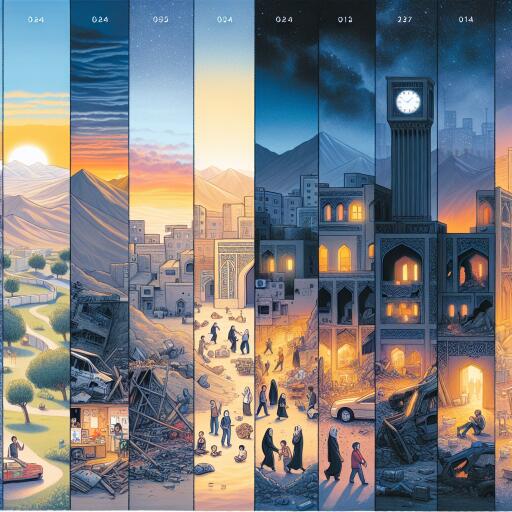
A 12-hour drive through Iran offers glimpses of destruction, defiance and daily life
ZANJAN, Iran — A black banner drapes the border crossing and portraits of Iran’s slain Supreme Leader Ayatollah Ali Khamenei gaze down, vowing revenge against the United States and Israel. Beyond that checkpoint, along a 12-hour road to Tehran, the country reveals itself in fragments: damage from recent strikes, quiet resilience, and the routines of everyday life.
Reporters traveling south from the Turkish frontier found ordinary rhythms persisting despite a grinding conflict that shows no sign of easing, even five weeks after Khamenei was killed in what Iranian officials describe as the opening U.S.-Israeli salvo. Shops were open, traffic flowed and, in roadside eateries, grilled lamb with rice was served as pop anthems drifted from speakers.
First scars of war in Zanjan
The first stark reminder of the fighting appeared in Zanjan, roughly six hours from the border, where an airstrike hit a religious community center, or husseiniyah. Officials said two people were killed, and a clinic and library were destroyed. Parts of the historic compound — including a golden dome — were left damaged.
Israel’s military said it struck “a military headquarters,” adding that it seeks to avoid civilian harm, without offering more details.
“It has hurt me a lot and distressed me a lot,” said Somayeh Shojaei, a local resident who attended religious and cultural events at the center. “With these airstrikes, they are showing their malicious intent to the whole world.”
Jaafar Mohammadi, the provincial director of cultural and Islamic guidance, said the dead included the library’s caretaker and a volunteer with the Iranian Red Crescent. He described the clinic as a lifeline for the poor and the library as a treasure of more than 35,000 books, including antique manuscripts. “I don’t know why the complex was targeted,” he said.
He added that Iran had once sought peace talks with then–U.S. President Donald Trump, only to be met with force. “He started the war, but we will definitely be the victorious side,” Mohammadi said.
A relentless campaign and a guarded capital
The United States and Israel have launched thousands of strikes across Iran, while rhetoric has escalated. Trump has warned of bombing Iran “back to the Stone Ages,” and reiterated a deadline for reopening the Strait of Hormuz, a key artery for global energy supplies.
Iran’s leadership has remained defiant, rejecting what it calls unreasonable proposals. Israel has signaled no letup and has urged Iranians to topple their rulers. Inside Iran, fear and uncertainty coexist with habit and routine: markets hum, families gather, students jostle for buses.
On the approach to Tehran, the team passed through two checkpoints without being stopped. Some women moved about without mandatory headscarves, enforcement of which has eased in many areas. Past midnight, the capital lay strangely subdued; mountains skirting the city had been pounded by heavy strikes the previous night.
Tehran bears the brunt of the air campaign, with successive waves of attacks that U.S. and Israeli officials say target the military and internal security forces. Iranian authorities say more than 1,900 people have been killed; the breakdown between civilians and soldiers remains unclear.
Along city arteries, several government buildings and police stations appeared gutted. Checkpoints run by plainclothes Basij units and uniformed members of the Revolutionary Guard dotted the route. The team was stopped once, asked to open the car and present press identification, then waved through.
Daily life under pressure
Even amid the tension, the mundane persists. In one busy restaurant, saffron drinks and barley soup accompanied plates of kebab as R.E.M.’s “Losing My Religion” played. Fuel remains heavily subsidized, with a gallon — roughly four liters — costing about 15 U.S. cents, though purchases are capped at around five gallons (20 liters) at a time. Despite limits, there were no visible lines at gas stations.
On highways and in provincial towns, people went about their errands, tending to shops, visiting relatives, and watching for the sudden closings and sirens that punctuate an otherwise predictable day. The road itself, winding through plains and hills, felt alternately ordinary and anxious — every few hours, a reminder of the war appeared: a shattered façade, a crater, a checkpoint.
Memories of old grievances, vows of endurance
Back in Zanjan, retired soldier Mohamoud Maasoumi connected the present conflict to a deeper history, citing the 1953 coup that many Iranians regard as a defining moment of foreign interference. He expressed confidence that Iran’s leaders would defend the country. “The enemy sees that we are not ever succumbing,” he said.
Across the long stretch of road to Tehran, that sentiment — tempered by grief and threaded with routine — was a constant refrain. The banners and portraits at the border promised vengeance; the ruins in Zanjan testified to loss; and the open storefronts, the late-night quiet, the careful nods at checkpoints all suggested a different kind of endurance, one measured not in firepower, but in the small, stubborn continuities of daily life.