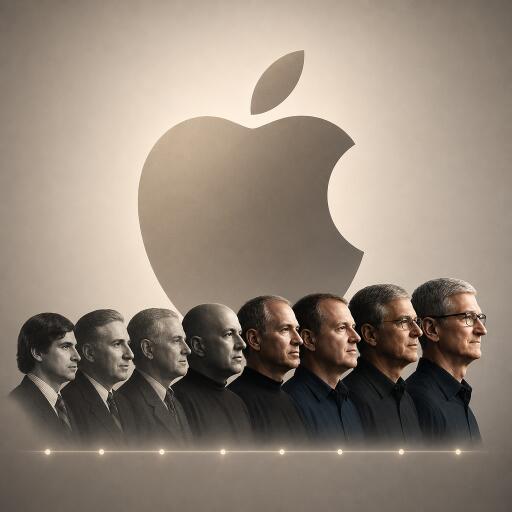
Apple’s 8 CEOs: A historical lookback
In April 2026, Apple announced that Tim Cook would step down as CEO on August 31, with senior vice president of Hardware Engineering John Ternus taking over on September 1. Cook will remain at Apple as executive chairman and help guide global policy outreach, while Ternus joins the board as Apple’s eighth chief executive. It marks the close of Apple’s longest modern-era CEO tenure and the start of a new chapter.
Michael Scott (1977–1981)
Apple’s first CEO, Michael Scott, was hired by early investor Mike Markkula in 1977. He oversaw the launch of the Apple II and the company’s 1980 IPO, which put Apple firmly on Wall Street’s radar. The Apple III, however, struggled. Scott’s term was also marked by a controversial round of layoffs known internally as Black Wednesday. Turmoil followed, and he departed soon after.
Mike Markkula (1981–1983)
Markkula, a key early backer and former Intel marketer, steadied Apple through the Apple IIe and the development of the Lisa. His “Apple Marketing Philosophy,” centered on empathy, focus, and impute, helped shape Apple’s brand ethos for decades. Boardroom influence defined his legacy too: he sided with John Sculley during the 1985 clash with Steve Jobs, later helped push Sculley out in 1993, and supported Jobs’s return in 1997.
John Sculley (1983–1993)
Recruited from PepsiCo with the famed “sugar water” challenge from Jobs, Sculley presided over the 1984 Macintosh launch and its era-defining Super Bowl ad. The LaserWriter (1985) jump-started desktop publishing, while the PowerBook (1991) set the template for modern laptops. Not every bet paid off—the Newton MessagePad arrived ahead of its time. Tensions with Jobs culminated in Jobs leaving Apple in 1985 to found NeXT, whose eventual acquisition would bring him back.
Michael Spindler (1993–1996)
Promoted from COO, Spindler kept a low public profile and focused on operations: layoffs, project cuts, and tighter R&D spending. He led the Power Macintosh era and the PowerPC transition. He explored mergers with IBM, Sun, and Philips, but none closed; he was replaced by Gil Amelio in 1996.
Gil Amelio (1996–1997)
Amelio’s brief tenure became pivotal when he approved the acquisition of NeXT in December 1996. The deal brought Steve Jobs back as an adviser and delivered the software foundation that evolved into Mac OS X—setting the stage for Apple’s turnaround.
Steve Jobs (1997–2011)
On his return, Jobs streamlined Apple’s product line and re-centered the company on the marriage of hardware and software. The iMac G3 revitalized the Mac; the iPod and iTunes pushed Apple beyond computing; the Intel transition made Macs a developer mainstay. Then came the iPhone and App Store, followed by the iPad—defining entire categories. Jobs also rebuilt Apple’s functional organization and reinvented the tech keynote as a storytelling spectacle, often closing with “One more thing…”
His hard-edged management style and public confrontations were part of the package, from calling time on Flash for iOS to patent battles with Android makers. Jobs resigned in August 2011 and passed away six weeks later.
Tim Cook (2011–2026)
Handpicked by Jobs, Cook scaled Apple into a services-and-ecosystem giant. Apple Watch anchored the company’s health push; AirPods made true wireless mainstream; the Apple Silicon transition, starting with the M1 MacBook Air in 2020, reshaped performance and efficiency across the Mac lineup. Apple Vision Pro became Cook’s most ambitious category bet in a decade.
Services emerged as Apple’s second-largest revenue engine, spanning music, payments, streaming, news, fitness, gaming, and credit. Cook also diversified Apple’s supply chain: Vietnam became a major manufacturing base for AirPods, iPads, Macs, and Apple Watch, while Malaysia took on Mac production; Apple expanded retail across Southeast Asia. Not every move landed cleanly—Apple Maps stumbled at launch, and more recently, Apple Intelligence rolled out slowly, with core features slipping into 2025 and major Siri overhauls into 2026. The iPhone 16 lineup shipped without its flagship AI enhancements, testing user patience and casting a shadow over Cook’s final year at the helm.
John Ternus (From September 1, 2026)
Ternus, 50, joined Apple in 2001 and has spent his career in hardware engineering. A University of Pennsylvania mechanical engineering graduate, he previously worked at a VR headset startup. At Apple, he cut his teeth on product design, led hardware engineering for the first iPad and every generation since, took on iPhone hardware in 2020, and became senior vice president of Hardware Engineering in 2021. As CEO, he will also sit on Apple’s board.
The Handover: What Comes Next
Each Apple leader inherited a defining moment: Sculley had the early Mac; Jobs rebuilt around iPod and iPhone; Cook scaled services and rewired the supply chain. Ternus now takes charge of a hardware powerhouse still searching for its next category-defining leap, with an AI strategy that needs sharper focus and a mounting memory supply crunch to navigate. Apple has been led by marketers, sales leaders, an operations chief, and a designer-at-heart in Jobs. Ternus arrives as the company’s first true engineer in the top seat since Apple’s earliest days—well positioned to write the next chapter in silicon, software, or both.