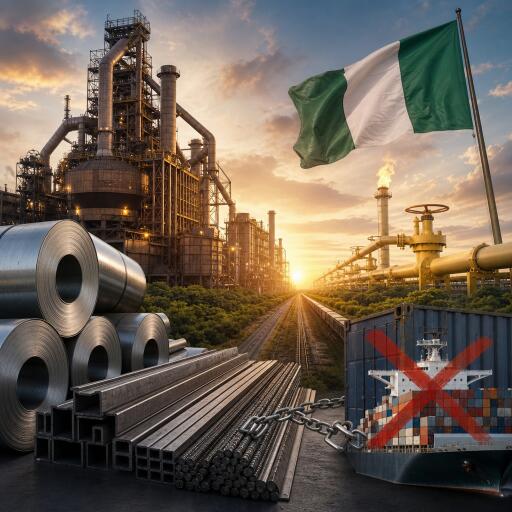
Ajaokuta may end steel imports as fresh gas deal revives hope
Nigeria is moving closer to unlocking one of its most unrealised economic assets as the Federal Government pushes to revive the Ajaokuta Steel Company through a landmark 20-year gas supply arrangement. The plan could save billions of dollars in foreign exchange, create thousands of skilled jobs and reposition the country’s manufacturing sector for long-term growth.
What the new gas deal changes
A Memorandum of Understanding and a 20-year Gas Sale and Aggregation Agreement were signed by NNPC Ltd, Ajaokuta Steel Company Limited (ASCL), NNPC Exploration and Production Limited (NEPL) and the Gas Aggregation Company of Nigeria (GACN) during the 2026 NOG Energy Week in Abuja. The agreement guarantees the supply of three million standard cubic feet of firm gas daily and an additional 47 million standard cubic feet of interruptible gas to power the steel complex.
Beyond energy supply, the MoU commits the parties to collaborate on manufacturing steel products for Nigeria’s oil and gas industry, including pipes for strategic projects such as the African Atlantic Gas Pipeline and the Escravos–Lagos Pipeline System Phase III.
According to a senior official in the Federal Ministry of Steel Development, the deal provides the kind of energy certainty investors need before committing capital to rehabilitation and operations. For decades, Ajaokuta struggled not just with funding and legal disputes, but with the most critical input for steelmaking—reliable, affordable energy.
Why it matters for Nigeria’s economy
Nigeria remains a major importer of finished and semi-finished steel, despite possessing abundant iron ore, limestone and dolomite, as well as one of the world’s largest proven natural gas reserves. Construction firms, rail and power projects, manufacturers, automobile assemblers and oil and gas operators depend heavily on imported bars, structural steel, plates, pipes and specialised products.
The result is persistent pressure on foreign exchange reserves and exposure to volatile global prices. Bringing Ajaokuta into commercial production would cut import dependence, conserve foreign exchange and strengthen domestic industrial capacity. Every tonne of steel produced locally keeps value within the economy.
Jobs, industries and wider ripple effects
Steel is the backbone of industrialisation—vital for roads, bridges, railways, power plants, refineries, pipelines, defence equipment, machinery, shipbuilding and automobiles. Countries such as China, India, Japan and South Korea built competitive manufacturing sectors on strong domestic steel production. For Nigeria, a revived Ajaokuta could energise hundreds of downstream industries, from engineering fabrication and machine tools to industrial equipment, agricultural machinery, home appliances and automotive components.
Rehabilitation and full operation would generate thousands of direct jobs—engineers, metallurgists, welders, technicians and other skilled roles—while supporting many more in mining, rail transportation, fabrication, logistics, maintenance and industrial services. The revival would also inject fresh momentum into the National Iron Ore Mining Company at Itakpe, originally designed to supply Ajaokuta but long constrained by the steel plant’s inactivity.
Technology transfer and skills development
Discussions with prospective technical partners include plans for training Nigerian engineers in modern steelmaking processes, plant maintenance, metallurgical engineering, quality assurance and industrial automation. The goal is not only to produce steel but to build enduring technical capacity so the industry can be sustained and upgraded domestically over time.
Lessons from nearly five decades
Construction of the Ajaokuta Steel Complex began in 1979 under an agreement with the former Soviet Union after surveys confirmed commercial iron ore deposits in Kogi State. The first phase was designed to produce 1.3 million tonnes of liquid steel annually. With captive power, rail links, workshops, water treatment and residential estates, Ajaokuta was conceived as the foundation of Nigeria’s industrial transformation.
Yet successive governments grappled with shifting policies, inadequate funding, corruption allegations and prolonged legal disputes, including a controversial concession arrangement that stalled progress for years. Despite substantial investment, the plant has never reached commercial production. Technical reviews suggest a significant portion of the installed equipment remains usable, though obsolete sections will need modern replacements during rehabilitation.
Energy as the missing piece
Analysts have long identified reliable, affordable energy as the project’s principal commercial weakness. The new gas agreement addresses this head-on and aligns with the government’s gas-based industrialisation strategy—leveraging natural gas to drive manufacturing, create jobs and diversify growth beyond crude oil exports.
What must go right
Officials and industry stakeholders agree that success will hinge on sustained political commitment, transparent procurement, disciplined project management and timely execution. The new deal provides a firmer commercial foundation than past attempts, but delivery will determine whether momentum translates into production.
The bigger picture
For Africa’s largest economy, reviving Ajaokuta represents more than restarting a dormant plant. It is a test of whether Nigeria can convert vast mineral and energy resources into globally competitive industry, reduce dependence on imports and build a manufacturing base capable of driving sustainable growth for decades.