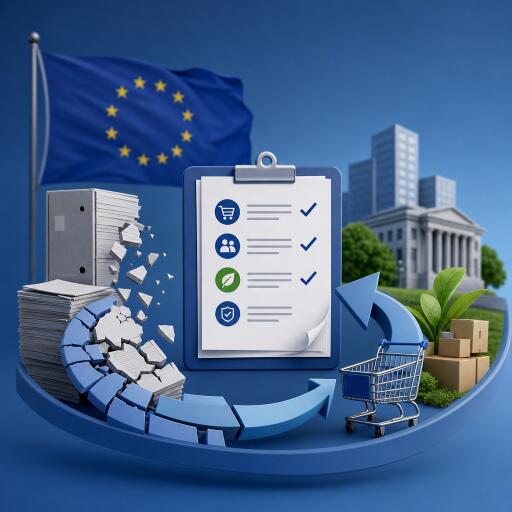
EU proposes major overhaul of public procurement rules
The European Commission has unveiled a proposal for a new Public Procurement Regulation that would replace and consolidate the EU’s existing framework. The reform aims to make it easier for companies to bid for public contracts, cut red tape for authorities, and give buyers more flexibility to prioritize value beyond price. Under the new approach, the cheapest bid would no longer be the automatic winner; authorities would be expected to give greater weight to quality, sustainability, innovation, and security.
Public procurement covers everything from major infrastructure and energy projects to equipment for schools and hospitals. It accounts for roughly 15% of the EU’s GDP, making it a central lever for economic efficiency and strategic policy goals. The Commission estimates the overhaul could reduce administrative costs by about €650 million annually—approximately €80 million for public authorities and €570 million for businesses—following extensive consultations with public sector bodies, companies, trade unions, and civil society.
Simpler, more flexible rules
A core element of the reform is to streamline today’s fragmented legal landscape into a single EU regulation. The Commission argues this will bring greater clarity, consistency, and predictability across Member States. The number of procurement procedures would be reduced from five to three, and public buyers would gain wider scope to negotiate with bidders during the process.
The proposal also introduces a dedicated procedure for developing and purchasing innovative products and services that are not yet on the market. This is intended to help public buyers work more closely with suppliers to solve complex challenges, accelerate the uptake of new solutions, and ensure the public sector can act as a driver of innovation. Overall, the changes are designed to make public purchasing less bureaucratic and closer to the way private-sector procurement is conducted, while maintaining fairness and transparency.
A connected digital marketplace
To broaden access across the Single Market, the Commission plans an integrated digital procurement marketplace that connects national e-procurement systems. In practice, a company could use its familiar home-country platform to participate in tenders elsewhere in the EU, as long as the systems are interconnected. The reform would also embed the “once-only” principle so that companies do not need to submit the same documents repeatedly to different authorities.
For public buyers, digital tools could automate routine checks, such as verifying eligibility and compliance criteria, reducing manual workload and errors. Standardizing how procurement data is exchanged between Member States would improve transparency, support better oversight, and help detect fraud. By lowering barriers to cross-border participation, the Commission expects stronger competition and more bids, potentially delivering better value for taxpayers.
Security, resilience, and fair competition
Reflecting evolving geopolitical and economic risks, the proposal strengthens security-related considerations throughout the procurement process. Public authorities would be empowered—and in certain cases required—to assess risks involving public security, sensitive information, cybersecurity, and foreign influence. Additional safeguards would apply to contracts linked to critical infrastructure and key services.
The measures aim to diversify supply chains and ensure that essential goods and services remain available during crises. The framework also allows, under defined conditions and consistent with international obligations, preference mechanisms that support European suppliers or products. Where evidence shows that EU companies do not enjoy fair access to a third country’s public procurement market, the Commission could limit that country’s access to EU tenders. Restrictions could also be used where necessary to reduce strategic dependencies or protect Europe’s economic security.
What happens next?
The proposal is not yet law. It will now be discussed and negotiated by the European Parliament and the Council of the EU, representing the Member States. The text may change during the legislative process. If adopted, the reform would mark a substantial shift in how public contracts are awarded across the EU, aiming to make the system simpler for businesses, less burdensome for public authorities, and more focused on quality, sustainability, innovation, and security.