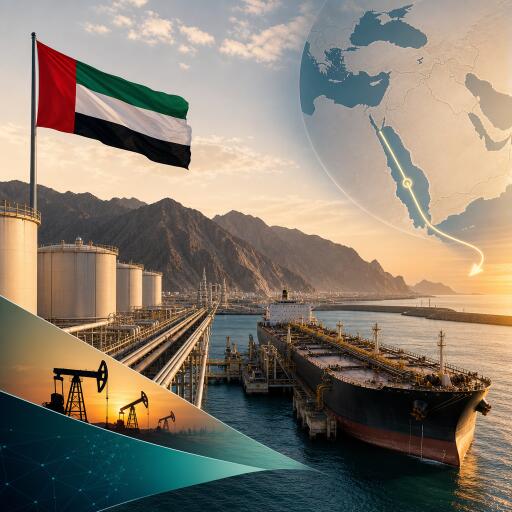
TotalEnergies backs UAE plan to double Fujairah oil export capacity outside Hormuz
The United Arab Emirates is accelerating plans to transform Fujairah into a larger strategic gateway for global oil exports, and TotalEnergies has committed to invest in the effort. The backing from one of the world’s largest energy companies aligns with Abu Dhabi’s strategy to expand crude transportation capacity outside the Strait of Hormuz amid ongoing regional disruptions to maritime traffic.
TotalEnergies steps in
TotalEnergies CEO Patrick Pouyanné said the company will invest in Abu Dhabi’s plan to double export capacity through Fujairah and also aims to participate in a separate pipeline project linking Baghdad with Syria. While the company has not disclosed the value or detailed structure of its UAE investment, the move underscores the growing commercial emphasis on pipeline routes that bypass Hormuz.
Doubling capacity via Fujairah
Abu Dhabi already operates the Abu Dhabi Crude Oil Pipeline (ADCOP), widely known as the Habshan–Fujairah pipeline. This route connects onshore producing areas to Fujairah on the Gulf of Oman and can transport up to about 1.8 million barrels per day, enabling crude exports without transiting the Strait of Hormuz.
The next phase is not simply an expansion of ADCOP. ADNOC is building a new West–East Pipeline to supplement existing infrastructure and double overall export capacity through Fujairah, with operations targeted for 2027. The project has been fast-tracked under directives issued in May as part of a broader program of large-scale energy investments. ADNOC has not publicly disclosed the new line’s precise throughput or cost, but doubling from the current ceiling suggests a potential capacity of around 3.6 million barrels per day, with some industry estimates placing eventual capability closer to 4 million barrels per day.
Why Fujairah matters
Fujairah’s location on the Gulf of Oman gives it strategic weight. Oil can be transported overland and loaded onto tankers without entering Hormuz, a chokepoint where interruptions have periodically constrained shipping. During recent disruptions, the Habshan–Fujairah line helped sustain UAE exports, which climbed above 3.9 million barrels per day in June. Bringing international partners into the next stage of expansion further anchors Fujairah as a permanent outlet for Abu Dhabi’s crude.
Trading through Hormuz still viable—for crude
Despite the bypass strategy, crude shipments through Hormuz remain commercially attractive when discounts are substantial. Regional producers have at times offered crude at around $50–$60 per barrel even when global benchmarks trade much higher. Shipping a very large crude carrier (VLCC) through Hormuz and back can add roughly $20 million per voyage—about $10 per barrel on a typical 2-million-barrel cargo—yet the underlying discounts can exceed that premium, keeping crude trades profitable.
Refined-product economics are different. Product tankers carry smaller volumes, so elevated passage costs translate into a much higher per-barrel burden—sometimes approaching $50 per barrel—undercutting many trades. As a result, crude has continued to move through Hormuz more readily than refined fuels, tightening product availability and supporting stronger refining margins.
Scale of Hormuz exposure and limited alternatives
Roughly one-fifth of the world’s petroleum liquids consumption typically moves through the Strait of Hormuz, with Asian markets especially exposed. While alternatives exist, they are limited. Among Gulf producers, the UAE and Saudi Arabia operate the principal crude pipelines that reach export terminals outside the strait. Saudi Arabia’s East–West Pipeline to Yanbu on the Red Sea can carry up to about 7 million barrels per day and has served as a critical outlet during disruptions. Oman benefits from a natural coastline outside Hormuz, while Kuwait, Qatar, and Bahrain remain more dependent on the waterway.
Regional diversification gathers pace
Iraq is also working to broaden export routes, including plans for a pipeline from Baghdad to Syria. TotalEnergies’ interest in both that project and the UAE’s Fujairah expansion signals that international energy companies view route diversification as a long-term commercial imperative—not merely a stopgap for today’s security environment.
For producers, the goal is not to replace seaborne exports entirely but to create flexibility: the ability to redirect volumes, choose among terminals, and avoid curtailing output when maritime routes are constrained. Saudi Arabia’s experience this year highlighted the value of redundancy; the UAE is now moving to scale its own equivalent capability.
Part of a larger ADNOC investment drive
The West–East Pipeline sits within a broader ADNOC program that includes plans for substantial project awards between 2026 and 2028 across the value chain. The new route is already under construction and is slated to double ADNOC’s export capacity through Fujairah when operations begin in 2027. As the UAE lifts its production capacity in the coming years, ensuring sufficient evacuation routes becomes increasingly important.
TotalEnergies deepens its UAE footprint
The pipeline investment would extend a decades-long partnership. TotalEnergies holds interests across the UAE’s oil, gas, LNG, power, and renewables sectors, including 10 percent of the ADNOC Onshore concession and stakes in the Umm Shaif and Nasr, Lower Zakum, and SARB/Umm Lulu offshore concessions. The company also owns 10 percent of Ruwais LNG, a 9.6 million-ton-per-year project under development at Al Ruwais Industrial City.
In 2026, TotalEnergies expanded its gas portfolio in Abu Dhabi, taking a 10 percent interest in the Bab Gas Cap concession targeting around 1.5 billion cubic feet per day. It also took a final investment decision on the Umm Shaif Gas Cap development, where it holds 20 percent, aiming for more than 600 million cubic feet per day by 2030 with potential expansion to 1.5 billion cubic feet per day.
Fujairah’s evolving role
Already a major storage, trading, and bunkering hub outside Hormuz, Fujairah’s importance to the UAE export network will rise as new capacity comes online. Greater throughput will give Abu Dhabi more options to allocate cargoes, respond to incidents, and manage shipping schedules—and allow a larger share of future production to reach buyers without entering the strait.
The new pipeline will not eliminate regional risk, and Fujairah is not immune to disruption. But it will reduce the extent to which one maritime chokepoint dictates the UAE’s ability to move crude to market. TotalEnergies’ planned participation adds capital, expertise, and a signal of long-term confidence—reinforcing a structural shift in Gulf energy logistics toward greater redundancy and resilience.