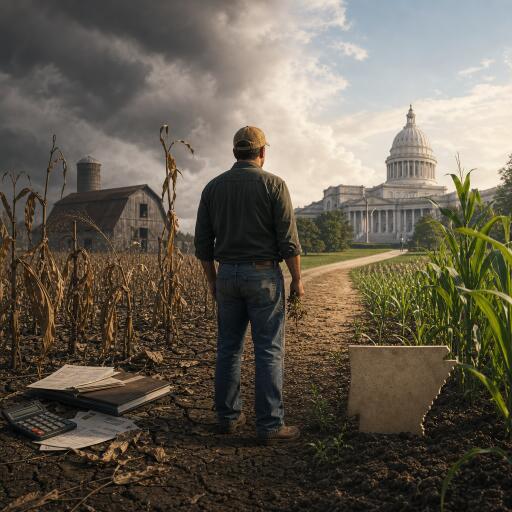
Special Report-As U.S. Agriculture Wilts Under Financial Pressure, Former Arkansas Farmer Cultivates U.S. Senate Bid
A decade after leaving a nonprofit career to help her aging parents, sixth-generation Arkansan Hallie Shoffner thought she had secured the future of her family’s century-old farm. But as input costs surged and margins thinned, she concluded last year the operation couldn’t survive. She sold nearly everything but the land and the 1901 homestead built by her great-granduncle.
That wrenching decision propelled the 39-year-old wife and mother into politics. Now the Democratic nominee for U.S. Senate in Arkansas, Shoffner argues the financial crisis battering farms like hers could shake up long-settled partisan loyalties across the rural South. She faces steep odds in a state where no Democrat has won federal office or the governorship since 2010, and where the incumbent, Senator Tom Cotton, holds a sizable fundraising advantage. A recent poll suggested the race could be tighter than expected, but election analysts still rate it safely Republican.
Cotton’s campaign has dismissed Shoffner as inauthentic and too liberal for Arkansas. Shoffner counters that her campaign is rooted in pocketbook issues, not ideology, and that Washington underestimates the severity of the farm slump. If she can no longer farm, she says, she’ll fight to improve the system that failed her family.
Analysts note that economic distress can scramble politics. Farming has always cycled through booms and busts, but the current squeeze is acute: tariffs disrupted export markets; the pandemic and global conflicts spurred inflation; seed, fertilizer, and chemical costs soared; and higher interest rates made annual operating loans more expensive. Federal aid has softened the blow, but not the underlying problems.
U.S. farm debt, including real estate and operating loans, is projected to reach about $625 billion this year, up roughly 3% from last year and nearly 18% since 2019, outpacing many other sectors. Farmers, unlike most small businesses, must borrow heavily each season for land, inputs, and equipment, with few ways to pivot midstream. As one agricultural economist put it, other Main Street businesses found a “release valve” after the pandemic; farmers largely did not.
The stakes ripple well beyond the field. Agriculture and related industries generate more than $1.5 trillion annually—about 5.5% of the U.S. economy. In Arkansas, the nation’s top rice producer, the strain is visible: the state recently led the country in Chapter 12 bankruptcy filings for family farmers, a lagging indicator that suggests more distress ahead.
Shoofner’s pitch centers on resilience. She wants Arkansas to diversify by building more in-state processing, adding value to crops before they leave the state, and fostering new industries and specialty crops to cushion both rural communities and cities from commodity price swings. When one farm shuts down, she warns, the ripple effects hit suppliers, lenders, truckers, and local businesses.
Arkansas remains a difficult venue for Democrats. The state has steadily shifted right, embracing a blend of populism and conservatism that delivered a 30-plus-point margin for Donald Trump in 2024. Even so, a new crop of candidates with farm and ranch backgrounds—many first-time contenders—has emerged across rural America, arguing that trade shocks, volatile input costs, and healthcare gaps demand a different approach. Republicans respond that they’ve advanced policies to support rural communities, from trade and tax changes to investments in development, and point to House passage of a long-delayed Farm Bill now awaiting action in the Senate.
Shoofner’s path to politics began with a personal crisis. Raised on the family farm near the western edge of the Mississippi Delta, she studied Spanish at Vanderbilt and earned a master’s in public service before working in nonprofits and marketing. In 2015, when her father’s dementia worsened, she returned home and took over daily operations by 2017. For a time, the farm prospered with rice, corn, and soybeans.
By mid-2024, however, budgets no longer penciled out. A nearly $1 million operating loan for the next season would have been secured by the farmland and her parents’ savings—an unacceptable risk given rising rates and unpredictable markets. She chose to liquidate. An Arkansas auctioneer who handled her sale said farm liquidations have accelerated across the region. Over two weeks in March 2025, Shoffner sold tractors, implements, and supplies for a little over $1 million, then navigated a tangle of tax and accounting consequences.
The campaign took shape almost by accident. A candid social media post about closing the operation drew wide attention and an invitation to speak at a town hall. Her blunt critique of politicians who court rural voters and then forget them resonated, and within months she assembled a team led by veteran organizer Anna-Lee Pittman. She won the Democratic primary and reported strong grassroots support, with most donations coming from Arkansans. Still, Cotton’s years-long fundraising base left him with far more cash on hand, and outside handicappers consider him a heavy favorite.
Shoofner insists a relentless ground game can blunt that advantage. She says Cotton has been largely absent from rural hustings; his campaign replies that his job often requires him to be in Washington, where he casts votes and advances legislation for Arkansas. Republicans have tried to paint Shoffner as extreme by resurfacing old online posts, but she argues that today’s farm economics matter far more to voters than youthful activism.
On a visit to the family property with campaign staff, Shoffner’s cousin Jack Kent, a Republican and Trump voter who now farms some of the land, said he urged her to run as a Republican but will back her anyway. What swayed him, he said, is her firsthand grasp of operating loans and debt levels he’s never seen in decades on the land.
At a “farmer revival” gathering outside Paragould—part worship service, part community meeting—Shoffner listened as producers described praying for relief that hasn’t come. She told them she doesn’t expect miracles either, but sees an opening for practical solutions: diversify crops, expand processing, recruit new industries, and stabilize financing so families like hers aren’t forced to gamble their land every spring. In her view, the crisis is also a chance to rebuild the rural economy on sturdier ground.