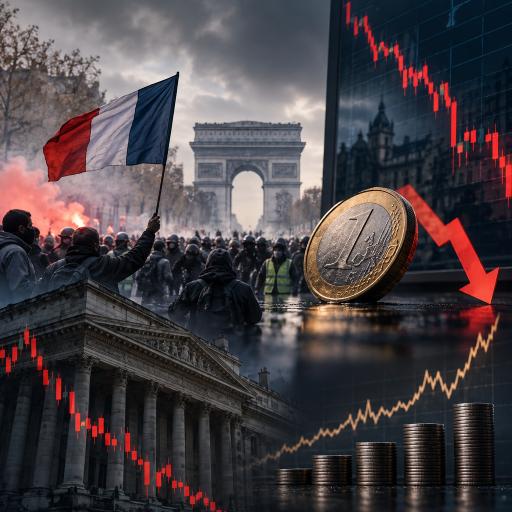
France Protests: Paris-Listed Stocks, Euro Falls As French 10-Year Bond Yields Hit Multi-Decade Highs
European markets declined on Monday as escalating protests in France intensified concerns about the country’s political stability, fiscal outlook and economic prospects. French stocks led the regional selloff, while the euro weakened and government borrowing costs climbed.
France’s CAC 40 fell as much as 1.35% during the session. The pan-European Stoxx 600 declined 0.82%, Germany’s DAX dropped 1.1% and the UK’s FTSE 100 retreated 0.94%.
French government bonds also came under pressure, pushing the 10-year yield to multi-decade highs. The rise reflected growing investor caution over political uncertainty, public debt and the government’s capacity to implement fiscal measures.
France Protests Pressure Markets
Thousands of demonstrators took to the streets across France over the weekend to protest against elevated living costs, inflation and deteriorating public services. In several areas, demonstrations turned violent, with arrests, property damage and reports of retail stores being looted.
The unrest has increased pressure on President Emmanuel Macron as France approaches the 2027 presidential election. His administration has faced persistent social discontent, economic challenges and mounting concern about the country’s public finances.
Investors are now assessing whether the demonstrations could develop into a prolonged period of instability or interfere with the government’s fiscal agenda. A worsening political outlook may reduce demand for French assets, particularly government debt.
Bond prices move inversely to yields, meaning the increase in France’s 10-year yield indicates that investors are demanding higher returns to hold the country’s debt. Such moves can be driven by several factors, including inflation expectations, interest-rate projections and perceived fiscal risk.
Markets will continue monitoring France’s borrowing costs and the yield spread between French and German government bonds. A widening spread would indicate that investors are assigning a larger risk premium to French debt.
Euro Weakens Against Dollar And Pound
The euro slipped 0.1% against both the US dollar and British pound as markets reacted to the unrest. According to the supplied market figures, the common currency has fallen about 4.4% against the dollar this year and 0.9% this month.
Expectations that the US Federal Reserve could maintain higher interest rates amid persistent inflation have also weighed on the euro-dollar exchange rate. Political uncertainty in France adds another potential source of pressure by making euro-denominated assets less attractive to some investors.
The currency’s longer-term direction will also depend on US economic conditions, Federal Reserve policy expectations and the European Central Bank’s interest-rate outlook.
Investors Prepare For Major Earnings
Political developments in France come ahead of a busy week for European corporate earnings. Company results are expected to provide further evidence about consumer demand, technology spending and the broader health of the regional economy.
The third-quarter reporting season began unevenly after luxury group LVMH disappointed investors with its revenue performance, renewing concerns about weak demand in China.
French luxury companies EssilorLuxottica and Kering are due to report results this week. Investors will focus on whether consumer demand is stabilising and whether sluggish Chinese spending continues to affect the luxury sector.
Technology will also remain in focus, with enterprise software group SAP and semiconductor equipment manufacturer BE Semiconductor scheduled to release results. Their updates could offer insight into corporate technology budgets and semiconductor demand following a global technology selloff.
Meta Platforms’ third-quarter report will also be closely watched for indications of how much major technology companies are investing in artificial intelligence infrastructure. Capital expenditure forecasts from large cloud and AI businesses could influence technology valuations and global risk appetite.
Oil Slips As Asian Markets Trade Mixed
Oil prices moved lower after US President Donald Trump issued an executive order waiving certain sanctions and tariffs associated with Russian energy transactions. The decision introduced another variable into the outlook for global energy supplies.
Asian markets delivered a mixed performance. South Korea’s Kospi advanced 1.76%, while Australia’s S&P/ASX 200 gained 0.44%. Japan’s Nikkei 225 fell 0.62%, and mainland China’s CSI 300 finished broadly unchanged at 4,174.53.
Investors will continue to track the protests in France, movements in sovereign bond yields and the latest corporate earnings as they evaluate political risk and the outlook for European markets.