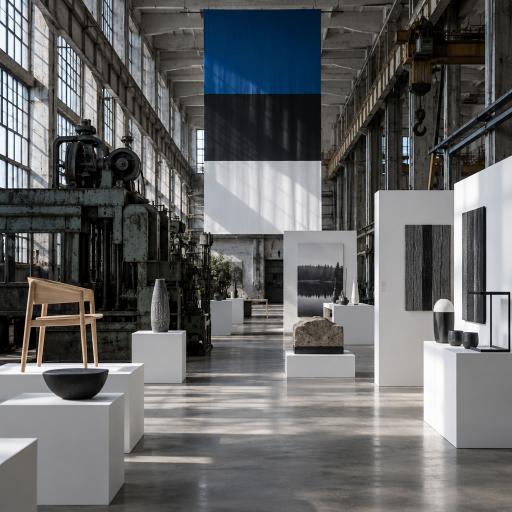
A week of Estonian design: where a factory floor became a gallery
For one packed week, Tallinn’s Põhjala Factory exchanged its industrial past for a new role as a sprawling design gallery. The former manufacturing complex hosted the 21st Tallinn Design Festival, known locally as Disainiöö, bringing furniture, tools, lighting and experimental products into its cavernous hangars.
Held from 28 September to 4 October, the festival combined exhibitions with talks, workshops, bicycle tours, a fashion show, an awards gala and a weekend market. As the largest design festival in the Baltics, it offered a broad view of how designers are responding to changing workplaces, limited living space, accessibility and the need to use fewer new materials.
Four ideas ran throughout the programme: sustainability, adaptability, inclusivity and greater awareness of what products are made from.
A design culture shaped by industry
The factory setting was particularly appropriate for Estonia. Applied arts education began in Tallinn in 1914, with graduates later creating products for interwar businesses and Soviet-era factories. From 1966, the State Art Institute also trained industrial designers as members of a newly recognised profession.
Estonian products developed a reputation for combining practical construction with visual influences from Western Europe. That legacy remains visible today, although contemporary designers often add dry humour, modularity and resource-conscious production. Several projects at the festival demonstrated these qualities especially clearly.
Pergola by Aivan for Standard
Standard, Estonia’s largest design company, presented Pergola, its latest collaboration with Finnish studio Aivan. Designed for contemporary workplaces, the modular furniture system is built around an adaptable aluminium profile.
Cabinets, screens, whiteboards and other meeting tools can be attached according to the needs of a team. The result can function as storage, a presentation area or a setting for collaborative work. Because Aivan is itself an office, its designers approached Pergola as something they could genuinely use, allowing everyday working habits to shape the final system.
Tekto by Franciszek Wesołowski
Tekto responds to the difficulties faced by creative people who cannot afford a dedicated studio and must make prototypes at home. Designer Franciszek Wesołowski developed a family of identical wooden modules that can connect horizontally or stack vertically.
Each unit can become a shelf, low table or tool-storage space. Made from solid oak and ramie fabric, the system allows a temporary workshop to be folded back into domestic life once the working day is over. Like Pergola, Tekto reflects the festival’s emphasis on flexible products designed around real experience.
ABLE tools by Barbora Bezděková
Barbora Bezděková created ABLE, a collection of mouthpieces and an adjustable workstation for people with physical disabilities. The tools make it possible to draw, operate a tablet, work on a screen or sign documents using the mouth.
The project grew from nine years of experience working with disabled people, many of whom had been forced to adapt ordinary pens and other unsuitable objects. Such makeshift tools can release plastic particles or wooden fragments and may even damage teeth. ABLE replaces them with equipment designed specifically for safety, comfort and independence.
Park benches with integrated bicycle racks by Timo Talvik
Tallinn designer Timo Talvik began with a familiar urban inconvenience: finding somewhere to leave a bicycle while stopping to rest. His solution was a series of three benches with integrated spaces for bikes.
The collection includes a conventional park bench, a semi-high leaning seat for brief stops and a reclining bench with an extended footrest for longer breaks. Wood and metal unite the three versions, creating a consistent family of street furniture that treats cycling as part of everyday public life.
KOMA by Eneli Siimon for Leandesign OÜ
Winner of the year’s BRUNO award in the spatial and environmental product design category, KOMA is a seat that does not prescribe a single “correct” posture. Its open but supportive shape allows users to sit upright, turn sideways or lean back.
The chair also makes a strong material statement. According to its manufacturer, 96.4% of its mass comes from secondary materials recovered from existing industrial side streams. KOMA therefore combines physical flexibility with a production model intended to create more value from resources already in circulation.
Designing Between Worlds by Levon Kostandyan
Levon Kostandyan transforms discarded pomegranate skins into handmade veneers, decorative inlays and furniture surfaces. In Armenia, the pomegranate is associated with fertility, abundance, prosperity and national endurance. It is also an agricultural by-product that is commonly thrown away.
By turning the skins into a durable material, Kostandyan explores how cultural identity can travel and evolve. The project approaches diaspora not as the preservation of culture behind glass, but as a process in which traditions take on new forms while retaining their emotional meaning.
Conductor Peer Kynntilä by Tarmo Luisk
Tarmo Luisk’s Conductor Peer Kynntilä is a metal-and-leather lamp created for his own brand and nominated for a BRUNO product design award.
Its name layers literary, linguistic and regional references. It evokes Henrik Ibsen’s character Peer Gynt, while “kynntilä” playfully resembles the Finnish word for candle. The lamp’s arched top also recalls the movement of a conductor’s baton.
Its form is rooted in the lamps once used in Estonia before electric lighting became widespread. By combining that historical reference with a contemporary silhouette, Luisk turns an everyday object into a compact tribute to heritage.
A practical vision of the future
Across the festival, the strongest projects were not speculative objects detached from ordinary life. They addressed recognisable needs: making room to work at home, accommodating different bodies, supporting cyclists and reducing dependence on virgin materials.
Inside Põhjala Factory, Estonia’s industrial history became a backdrop for a more adaptable future—one in which good design is measured not only by appearance, but also by usefulness, accessibility and responsible use of resources.