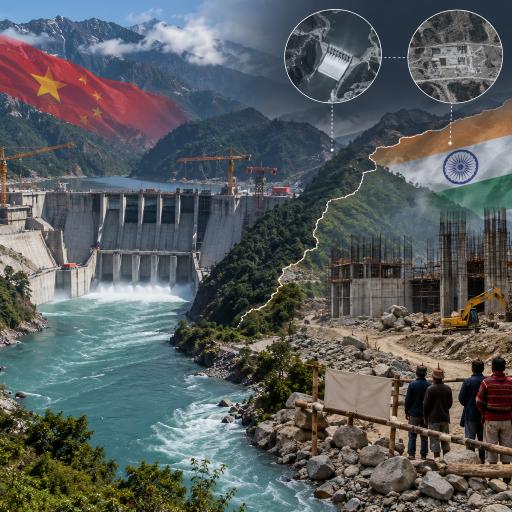
China has made significant progress on its planned 60-gigawatt Medog hydropower project along the Yarlung Tsangpo River, close to Arunachal Pradesh, according to a recent analysis of satellite imagery. Meanwhile, India’s proposed Upper Siang project continues to face local opposition over displacement, environmental damage and large-scale deforestation.
Satellite Images Indicate Extensive Construction
The satellite analysis, conducted by an Indian geospatial artificial intelligence startup incubated at IIT Delhi’s Foundation for Innovation and Technology Transfer, indicates large-scale activity at the Chinese project site.
Images reportedly show that several villages near the main dam location have been cleared. Heavy industrial infrastructure, access routes and river-diversion works are also visible in areas near the border.
The analysis identified four important components of the project: a large dam near Mainling, a lower dam, a tunnel through the Namcha Barwa mountain region and another tunnel close to the India-China border.
Construction at the larger dam site appears to have accelerated after July 2025. Development of the tunnel outlet near the border is also believed to have begun, with preparatory work reportedly taking place even before the project’s formal groundbreaking ceremony.
Earlier satellite observations indicated that multiple settlements in the region were removed within a relatively short period during 2025.
>
India Plans Upper Siang Multipurpose Project
Against the backdrop of China’s construction activity, India has proposed the 11,200-megawatt Siang Upper Multipurpose Project in Arunachal Pradesh. Indian officials have said the project could help manage the potential downstream effects of the Chinese dam, including changes in water flow and the risks associated with sudden releases.
Arunachal Pradesh Chief Minister Pema Khandu has emphasized the strategic importance of the Indian project while calling for greater transparency from Beijing regarding its activities on the Yarlung Tsangpo, which enters India as the Siang before joining the Brahmaputra river system.
Local Groups Raise Environmental Concerns
Several community and regional groups in Arunachal Pradesh have opposed the Upper Siang proposal. Their concerns include possible displacement, loss of traditional land, disruption of livelihoods and extensive forest clearance.
Opponents have also sought more information about the project’s environmental and social consequences. The region is ecologically sensitive and home to Indigenous communities whose lives and cultural practices are closely connected to the river and surrounding forests.
Officials have said local concerns will be considered before major decisions are taken. However, the contrasting pace of the two projects has sharpened India’s challenge: responding to rapid upstream construction in China while building public confidence and addressing environmental objections at home.