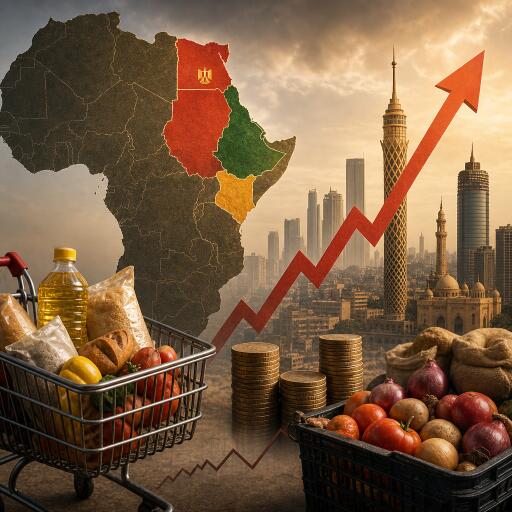
Africa’s inflation fight falters as Ethiopia, Egypt, Kenya lead price surge in first half
Africa’s progress on disinflation has stalled, with several of the continent’s largest economies posting faster price growth in the first half of 2026. Higher fuel costs linked to renewed Middle East tensions have pushed up transport, food, and household expenses, reversing much of last year’s relief.
An analysis of inflation data from statistical agencies in 10 major African economies shows every one recorded higher consumer price growth in the first six months of 2026 than in the same period of 2025. The steepest increases were seen in Ethiopia (+4.1 percentage points), Egypt (+2.4), Kenya (+2.0), and Ghana (+1.5), with the remaining countries also rising.
The trend marks a sharp turn from 2025, when tighter monetary policy, softer global food and energy prices, and firmer exchange rates helped cool inflation across much of the continent. Last year, a large majority of African countries saw inflation decline. In contrast, the average increase among the four worst performers rose by 2.5 percentage points in H1 2026, compared with a 5.3 percentage-point drop a year earlier.
Rising geopolitical risks threaten the region’s near-term outlook even as growth is projected to hover around 4.1 percent this year. Higher fuel, food, and fertilizer costs, alongside tighter global financial conditions, risk pushing inflation higher, slowing activity, and hitting poorer households hardest due to their larger spending shares on essentials. Policymakers are being urged to protect vulnerable households while preserving macroeconomic stability through inflation control and prudent fiscal management.
Global energy dynamics have turned adverse again. The resurgence of conflict in the Middle East since July erased the brief oil-price relief that followed the June ceasefire. After dipping below $80 a barrel, Brent crude rebounded toward $100, raising fuel import bills across oil-importing African economies. That has fed through to transport and food costs, eroding purchasing power and complicating central banks’ efforts to extend last year’s disinflation.
Business activity has softened marginally. A composite gauge of private-sector conditions across key African markets averaged 50.5 in the first half, down from 50.9 a year earlier—still indicating expansion, but at a slower pace amid geopolitical uncertainty.
Ethiopia: Largest jump in prices
Ethiopia posted the biggest inflation increase among the countries tracked. Annual inflation reached 13.9 percent in June, up from 13.4 percent in May and the highest in a year. Food inflation rose to 15.1 percent, continuing an upswing after briefly slipping into single digits last December for the first time in nearly a decade. In response, the National Bank of Ethiopia raised its benchmark rate to 16 percent from 15 percent, its first move since adopting a formal policy rate in 2024.
Egypt: Easing paused as inflation stays high
Egypt recorded the second-largest rise. Headline inflation stood at 14.3 percent in June, up from 11.9 percent in January, despite softer domestic demand. The Central Bank of Egypt kept its key rate unchanged at 19 percent, extending a pause in its easing cycle and signaling it is too soon to resume cuts even if inflation moderates over the medium term. The pound weakened by about 3.9 percent against the U.S. dollar in the first half, adding to imported price pressures.
Kenya: Contained but higher than a year ago
Kenya ranked third by the size of the increase compared to last year, though overall pressures remain relatively contained. Inflation eased to 6.4 percent in June from 6.7 percent in May as transport costs moderated. The Central Bank of Kenya left its benchmark rate unchanged at 8.75 percent, citing a policy stance it considers adequate to anchor inflation expectations and support exchange-rate stability. The shilling depreciated about 0.9 percent against the dollar in H1.
Ghana: Momentum rebuilds
After returning to single-digit inflation in September for the first time since 2021, Ghana is again facing renewed pressures. Annual inflation accelerated for a third straight month to 5.3 percent in June, from 3.7 percent in May—the highest since last December. Non-food prices led the rise, notably transport, housing, and education, while food inflation also edged higher. The cedi weakened by about 5.46 percent against the dollar in H1. Reflecting the risks, the Bank of Ghana kept its policy rate at 14 percent, extending its pause on easing.
South Africa: Fuel costs bite
South Africa’s inflation quickened to 5.0 percent in June from 4.5 percent in May, beating expectations. Transport costs jumped 12.7 percent, reflecting a 34.3 percent surge in fuel prices as higher global oil filtered through. The South African Reserve Bank unexpectedly held the repo rate at 7 percent, balancing rising price risks against subdued growth. The rand appreciated slightly in the first half, strengthening from 16.50 to 16.35 per dollar.
Ivory Coast and Uganda: Mildest increases
Ivory Coast and Uganda posted the softest moves higher. Ivory Coast’s inflation edged up to 1.8 percent in June from 1.6 percent in May, remaining among the lowest on the continent. Uganda’s inflation rose to 3.7 percent from 3.2 percent, driven by transport, food, and housing. The Bank of Uganda has kept its policy rate at 9.75 percent since October 2024, maintaining a steady stance as inflation nudges higher. Uganda’s shilling weakened around 1.21 percent in H1, while the country continued to deliver some of the region’s strongest private-sector activity readings.
Outlook: Policy trade-offs intensify
With oil near triple digits and currencies under pressure, Africa’s inflation outlook has become more fragile. Central banks face tougher trade-offs between supporting growth and anchoring prices, particularly where fuel pass-through is fast and expectations are sensitive. Fiscal space remains limited in many countries, sharpening the need to target support to vulnerable households and maintain budget discipline. If global energy prices stabilize and geopolitical risks ease, the disinflation path could resume later in the year—but for now, the balance of risks points to stickier inflation and a slower expansion than previously hoped.