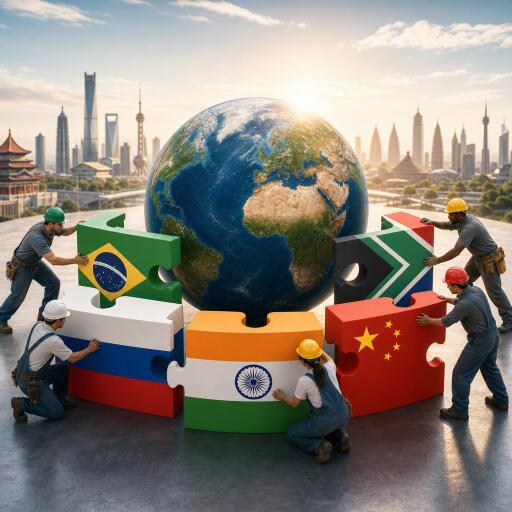
Building BRICS for the world
As close neighbors at pivotal moments of national renewal, India and China face a clear choice: cooperate and prosper together, or slide into confrontation that leaves everyone worse off. The stakes extend well beyond our borders; what we build together can anchor stability and growth across the Global South and the wider world.
Conceived in 2001 as “BRIC,” the idea matured from early ministerial meetings in 2006 to a first leaders’ summit in 2009, with South Africa’s accession in 2010 marking the birth of BRICS. In Chinese, the acronym evokes a “golden brick,” a fitting image for a foundation under construction—solid, valuable, and designed for the long term.
BRICS+ now encompasses 11 members—Brazil, Russia, India, China, South Africa, Egypt, Ethiopia, Indonesia, Iran, the United Arab Emirates, and Saudi Arabia—and 10 partner countries: Belarus, Bolivia, Cuba, Kazakhstan, Malaysia, Nigeria, Thailand, Uganda, Uzbekistan, and Vietnam. Together, BRICS and BRICS+ account for roughly 45 percent and 55 percent of the world’s population, respectively, and are converging toward 35–45 percent of global GDP in purchasing-power terms. Even at nominal exchange rates, BRICS+ economies collectively exceed $30 trillion. The bloc’s growth trajectory is set to outpace that of the G7 by a wide margin over the coming years. As ancient civilizations that once led global progress, these countries are reclaiming dynamism and reshaping the world’s economic center of gravity. Interest in formal membership continues to grow, with countries such as Argentina, Algeria, and Türkiye exploring pathways to join.
New Delhi will host the BRICS Summit in 2026. As a platform for cooperation among emerging markets and developing economies, BRICS+ must adapt to shifting global realities while keeping its compass fixed on inclusive, people-centered development. India’s agenda highlights four priorities—resilience, innovation, cooperation, and sustainability—advanced through three pillars: political and security coordination, economic and financial partnership, and cultural and people-to-people exchanges. This balance of hard and soft connectivity can convert shared aspirations into tangible outcomes.
China supports India’s leadership for the summit and sees partnership as the optimal path for our two nations. By purchasing-power parity, our economies rank first and third worldwide, and together our populations represent about 35 percent of humanity. Practical cooperation is already moving forward: direct flights between our countries are resuming, and exchanges among sister cities, universities, and businesses are deepening. Such steady links create the trust, predictability, and problem-solving spirit that big neighbors need.
Stronger India–China solidarity would benefit Asia and the world. In the near term, both countries will remain powerful engines of global growth. Our combined contribution to world output—currently about 28.4 percent in PPP terms and roughly one-fifth in nominal terms—will continue to rise. The Five Principles of Peaceful Coexistence (Panchsheel), jointly articulated by India and China, have become bedrock norms in international relations and a durable guide for managing differences while expanding common ground. With strategic guidance from our leaders, the two sides can better align development strategies, unlock complementary strengths, and create new corridors of trade, investment, technology collaboration, and green transition.
Equally important is the human dimension. As travel and study opportunities expand, a new generation of Indian and Chinese youth can serve as bridges—fluent in each other’s cultures, confident in cooperation, and motivated to solve shared challenges from climate resilience and public health to urbanization and digital inclusion. Their curiosity and entrepreneurship will be essential to the next chapter of BRICS+ cooperation.
BRICS has always been an inclusive platform. Its expanding membership and partnerships reflect a readiness to listen, to accommodate diverse development paths, and to design solutions that respect national circumstances while pursuing collective gains. That spirit—pragmatic, respectful, and future-focused—is what the world needs more of today.
Building BRICS for the world means strengthening the habits of consultation, widening the channels of commerce and knowledge, and prioritizing people’s aspirations for dignity, opportunity, and sustainability. Through resilience, innovation, cooperation, and sustainability—and through the three cooperation pillars that translate these priorities into action—BRICS+ can help anchor a more balanced, multipolar, and prosperous global order. The choice is clear: by choosing partnership over rivalry, we lay the golden bricks of a common future.