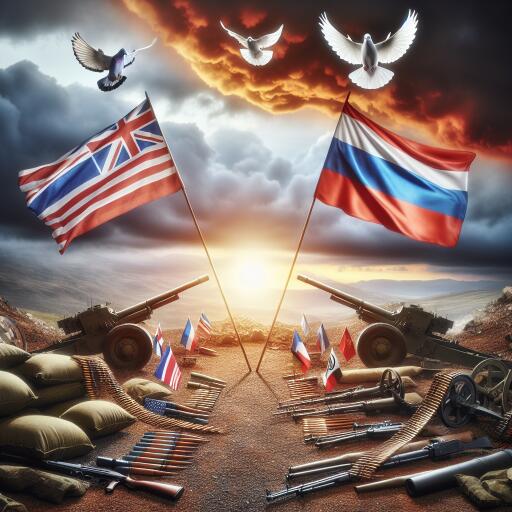
US-Iran Ceasefire: A Pause, Not A Path To Peace – OpEd
The two-week ceasefire between the United States, Iran, and Israel—announced by Donald Trump just hours before his self-imposed escalation deadline—has frozen a 39-day confrontation that was accelerating toward broader regional conflict. It is best understood as a tactical halt, not a durable settlement. The pause underscores how fragile deterrence has become and how limited coercive diplomacy is when structural grievances remain unresolved.
A transactional freeze, not a breakthrough
At its heart, the arrangement is a trade. Tehran agreed to reopen the Strait of Hormuz—through which roughly 20 percent of global oil transits—while Washington dialed back threats, including talk of strikes on civilian infrastructure. Markets responded predictably: oil prices eased after an initial surge, and the risk premium for a wider war briefly narrowed. Yet nothing fundamental has changed in the underlying power balance or the incentives that drove the escalation.
Anchoring the talks, shifting the baseline
Iran’s reported 10-point plan is less a compromise blueprint than an initial anchor. Its core demands—sweeping sanctions relief, formal recognition of domestic uranium enrichment, a U.S. military drawdown in the region, and sustained Iranian sway over Hormuz—are positions Washington has long resisted. That is partly the strategy: by setting maximalist terms, Tehran drags the negotiating baseline in its direction. The ceasefire therefore marks the start of positional bargaining, not a convergence of interests. It opens space for talks while hardening public red lines that will be politically costly for either side to soften.
For the United States, accepting any explicit Iranian authority over Hormuz would depart from decades of maritime security doctrine and freedom-of-navigation norms. For Iran, curbing enrichment would undermine both domestic legitimacy and deterrence. The gap is not merely technical; it reflects clashing strategic worldviews.
Washington’s divided front
U.S. reactions mirror this ambiguity. Republican voices, including Lindsey Graham, have cautiously welcomed a pause in fighting while warning against rewarding coercion. Some in Trump’s orbit frame the ceasefire as a tactical concession rather than a strategic win. Democrats have supported de-escalation but pressed for accountability, with figures such as Alexandria Ocasio-Cortez and Ed Markey questioning the constitutional basis of the conflict and criticizing threats to civilian infrastructure. This partisan split matters: any deal without some bipartisan foundation risks being reversible, a reality not lost on Tehran.
Hormuz: leverage, lifeline, and fault line
Control of the Strait of Hormuz is the central variable. For Iran, it is both leverage and insurance; for the United States and its partners, it is a critical artery of global commerce. The waterway has reopened, but on terms that remain purposely ambiguous. Iranian officials have hinted at a role in coordinating traffic and even floated ideas akin to transit fees—moves that would, if formalized, challenge longstanding norms. Should talks stall, Tehran could quickly tighten the valve again, injecting immediate economic shock. In effect, energy flows have been folded into the bargaining itself, making the arrangement inherently unstable.
Middle-power mediation and shifting crisis management
Intermediaries helped prevent a spiral. Prime Minister Shehbaz Sharif facilitated the two-week framework and offered Islamabad as a venue for follow-on talks, reflecting Pakistan’s reemergence as a pragmatic crisis interlocutor. This diplomacy has been reinforced by institutional backing from Field Marshal Asim Munir, strengthening Pakistan’s posture as a stabilizing security actor amid volatility. The purpose was not to solve the dispute but to buy time—an increasingly essential function when military tempos outpace diplomatic bandwidth.
Claims that Pakistan’s relations with the United Arab Emirates have frayed—citing the return of matured UAE deposits in April 2026—misread routine financial operations. The broader relationship remains rooted in defense cooperation, substantial economic ties, and a large Pakistani diaspora, foundations that argue against interpretations of a fundamental rift.
China’s quiet leverage
Wang Yi signaled Beijing’s support for de-escalation, and Trump acknowledged that China may have nudged Tehran toward engagement. Chinese officials indicated they had been pushing for a ceasefire from the outset. As Iran’s largest trading partner, Beijing wields economic leverage that complements discreet diplomacy. Its earlier role in bridging Tehran and Riyadh fits a broader ambition: to position itself as a credible mediator in regional crises. Together, these interventions underscore a shifting landscape in which middle and economically influential powers shape outcomes not by dictating settlements, but by preventing dangerous escalatory leaps.
Compressed timelines, eroded trust
The ceasefire unfolds against a strategic backdrop transformed by rapid escalation cycles. Actions that once took weeks now occur within hours. Targeting of senior leadership and critical infrastructure has raised the stakes beyond traditional deterrence thresholds, further corroding already thin trust. In this environment, diplomacy becomes reactive—arriving after thresholds are tested—making it more about crisis management than conflict resolution.
The path ahead: time gained, clarity not
For the moment, immediate pressures have eased. Shipping lanes are open, markets steadier, and preparations for talks—potentially in Islamabad—are underway. But this is not structural progress. The United States seeks to constrain Iran’s nuclear trajectory and regional reach; Iran seeks sanctions relief, strategic autonomy, and recognition of its role. These aims remain misaligned, and neither side is eager to appear to retreat from its public commitments.
The ceasefire has bought time, not consensus. Its durability will hinge less on stated intentions than on whether both sides can recalibrate their red lines without seeming to concede them—an inherently difficult task in polarized domestic environments. If negotiations inch toward a workable equilibrium, this pause could form a foundation for something more enduring. If not, it will be remembered as an intermission in a conflict that was not settled, only delayed. The war has not ended; it has merely been postponed.