Cultivating farmers, not the seeds: Germination Project’s 50-year bet on Philadelphia
In 1727, a young Benjamin Franklin convened the Junto, a small group that met weekly to improve themselves and their city. From that circle grew foundational institutions: a subscription library, a volunteer fire company, a philosophical society, a university, and the nation’s first hospital. The lesson endures: Philadelphia became great not by wealth alone, but by nurturing a network of young people who saw personal advancement and civic progress as one and the same.
Why promising Philadelphians leave
Philadelphia is rich in talent but weak in gravitational pull. Young people flock here for college and often stay through their twenties; then, as careers demand bigger platforms, many depart.
- Thin opportunity at the top: In cutting-edge sectors like AI and advanced biotech, the city too often lacks senior roles and headquarters-scale opportunity. Graduates gravitate to New York, Boston, and the Bay Area where the ladders are taller.
- Networks over merit: Opportunity often flows through relationships. Without access to the right rooms, emerging leaders with skill but limited connections look elsewhere.
- Decisions made elsewhere: Philadelphia repeatedly pioneers discoveries while commercialization—and the executive suites—settle in other cities. mRNA breakthroughs tied to Penn reached the world through companies headquartered in Cambridge and Mainz; CAR-T’s ascent rode with a multinational based in Basel. When senior jobs and mentors leave, the next generation follows.
Capital markets reinforce this pattern. Mega-deals skew toward AI hubs; the region’s raises are meaningful but comparatively thin. Cities rarely outbid Silicon Valley on capital, but capital follows founders, and founders follow roots. The scarcest resource isn’t money—it’s rooted leadership.
Proof Philadelphia still leads
Philadelphia’s capacity to lead the world is already visible at Penn Medicine. It helped deliver the mRNA platform recognized by a Nobel Prize, pioneered CAR-T cell therapy, and recently collaborated with CHOP on a customized CRISPR gene-editing treatment delivered within months to correct a rare genetic disorder. These were not overnight miracles but the product of long bets by people who stayed.
Penn Medicine is also closing a key gap through its co-investment program that helps turn academic research into companies. The region possesses an invention engine; what it needs is more leaders who choose to build the next generation of companies here.
A 50-year bet
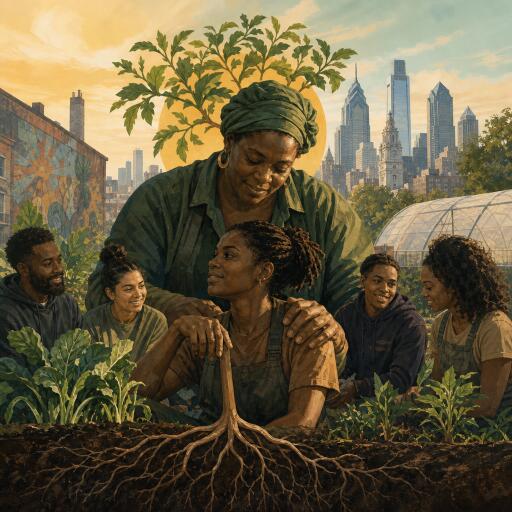
The Germination Project, founded in 2014, is designed to retain and return the region’s best by starting earlier and staying longer. Instead of competing for loyalty at 22, it begins at 15: recruiting top 10th graders from all backgrounds into a lifetime fellowship bound by one condition—invest in the Philadelphia region through civic service. The aim is not to sow quick seeds but to cultivate a class of civic farmers who choose their own crops, steward institutions, and build anew over decades.
Partners show Fellows what’s possible here. Since 2016, Penn Medicine has hosted the Project’s annual Leadership Boot Camp, where eminent faculty expose teenagers to the frontier of medicine. After a week with the scientists behind mRNA and CAR-T, Fellows don’t see Philadelphia as a city of small ambitions; they see it as a place where the impossible gets done—and where they are expected to do the next impossible thing.
The leaders being cultivated
Consider Mary Cipperman, selected as a Fellow in 2019 at age sixteen. During the early pandemic weeks, she led an initiative that quietly delivered 100,000 masks to local communities. She later became the first Fellow to run the Penn Medicine Boot Camp, mentoring successors into the role. She also founded the National Organization for Youth Activists, a nonpartisan network that built voter-registration tools, operated a national phone bank, and convened a multi-day conference with partner groups.
Today she is a physicist, summa cum laude from Harvard, with research experience at CERN, imaging work supported at Penn, and AI-driven clinical research with teams affiliated with Harvard Medical School, Mass General, and the Broad Institute. Most of those achievements came while she was undergoing chemotherapy for acute leukemia, diagnosed at nineteen. From her hospital bed, she created a peer-to-peer mentorship program for blood cancer patients; she still volunteers weekly in hospice and with young patients, and is now cancer-free.
Mary’s life’s work bridges oncology and humanity. She argues that medicine is learning to eradicate disease faster than it learns to preserve the whole person—especially adolescents and young adults who fall between pediatric and adult systems and are often underrepresented in trials and imaging datasets. Her research in radiobiology and a prize-winning thesis on adolescent-specific bias in frontier AI models are helping to define a field that barely exists, informed by lived experience.
By market logic, she belongs to Boston or London. By Philadelphia’s new logic, she remains tethered: to mentors at Penn Medicine, to a decade of relationships, and to a fellowship that expects her back—not merely as an employee, but as a builder.
Three legs, three answers
The Germination Project counters the three drivers of brain drain with three long-term mechanisms:
- Lifetime Fellowship: Identifies leaders at fifteen, shapes them within a culture of long bets and service, and binds them for life. Fellows report back on their civic acts—this summer’s class presented ten completed projects per Fellow since Selection Day.
- Vision 20/20: Builds networks by convening 20 influential leaders for a year to deliver 20 concrete solutions to a chronic city challenge. It functions as a modern, cross-generational Junto, placing emerging leaders in the rooms where decisions are made and holding all participants accountable for outcomes, not panels.
- Germination Shares: Makes service visible and prestigious. Acts of service are scored on Impact (40%), Scalability (35%), and Complexity (25%). A visit to an isolated neighbor earns a Share; designing a scalable AI-literacy program for seniors earns many more. The model is expanding into high schools and companies through the Civic Cup, with a public registry and annual gala. Over time, the data will estimate a Service GDP—a ledger for contribution, not just accumulation.
Together these legs form a flywheel: the Fellowship forms leaders, Vision 20/20 connects them to power and hard problems, and Germination Shares transforms service into standing—drawing in the next generation.
Friday nights, again
The Junto began with a simple promise: meet regularly, ask what good can be done, and do it here. Twelve years into a fifty-year bet, the Germination Project is rebuilding that promise at scale. The world will compete for the city’s best; it often wins the first round. Philadelphia can win the return—by cultivating farmers, not just seeds, and giving them every reason to meet here, every Friday night, for the next fifty years.