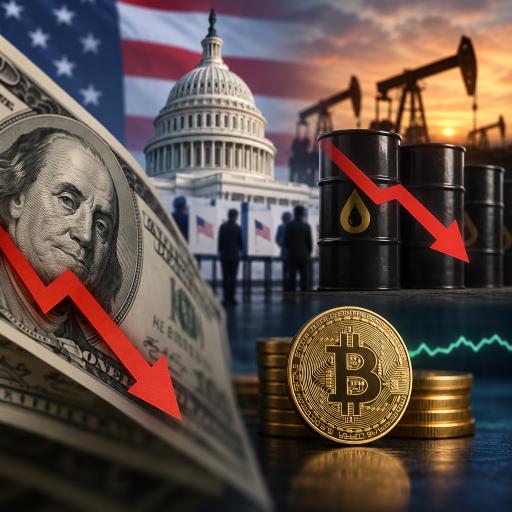
Dollar Declines Ahead of US Midterms as Oil Falls; Bitcoin Steadies After Crypto Theft
The US dollar weakened on Monday as oil prices fell sharply and global equities advanced ahead of the US midterm elections, key labor market data and several central bank interest-rate decisions.
Crude oil prices dropped about 6% as talks involving Iranian and Qatari officials raised hopes that disruptions to Middle Eastern energy supplies could ease. The decline helped improve investor sentiment following a difficult October for technology stocks, when concerns about heavy corporate spending on artificial intelligence weighed on the Nasdaq.
December West Texas Intermediate crude, which tested $105 a barrel on Friday, slipped below $100. The reversal in oil prices and recovery in equities offered markets some relief after the previous week ended with stocks under pressure and crude at new contract highs.
Dollar Index Retreats
The dollar index, which tracks the US currency against a basket of major peers including the euro and Japanese yen, fell 0.38% to 101.59. It was on course for its largest one-day percentage decline since October 15.
The euro gained 0.48% to trade at $1.1212, despite Fitch revising France’s credit outlook from “stable” to “negative” late on Friday.
Sterling rose 0.22% to $1.3424 after purchasing managers’ index data showed that British manufacturers began the final quarter of 2026 with their strongest output growth in more than two years. However, rapidly increasing costs could remain a concern for the Bank of England, which is expected to raise interest rates this week.
Against the Japanese yen, the dollar edged up 0.08% to 157.66. The Bank of Japan said the country’s real interest rates had recently increased, particularly for long- and super-long-term maturities.
Manufacturing Data Shows Resilience
US manufacturing activity strengthened in October. The Institute for Supply Management’s manufacturing purchasing managers’ index rose to 55.5 from 54.5 in September, although input prices remained elevated.
Investors are also preparing for several US labor market reports during the week, culminating in the government’s October payrolls data on Friday.
In the eurozone, manufacturing activity continued to expand in October, according to S&P Global’s purchasing managers’ index. Growth moderated as new orders slowed, while higher energy costs and supply-chain disruptions put pressure on profit margins.
Central banks in Britain, Australia, Norway and Sweden are among those scheduled to announce monetary policy decisions during the week.
Bitcoin Stabilizes Following Binance Theft
Cryptocurrency markets steadied after the previous week’s record $6.3 billion theft from Binance, the world’s largest cryptocurrency exchange.
Bitcoin slipped 0.06% to $77,765.90, while ether advanced 1.06% to $2,286.31. Binance said customers had withdrawn almost $5 billion from the exchange after it reopened following the security breach.
US Midterm Elections in Focus
Americans are set to vote on Tuesday in elections that will determine control of Congress. The economy and high consumer prices are among the leading concerns for voters.
Democrats are broadly expected to gain control of the House of Representatives from President Donald Trump’s Republican Party, although winning the Senate is expected to be more difficult. The election result, alongside labor data and central bank decisions, could shape currency, equity and bond market movements throughout the week.