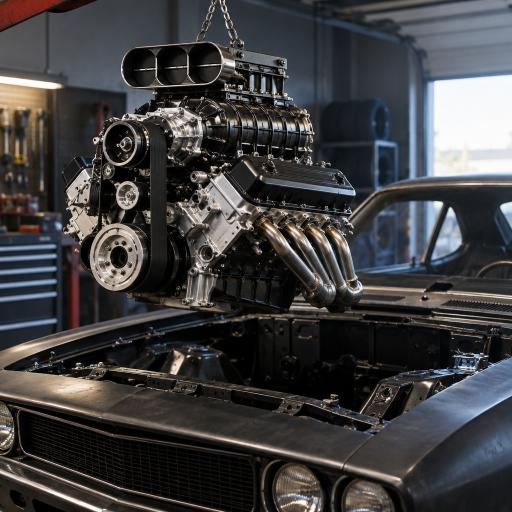
Fancy dropping this 1,200-hp supercharged V8 into your project car?
Crate engines are the lifeblood of custom-car culture, giving builders a complete, factory-assembled powerplant that is ready to install. Ford has pushed that concept to a new extreme with the Megazilla 2.0, which it describes as the most powerful crate engine offered by a mainstream manufacturer.
Rather than sourcing a worn engine from a salvage yard and spending months rebuilding it, enthusiasts can buy a factory-engineered package with known specifications and serious performance potential. For hot rods, restomods, drag cars and extreme off-road machines, that convenience can transform an ambitious project.
More than 1,200 horsepower
The Megazilla 2.0 is a supercharged 7.3-liter, or 445-cubic-inch, V8. Running on race fuel, it produces more than 1,200 horsepower and over 1,000 lb-ft (1,356 Nm) of peak torque.
Ford showcased the engine in the Frostwarden Bronco, a dramatic one-off concept inspired by Arctic search-and-rescue vehicles. Equipped with enormous 42-inch tires, the SUV was designed to demonstrate how the engine’s output could suit demanding off-road applications as well as straight-line performance builds.
Heavy-duty truck roots
The Megazilla family traces its origins to Ford’s cast-iron pushrod V8 developed for Super Duty trucks. That commercial foundation was adapted into the naturally aspirated Megazilla 1.0, which produces 612 horsepower and 670 lb-ft (908 Nm) of torque on premium pump fuel.
Creating the 2.0 version required much more than simply bolting on a supercharger. Ford revised the engine to cope with the additional heat, cylinder pressure and mechanical stress generated by nearly twice the horsepower.
Cooling passages machined between the cylinder bores improve thermal management. The bottom end uses six-bolt main caps, with four fasteners installed vertically and two entering from the sides. This arrangement helps keep the crankshaft stable under extreme loads.
High-strength racing head studs provide the clamping force needed to seal the combustion chambers under substantial boost. Internally, the engine receives forged pistons and a bespoke camshaft profile intended to maximize airflow and support its forced-induction setup.
A huge twin-screw supercharger
Air is supplied by a 3.0-liter Generation 6 twin-screw supercharger. It is driven by a heavy-duty 10-rib belt and supported by high-capacity fuel injectors capable of feeding the engine at full output.
The twin-screw design is particularly well suited to applications that require immediate torque. Unlike setups that need time or engine speed to build boost, this configuration can deliver strong low-end response alongside its massive peak output.
Taking aim at the Hellephant
The Megazilla 2.0 enters a crate-engine market that has evolved far beyond the traditional small-block V8. Lightweight, naturally aspirated engines remain popular, but factory-supercharged packages have raised expectations to four-figure horsepower levels.
One of its clearest rivals is Dodge’s 7.0-liter Hellephant, an aluminum-block supercharged V8 producing around 1,000 horsepower and 950 lb-ft (1,288 Nm) of torque. Ford’s new engine exceeds those figures, although it takes a different approach.
Instead of using aluminum to reduce weight, Ford retains a substantial cast-iron block. The trade-off is extra mass, but cast iron offers excellent rigidity when exposed to intense combustion pressures. That strength can help reduce cylinder-bore distortion in exceptionally demanding applications.
Combining 7.3 liters of displacement with a large supercharger also means the engine does not need to extract all of its performance from a smaller capacity and extreme boost alone. The result is an OEM-developed powerplant intended to tolerate the punishing loads associated with drag racing, heavy off-road vehicles and high-end custom builds.
Power will come at a price
Ford has not yet confirmed final pricing for the Megazilla 2.0. The naturally aspirated Megazilla 1.0 costs $25,295 in the US, so the more complex supercharged version is expected to exceed $35,000.
That would make it an expensive starting point for a project, before accounting for the transmission, cooling system, fuel delivery, electronics and chassis upgrades required to handle 1,200 horsepower. Even so, the prospect of buying this level of factory-tested performance in a ready-made package is likely to appeal to professional restomod shops, drag racers and builders of extreme off-road machines.
The larger challenge may not be finding a car for the Megazilla 2.0, but ensuring everything around it can survive the engine’s extraordinary output.