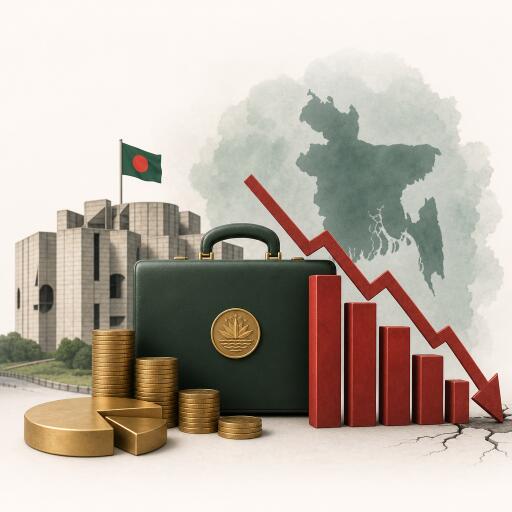
Tk 2.43 lakh crore budget deficit projected in FY27 | National Budget 2026-2027
The government has projected a budget deficit of Tk 2.43 lakh crore for the fiscal year 2026-27 (FY27), equivalent to 3.6 percent of GDP. Despite a planned scale-up in both social and infrastructure investment, the deficit-to-GDP ratio is set to remain at the same level as the previous fiscal year. Finance Minister Amir Khosru Mahmud Chowdhury presented the proposal in the Jatiya Sangsad on June 11, 2026, noting that the increased allocations will be financed through stronger domestic revenue mobilization backed by reforms.
The minister underscored that the recent depreciation of the Taka against foreign currencies has raised the cost of servicing external debt—both principal and interest—adding pressure to fiscal management. He also pointed to elevated debt servicing and interest expenditures stemming from heavy borrowing in past years, which has contributed to the higher deficit level in the proposed budget compared to earlier periods.
- Total projected deficit in FY27: Tk 2.43 lakh crore (3.6% of GDP).
- Domestic financing: Tk 1.27 lakh crore of the deficit.
- External financing: Tk 1.16 lakh crore of the deficit.
- Borrowing from the domestic banking system: Tk 112,000 crore in FY27, down from Tk 118,000 crore in FY26—a reduction of Tk 6,000 crore.
Providing context, the minister cited how the budget deficit has evolved over time: from 2.9 percent of GDP in FY2005-06 to 4.05 percent in FY2023-24. Against this backdrop, the FY27 plan aims to maintain the deficit ratio at last year’s level while prioritizing investment that supports growth and social outcomes.
To support the financing strategy without placing undue strain on the banking system, the proposal balances domestic and external borrowing, with a modest reduction in bank borrowing compared to the current fiscal year. This approach is intended to help contain crowding-out risks, stabilize liquidity conditions, and keep space for private sector credit growth.
The revenue strategy centers on strengthening tax policy and administration, expanding the tax base, and improving compliance through targeted reforms. The government plans to enhance debt management to optimize costs and risks, including careful sequencing of external and domestic borrowing. Public investment will be channeled toward high-return projects, backed by a modernized project implementation framework designed to reduce delays, curb cost overruns, and improve value for money.
According to the minister, these combined measures are expected to:
- Boost revenue collection and improve fiscal space;
- Ensure higher-quality public investment with stronger economic returns;
- Increase money circulation through the multiplier effect, energizing economic activity; and
- Gradually reduce the budget deficit over the medium term as growth and revenues strengthen.
Overall, the FY27 budget framework reflects a balancing act: protecting critical social and infrastructure spending while keeping the deficit stable relative to GDP. The authorities are banking on revenue reforms, prudent debt management, and better project execution to manage short-term pressures and place public finances on a more sustainable trajectory.