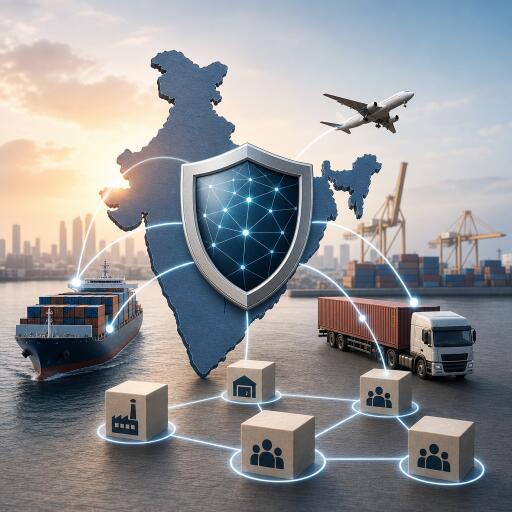
Indian firms boost supply chain resilience, diversify suppliers: Report
Indian businesses are stepping up efforts to fortify their supply chains by diversifying suppliers, building strategic inventories, and accelerating digital adoption, according to a new report by DP World. The findings, drawn from a survey of 451 senior supply-chain and logistics executives, indicate India is outpacing global peers in digitalisation and access to trade finance, while free trade agreements (FTAs) are seen as the top policy lever for future trade growth.
New Delhi, Aug 31
Resilience takes center stage
The report underscores that Indian firms place stronger emphasis on resilience than their global counterparts. Companies are actively redesigning sourcing strategies to mitigate disruptions and reduce dependency on single geographies.
- Supplier diversification is the leading priority for Indian companies.
- Inventory build-up ranks next, as firms maintain higher safety stocks to buffer shocks.
- Friend-shoring is gaining traction to balance cost, reliability, and geopolitical risk.
Alongside risk mitigation, businesses are pursuing growth through technology adoption and expansion into new markets, signaling a dual focus on stability and opportunity.
Digitalisation surges ahead
Indian businesses are moving faster than global peers to digitise operations and customer engagement. More than half of Indian firms have fully digitalised customer-facing services, compared with fewer than four in ten globally.
Artificial intelligence is already improving key logistics functions, including:
- Route optimisation to cut transit times and costs
- Digital documentation to reduce errors and delays
- Customs processing to enhance clearance efficiency
These advances are helping firms strengthen visibility, responsiveness, and cost control across supply chains.
Policy and finance: FTAs and capital access lead
Free trade agreements emerged as the top policy priority for unlocking future trade growth, cited by nearly half of surveyed executives. FTAs are viewed as essential for reducing trade barriers, improving market access, and enabling diversified sourcing.
Access to trade finance is another differentiator. In India, 57% of respondents reported reasonable availability of trade finance, compared with 39% globally—an advantage that supports working-capital needs, inventory strategies, and cross-border expansion.
The report also highlights the role of domestic initiatives such as the Production-Linked Incentive (PLI) scheme in bolstering local manufacturing, while expanding trade relationships create new sourcing and market opportunities.
Infrastructure priorities and multimodal shift
As trade volumes grow, logistics leaders are focusing on infrastructure that improves reliability and reduces bottlenecks. Nearly 46% of executives identified road networks as a priority, reflecting the need for last-mile connectivity and interstate efficiency.
At the same time, businesses are adopting multimodal strategies to optimise routes and costs, increasingly turning to rail and coastal shipping as part of integrated logistics solutions.
Executive perspective
“Diversified sourcing, strategic inventory, digitalisation and access to new markets are becoming increasingly important in navigating disruption,” said Rizwan Soomar, CEO & MD, Subcontinent, Central Asia, Levant and Egypt, DP World.
Why it matters
Supply chain resilience has evolved from a defensive posture to a competitive advantage. Indian companies are leveraging digital tools, diversified networks, and better financing to balance cost efficiency with reliability. As global trade corridors shift, these capabilities can help Indian businesses capture new demand while managing volatility.
Outlook
With continued investment in integrated infrastructure, stronger digital capabilities, and trade facilitation, India is well positioned to enhance business competitiveness and deepen participation across emerging trade routes. The combination of policy support, technology adoption, and diversified sourcing suggests India’s supply chains are becoming more agile, transparent, and future-ready.