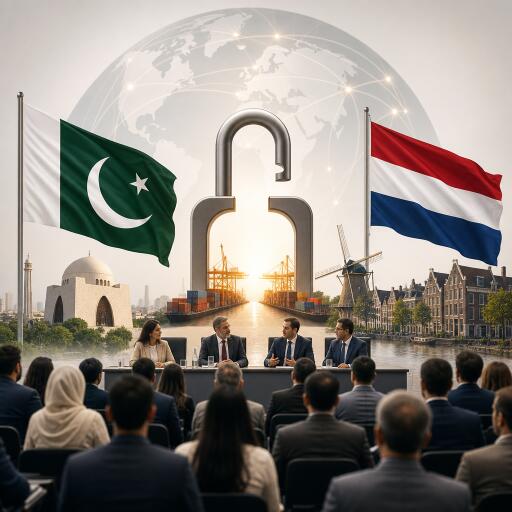
ICCI hosts seminar to unlock untapped Pakistan-Netherlands trade potential
The Islamabad Chamber of Commerce and Industry (ICCI) convened a seminar titled “Enhancing Bilateral Trade between Pakistan and the Kingdom of the Netherlands,” bringing together business leaders and entrepreneurs to chart practical pathways for deeper commercial ties. Speakers called for a sharper focus on innovation, value addition, technology transfer, and sustainability to unlock the vast, yet underutilized, potential in bilateral trade and investment.
Pakistan’s value proposition highlighted
Welcoming participants, ICCI President Sardar Tahir Mehmood underscored the Netherlands’ stature as a European hub for trade, logistics, agriculture, renewable energy, innovation, and advanced manufacturing. He noted that these strengths align well with Pakistan’s economic priorities and can serve as a springboard for mutually beneficial partnerships.
He emphasized that Pakistan seeks to elevate its longstanding relationship with the Netherlands by diversifying trade, promoting joint ventures, attracting Dutch capital, and accelerating technology transfer. Pakistan’s strategic location, population of over 240 million, youthful and skilled workforce, expanding IT ecosystem, competitive manufacturing base, and resilient agricultural sector were cited as compelling draws for foreign investors.
Sectors ripe for collaboration
- Agriculture and agri-technology, including smart seeds and precision farming
- Horticulture, dairy, and livestock development
- Food processing and value-added exports
- Value-added textiles and apparel
- Information technology and digital services
- Renewable energy and energy efficiency solutions
- Logistics, supply chain, and cold-chain infrastructure
- Healthcare, education, and skills development
- Water resource management, irrigation, and climate-resilient solutions
Dutch perspective: build on strong foundations
Addressing the seminar, Alexander Akerboom, First Secretary for Economic Affairs at the Embassy of the Kingdom of the Netherlands, noted that the Netherlands is already one of Pakistan’s leading partners within the European Union. He highlighted that the EU remains a major destination for Pakistani exports and that preferential market access has helped expand exports, support employment, and increase recognition of Pakistani products across European markets.
While acknowledging the solid base of cooperation, he pointed out that significant opportunities remain untapped. He encouraged Pakistani firms to pivot more decisively toward value-added textiles, as European buyers increasingly prioritize high-quality finished products over raw or semi-finished goods. He also identified agriculture, water management, climate-smart technologies, and information technology as priority avenues for future collaboration.
According to Akerboom, Dutch expertise in areas such as high-performance seeds, efficient irrigation, and modern water management can help Pakistan improve agricultural productivity and food security, while addressing climate-related pressures. Strengthening partnerships in these domains, he suggested, would yield immediate commercial benefits and longer-term developmental gains.
From potential to performance: next steps
Participants underscored the need for practical, business-led actions to convert opportunity into outcomes. Proposed measures included:
- Facilitating matchmaking and trade missions to connect exporters, distributors, investors, and technology partners
- Developing joint ventures in value-added textiles, food processing, and agri-tech
- Launching pilot projects in climate-smart agriculture, efficient irrigation, and water stewardship
- Promoting technology transfer, R&D collaboration, and skill-building programs to meet EU quality and sustainability standards
- Upgrading quality assurance, certification, and traceability to enhance market access in Europe
- Expanding logistics and cold-chain capacities to reduce post-harvest losses and improve export reliability
Shared goals, sustainable outcomes
The seminar concluded with a shared commitment to move beyond traditional trade patterns and build higher-value, innovation-driven linkages. By pairing Pakistan’s industrial and agricultural capabilities with Dutch know-how in technology, water, and sustainability, stakeholders agreed that both sides can accelerate growth, create jobs, and bolster resilience in a changing global economy.
ICCI reaffirmed its readiness to work closely with the Dutch business community and relevant institutions to translate dialogue into deliverables—creating a steady pipeline of projects, partnerships, and investments that can elevate Pakistan–Netherlands economic relations to the next level.