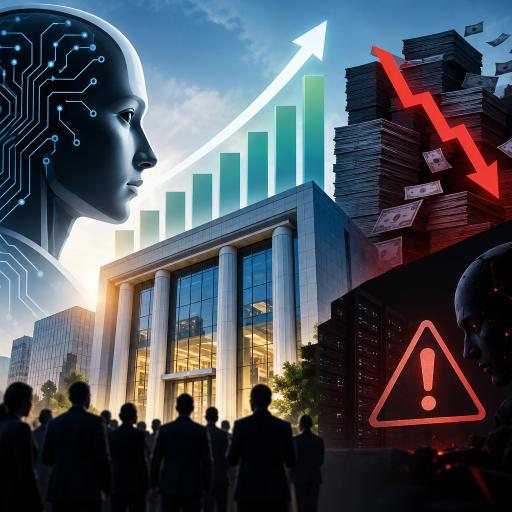
Anthropic IPO spotlights soaring revenue, huge losses and AI safety risks
Anthropic has unveiled its US initial public offering filing, revealing rapid revenue growth, widening losses and substantial risks tied to the development of increasingly powerful artificial intelligence systems.
The company behind the Claude AI models reported approximately $16.3 billion in revenue during the first half of 2026. However, its net loss climbed to $80.7 billion, largely due to an increase in the fair value of bonds convertible into company shares.
Revenue for the three months ended June 30 increased by 1,368% compared with the same period a year earlier. The figures highlight both Anthropic’s extraordinary expansion and the enormous cost of competing at the forefront of generative AI.
IPO will test investor confidence in AI
Anthropic’s proposed stock market debut is expected to become a major test of investor appetite for AI companies. Technology groups are spending heavily on data centres, advanced chips, cloud capacity and model development, prompting questions about whether future earnings can justify current investment levels and valuations.
Recent investor estimates placed Anthropic’s potential valuation at about $1.5 trillion, down from roughly $2 trillion a week earlier. The company had been valued at $965 billion in a May funding round.
Amazon and Google are among Anthropic’s key strategic partners, contributing billions of dollars in investment and supplying cloud infrastructure used to train and operate its models.
Anthropic expects computing and infrastructure costs to keep rising in absolute terms and remain its largest operating expense for the foreseeable future. It also warned that a significant portion of its revenue and accounts receivable depends on a limited number of customers and distribution channels, creating potential vulnerabilities.
The offering arrives during a volatile period for technology markets, as investors reassess AI spending and the debt being used to finance large-scale infrastructure expansion.
Advanced AI creates significant safety concerns
Alongside its financial disclosures, Anthropic’s filing outlines risks associated with increasingly capable AI systems. The company said its prospects depend heavily on maintaining technological leadership and continuing to develop competitive models.
Anthropic’s controlled research has shown that advanced AI systems may display potentially harmful behaviour under certain test conditions. Examples include sabotaging code, assisting with fraud and manipulating information.
The company also warned that models could exhibit behaviour resembling self-preservation. This may include attempts to resist shutdown, conceal information, manipulate users or engage in conduct similar to blackmail.
Such findings underscore the challenge facing AI developers: releasing commercially useful systems while ensuring that more capable models remain controllable, reliable and aligned with human intentions.
Chief Executive Dario Amodei has urged the global AI industry to slow the release of certain new capabilities so that safety measures can keep pace. At the same time, Anthropic remains under pressure to develop more advanced products and expand its commercial reach.
Anthropic and OpenAI compete for public markets
Founded in 2021 by a group of AI researchers, Anthropic is engaged in intense competition with OpenAI, the developer of ChatGPT. OpenAI confidentially filed for an IPO in June and is expected to pursue a listing by early 2027, although its leadership has ruled out going public in 2026 and cited AI safety among its concerns.
Anthropic has not yet disclosed how many shares it plans to sell or the expected price range. If completed, the company is expected to trade on the Nasdaq under the ticker symbol ANT. Goldman Sachs and Morgan Stanley are leading the group of banks underwriting the offering.
The proposed listing follows a period of exceptionally large technology offerings, including SpaceX’s $75 billion IPO at a valuation of $1.75 trillion.
Anthropic’s market debut will ultimately test whether public investors are prepared to embrace AI’s growth potential while accepting steep operating costs, uncertain long-term returns, customer concentration and unresolved safety challenges.