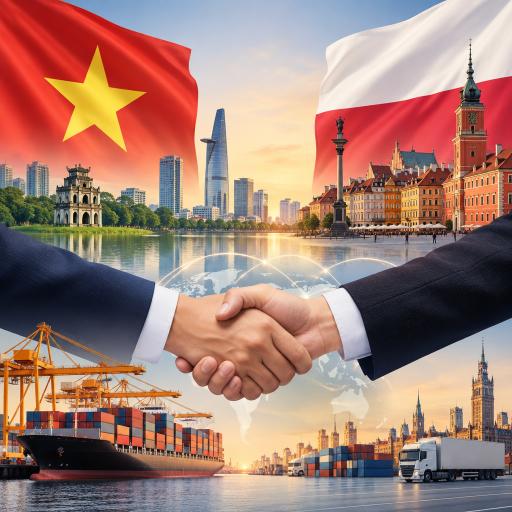
Việt Nam, Poland to turn strategic partnership into business opportunities
Việt Nam and Poland are working to deepen economic cooperation and raise bilateral trade to US$6 billion, with pharmaceuticals, defence, space technology and other high-tech industries emerging as promising areas for investment.
The priorities were discussed at the Việt Nam-Poland Business Roundtable attended by Vietnamese Prime Minister Lê Minh Hưng and Polish Prime Minister Donald Tusk.
The event followed the two countries’ decision to elevate bilateral relations to a Strategic Partnership. Hưng said the new framework reflected strong political trust, a shared vision and a determination to advance their longstanding friendship through practical programmes and projects.
Economic, trade and investment cooperation remains a key pillar of bilateral ties. Poland is Việt Nam’s largest trading partner in Central and Eastern Europe, with two-way trade approaching $3.5 billion in the first nine months of 2026, up 19 per cent from the same period a year earlier.
Hưng said Poland’s position in Central and Eastern Europe and Việt Nam’s role as a gateway to Southeast Asia create significant opportunities to connect markets, strengthen production networks, develop supply chains and expand investment.
Poland has expertise in pharmaceuticals, healthcare, defence, renewable energy, digital transformation, smart agriculture, railways, shipbuilding and environmental technology. Việt Nam offers strong processing capacity, an extensive seaport network, a large workforce and 18 free trade agreements covering more than 60 partners.
Combining these advantages could create more competitive production, supply and distribution chains, Hưng said. He added that the $6 billion trade target is achievable if governments and businesses coordinate effectively.
Investment tied to technology and sustainability
The Vietnamese prime minister encouraged Polish companies to explore investment opportunities aligned with Việt Nam’s sustainable development priorities. Projects should promote technology transfer, environmentally responsible growth and higher-value economic activity.
He also called on both countries to address obstacles related to policies, investment procedures, immigration, customs, standards and technical regulations. Stronger dialogue between companies and government agencies would help resolve difficulties and improve the business environment.
Polish enterprises were encouraged to bring Vietnamese businesses into their production and supply chains, train and employ local workers, and make long-term investments using modern, environmentally friendly technologies.
Hưng reaffirmed that the Vietnamese Government would continue supporting investors and creating favourable conditions for stable, effective and sustainable cooperation.
Poland highlights pharmaceuticals, defence and space
Tusk described the roundtable as an opportunity to identify concrete projects, investment prospects and long-term commercial partnerships. He called Việt Nam one of Asia’s most dynamic economies and an increasingly important part of global supply chains.
He noted that Việt Nam has made substantial economic progress, becoming a major export centre while seeking to build a modern technology base, promote innovation and increase the contribution of higher-value products.
Despite positive trade growth, Tusk said the structure of bilateral commerce remains unbalanced and two-way investment is still below the potential of both economies. He urged the two sides to diversify trade, develop new export opportunities and improve conditions for investors.
The EU-Vietnam Free Trade Agreement provides an important framework for closer economic ties. Within that framework, Poland sees considerable potential in pharmaceuticals and healthcare, defence and dual-use technology, the space industry and other advanced sectors.
Polish investment could help develop Việt Nam’s pharmaceutical industry through research, manufacturing and exports of medicines and medical products to regional markets. Such projects could create jobs, strengthen domestic capacity and improve access to modern technologies.
In defence and dual-use industries, Polish companies can provide unmanned aerial systems, communications equipment, electronics, optoelectronics and security solutions. Several of these technologies also have civilian uses, including transport management and critical infrastructure protection.
Poland is also developing satellite technology, optical systems, advanced software and data analytics, while Việt Nam is investing in its own satellite and space capabilities. Potential areas of cooperation include Earth observation, satellite data analysis and applications for agriculture, water management, environmental protection and infrastructure.
Tusk said combining space technology with artificial intelligence could generate further opportunities. He encouraged companies to move beyond simple technology supply arrangements and instead jointly develop products, strengthen technological capabilities and commercialise solutions in international markets.
Officials and business representatives also discussed cooperation in aviation, pharmaceuticals, defence and the space industry. Both governments expect future forums to produce new investments, joint industrial projects, commercial contracts and technologies developed collaboratively by Polish and Vietnamese companies.