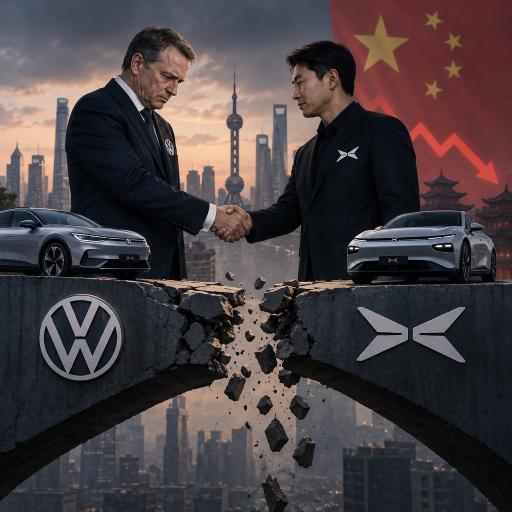
Volkswagen bet on Xpeng to save its China business. It’s not going to plan
Volkswagen’s partnership with Chinese electric vehicle maker Xpeng was supposed to help the German group develop competitive cars at the speed demanded by China’s fast-moving market. Instead, the alliance’s first model has highlighted how difficult Volkswagen’s recovery will be.
The ID. UNYX 08 electric SUV averaged only 267 sales per month between its April launch and August. Volkswagen had initially targeted monthly sales of 3,622 vehicles, according to internal planning documents.
The disappointing performance reflects a broader reversal for a company that dominated China’s car market for decades. China once generated nearly half of Volkswagen Group’s profits but now contributes about 10%, adding pressure to the largest restructuring in the automaker’s history.
A new SUV struggles to stand out
The UNYX 08 launched at approximately $34,260, placing it against technologically advanced Chinese SUVs. Comparable models offered features such as sophisticated sensors and faster charging, often with stronger brand momentum among younger buyers.
Between April and August, Xiaomi sold almost 57,000 YU7 SUVs, while Zeekr delivered more than 21,000 units of its 7X. Volkswagen sold only about 1,300 UNYX 08 vehicles during the same period.
Chinese consumers increasingly question the value of paying a premium for a foreign brand when domestic manufacturers offer more advanced technology at lower prices. Volkswagen’s development timelines have also left it vulnerable: designs that appeared competitive during planning can look familiar or outdated by the time they reach showrooms.
A limited dealer network
Distribution compounded the vehicle’s problems. Volkswagen mainly sold the UNYX 08 through a relatively new network operated by Volkswagen Anhui, its electric vehicle-focused business. It did not initially benefit from the full reach of the more than 3,000 dealerships connected to Volkswagen’s established joint ventures with FAW and SAIC.
Volkswagen Anhui expanded its network to 166 outlets and began working with selected FAW-Volkswagen dealerships. The company said sales across the UNYX range were growing, but the network’s smaller footprint meant many potential buyers had limited awareness of the new SUV.
Volkswagen also emphasized that its cooperation with Xpeng produced a new electric architecture for locally manufactured vehicles in only 18 months. That platform is intended to shorten development cycles and support future models, including the UNYX 09 sedan.
Another ambitious target
Despite the UNYX 08’s weak start, Volkswagen has set aggressive goals for the UNYX 09. Planning documents forecast average monthly sales of nearly 4,900 vehicles and annual volume exceeding 90,000 by 2034.
Such optimistic projections can be important when managers seek approval for new vehicles from Volkswagen’s headquarters in Wolfsburg. However, the targets for the UNYX 08 have already been revised sharply.
Volkswagen originally expected to sell 32,600 UNYX 08 vehicles through the end of 2026, followed by 70,400 the next year. It later reduced the 2026 projection by more than 60% to 12,300 units, while retaining a relatively ambitious forecast of 64,000 for 2027. The company has also advertised the SUV at a discount of about 17% from its launch price.
A history of partnerships and missed opportunities
Volkswagen had anticipated China’s transition to electric vehicles. In 2019, it said it was preparing nearly 40 locally produced electric and plug-in hybrid models and could deliver 1.5 million new-energy vehicles in China by 2025. It ultimately delivered only 115,500 battery-electric vehicles in the country last year.
As the market accelerated, Volkswagen considered or entered partnerships involving batteries, software, autonomous driving, charging infrastructure and other technologies. It also explored potential cooperation with major Chinese manufacturers including BYD and Leapmotor, but those discussions did not produce agreements.
Some ventures created additional difficulties. A planned flying-car project was canceled amid legal disputes, while a fast-charging partnership launched in 2020 became entangled in shareholder disagreements, litigation and complaints from suppliers.
The wider challenge affects many foreign automakers. Access to Chinese technology does not automatically provide the development speed, cost structure or consumer appeal achieved by local manufacturers. Companies such as BYD and Geely have gained market share by launching software-rich vehicles quickly and pricing them aggressively.
A rapidly contracting market
Volkswagen’s difficulties are unfolding as China’s auto industry faces slowing growth, shrinking margins and intense price competition. Management has warned employees that passenger-car sales could fall by about 20%, equivalent to approximately 4.5 million vehicles.
Industry profit margins have dropped to around 1.5%, while typical product cycles have shortened from seven years to roughly three. Some newly launched electric vehicles begin suffering steep sales declines after only three months, making long development schedules increasingly risky.
Volkswagen is now under pressure to adjust production capacity, simplify its operations and eliminate duplication among its Chinese brands and business units.
In 2019, Volkswagen accounted for about one in every five passenger cars sold in China. Its share fell to roughly 10% during the first eight months of the latest reported year.
The Xpeng alliance may still deliver faster technology development, but the UNYX 08 demonstrates that a modern platform alone is not enough. Volkswagen must also improve pricing, distribution, software and speed to regain relevance. Its greatest risk is that China’s market will continue changing faster than the company can reinvent itself.