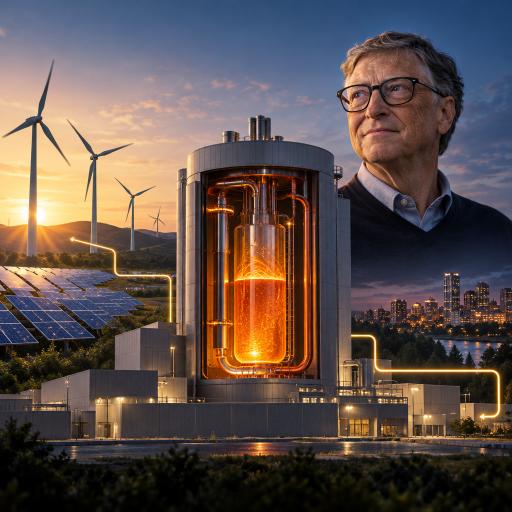
Bill Gates’s Molten-Sodium Reactor Could Give Wind and Solar a Nuclear Backup
TerraPower, the nuclear energy company founded by Bill Gates, is developing an advanced reactor designed to complement wind and solar power. Unlike most conventional nuclear plants, the proposed system would use liquid sodium as its coolant rather than pressurized water.
The choice has attracted attention because sodium reacts vigorously with water and can burn when exposed to air. However, its physical properties also offer potential engineering advantages when carefully managed inside a sealed reactor system.
How the reactor would work
Liquid sodium has a boiling point of roughly 1,616 degrees Fahrenheit. It can therefore operate at high temperatures without the extreme pressures required to prevent water from boiling in conventional reactors.
Lower operating pressure could simplify some equipment and reduce risks associated with high-pressure cooling systems. Sodium also transfers heat efficiently, making it useful for carrying energy away from the reactor core.
However, the coolant introduces different safety challenges. Designers must prevent it from contacting water or air, requiring specialized materials, monitoring systems, and containment measures.
A flexible source of nuclear power
The proposed plant is expected to generate about 345 megawatts during normal operation. When electricity demand rises, it could increase output to approximately 500 megawatts for more than five hours.
This flexibility would come from a thermal energy storage system. Heat produced by the reactor would be transferred to large tanks of molten salt, where it could be stored until additional electricity is needed. Although the reactor uses liquid sodium as its coolant, the energy-storage medium is molten salt.
When wind and solar generation falls because of changing weather or nighttime conditions, the plant could use its stored heat to generate more electricity. That could reduce the need to activate natural gas or coal plants during temporary renewable-energy shortfalls.
Supporting wind and solar power
Traditional nuclear plants are generally designed to provide a steady supply of electricity around the clock. TerraPower’s concept is intended to operate more flexibly, allowing the reactor and electricity-generating equipment to function somewhat independently.
The reactor could continue producing heat at a relatively stable rate while excess thermal energy is stored. The plant’s turbines could then draw on that reserve when demand increases or renewable output declines.
This approach is not intended to replace wind and solar. Instead, it could provide dependable, low-carbon power that helps balance a grid containing large amounts of weather-dependent generation.
Benefits and unresolved concerns
Advanced reactors could provide substantial amounts of electricity while producing relatively low greenhouse gas emissions during operation. A sodium-cooled design may also avoid some of the high-pressure equipment used in conventional nuclear facilities.
Nevertheless, it does not eliminate the broader challenges associated with nuclear power. Radioactive waste still requires secure long-term management, while new plants face strict regulatory requirements, lengthy development schedules, and potentially high construction costs.
Sodium itself must also be handled carefully because of its chemical reactivity. Safe operation depends on preventing leaks, detecting problems quickly, and keeping the coolant isolated from water and oxygen.
A different role for nuclear energy
TerraPower’s design represents a shift in how nuclear plants could serve the electrical grid. Rather than operating only as constant-output generators, future reactors might combine steady heat production with energy storage and adjustable electricity output.
If the technology performs as planned and can be built economically, it could give utilities another way to maintain reliable power while adding more renewable energy. Its success, however, will depend on demonstrating safety, controlling construction costs, securing fuel and components, and meeting regulatory standards.