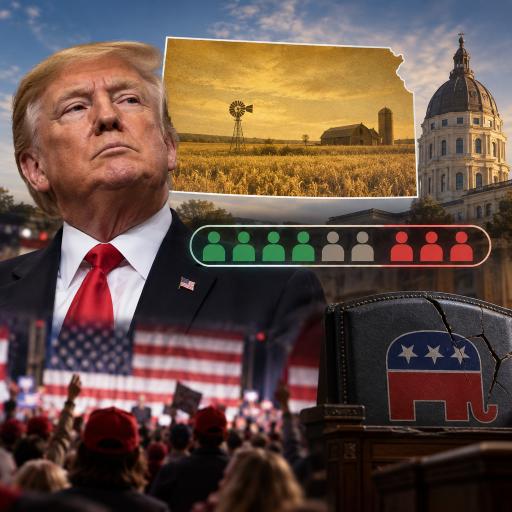
Trump’s Kansas approval rating ahead of rally as GOP Senate seat at risk
President Donald Trump is heading to Kansas for a campaign event near Wichita as Republican Senator Roger Marshall faces a close race against Democrat Adam Hamilton ahead of the November 3 election.
The contest has emerged as a potential Senate battleground despite Republicans having held both of Kansas’ Senate seats for decades. With the GOP’s 53-47 majority at stake nationally, both parties see the race as one that could help determine control of the chamber.
Trump has been campaigning across the country for Republican candidates, including those running in traditionally conservative states. Republicans hope his Kansas appearance will energize the party’s base and increase turnout for Marshall.
Marshall’s campaign described the election as a choice between a senator who has delivered for farmers, cut middle-class taxes and strengthened border security, and a Democrat supported by national party leaders. The campaign also welcomed Trump’s involvement, citing his ability to motivate Republican voters.
Trump’s approval rating in Kansas
Recent polls indicate that Trump’s approval rating is underwater in Kansas, even though he carried the state by approximately 16 percentage points in the 2024 presidential election.
A YouGov survey of 2,255 likely voters, conducted from September 24 to October 4, found that 46 percent approved of Trump’s performance and 53 percent disapproved. That gave him a net approval rating of minus 7 points. The poll had a margin of error of 3.2 percentage points.
A New York Times/Siena survey conducted from September 22 to 30 found Trump at 40 percent approval and 55 percent disapproval, producing a net rating of minus 15 points. The survey included 605 voters and had a margin of error of 4.6 percentage points.
An Emerson College poll of 750 likely voters produced similar findings. Forty percent approved of Trump, while 53 percent disapproved. The September 15-16 survey had a margin of error of 3.6 percentage points.
Marshall and Hamilton locked in close race
Polling suggests the Senate contest remains within the margin of error. YouGov showed Hamilton leading Marshall by 48 percent to 45 percent, while the New York Times/Siena survey placed both candidates at 45 percent.
Emerson College found Hamilton ahead by 45 percent to 43 percent. However, an InsiderAdvantage poll conducted October 13-14 showed Marshall narrowly leading, 48 percent to 47 percent. That survey included 1,200 likely voters and had a margin of error of 2.83 percentage points.
Hamilton, a prominent pastor in Kansas, has also posted a substantial fundraising advantage. He raised nearly $10 million during the third quarter of 2026, compared with less than $1 million raised by Marshall.
Republicans are counting on Kansas’ long-standing conservative lean to keep the seat in their column. Democrats last won a U.S. Senate election in the state in 1932, and Marshall defeated Democrat Barbara Bollier by more than 11 points in 2020.
Could Kansas become more competitive?
Although Kansas remains Republican at the federal level, its presidential margins have shifted over time. Trump won the state by about 20 points in 2016, 15 points in 2020 and 16 points in 2024. Republican presidential candidates had carried it by larger margins in several earlier elections.
Democratic gains in the Kansas City suburbs, particularly in Johnson County, have encouraged the party. Kansas voters have also elected Democratic Governor Laura Kelly twice, in 2018 and 2022. Even so, Republicans continue to hold a statewide advantage.
Economic concerns could affect the Senate race. Kansas’ large agricultural sector is especially sensitive to diesel prices because farmers depend on fuel for tractors, harvesters, irrigation equipment and transportation.
Diesel averaged about $6.07 per gallon in Kansas on Monday. That was below the previous month’s average of roughly $6.20 but far above the average of approximately $3.39 one year earlier. Higher fuel costs can increase expenses throughout the agricultural supply chain.
Prediction markets favor Marshall
Marshall remains the favorite in political prediction markets, with traders assigning him roughly a 61 to 63 percent chance of winning. That represents a notable decline from about 74 percent one month earlier.
Prediction-market prices reflect traders’ assessments based on polling, fundraising, campaign developments and broader political conditions. They indicate sentiment at a particular moment but do not guarantee an election result.
What happens next
Marshall and Hamilton will use the closing weeks of the campaign to mobilize supporters and persuade undecided voters. Major election forecasters classify the Kansas race as a toss-up, making turnout—and the effect of Trump’s rally—potentially decisive.