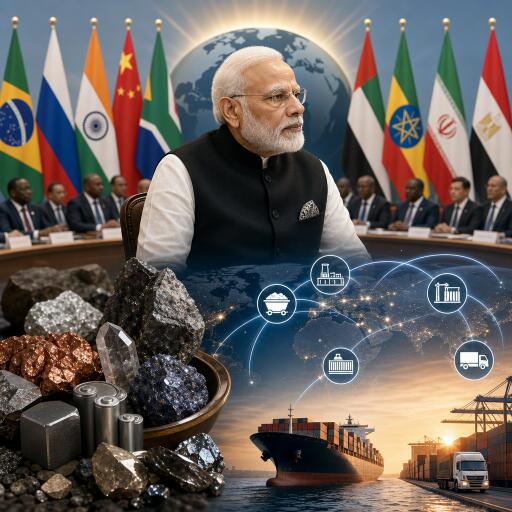
BRICS Summit 2026: PM Modi’s ‘critical minerals’ and ‘supply chain’ message on Day 2
On Day 2 of the BRICS Summit 2026, Prime Minister Narendra Modi underscored India’s focus on resilience, innovation, cooperation, and sustainability during its BRICS presidency. He described the term as a “win-win collaboration,” highlighting new efforts to bolster health preparedness, secure supply chains, and accelerate innovation across startups, digital agriculture, and MSMEs.
Four pillars shaping India’s BRICS chairmanship
PM Modi said India’s approach centered on four guiding pillars—resilience, innovation, cooperation, and sustainability—with the aim of translating a shared vision into practical outcomes. Emphasizing a whole-of-society approach, he noted that BRICS cooperation should not be limited to governments alone. Instead, it should actively involve entrepreneurs, farmers, researchers, women, youth, and everyday citizens to drive inclusive growth and meaningful impact across member countries.
Making supply chains reliable and resilient
Reinforcing the importance of economic security, PM Modi announced the BRICS Logistics Supply Chain Cooperation Framework, designed to enhance reliability and resilience across member economies. By improving logistics coordination and addressing bottlenecks, the framework aims to reduce vulnerabilities and ensure that essential goods and services move efficiently even under stress.
Backing startups and innovation at scale
To catalyze innovation, he highlighted two key initiatives:
- BRICS Incubator Network: A platform to connect startups with incubators across the bloc, facilitating mentorship, access to markets, and cross-border collaboration.
- Proposed BRICS Startup Innovation Fund: A dedicated vehicle to support scalable, tech-driven solutions that can address shared development challenges and unlock new growth opportunities.
Digital agriculture for farmers’ needs
PM Modi also outlined the BRICS Network on Digital Agriculture, which will harness AI, geospatial technology, and digital public infrastructure to deliver farmer-centric tools and services. From precision farming to better market access and advisory support, the initiative seeks to raise productivity, improve resilience to climate and price shocks, and expand rural opportunities.
Warning against weaponization of technology and minerals
Calling for equitable access to emerging technologies, PM Modi cautioned that the weaponization of technology and critical minerals could stall shared progress. He urged the grouping to foster inclusive, secure, and responsible technology adoption. “Weaponisation of critical minerals can be a hurdle to common growth,” he said, stressing the need for fair and predictable frameworks that support sustainable industrial transitions across the Global South.
Day 1 context: Reforming global governance
Setting the tone on Day 1 during the session on Inclusive Global Governance and Strengthening, PM Modi argued that while the Global South bears the brunt of global crises, it remains sidelined in decision-making. He proposed that BRICS drive reform with a focus on three priorities—Representation, Responsiveness, and Rule-making—so that international institutions better reflect today’s realities and serve broader human development goals.
He called for jointly preparing ten concrete proposals for global governance reform, to be developed into a BRICS Reform Roadmap by the next summit. The vision is to replace a “pyramid of privilege” with a “platform of partnership,” where every country has a voice and stake, and where outcomes are measured by their impact on people’s lives.
A broader, people-first BRICS agenda
Across both days, PM Modi’s message emphasized practical cooperation and inclusive growth. By strengthening health preparedness, fortifying supply chains, empowering startups, and deploying digital tools in agriculture, the agenda seeks to deliver near-term benefits while laying foundations for sustainable development. The call to avoid the politicization of critical resources and to democratize technology access reflects a broader push to make the global economic order more balanced, resilient, and fair.
As India’s presidency advances these initiatives, BRICS is being positioned not just as an intergovernmental forum, but as a community of innovators, producers, and citizens working together to turn shared aspirations into tangible outcomes.