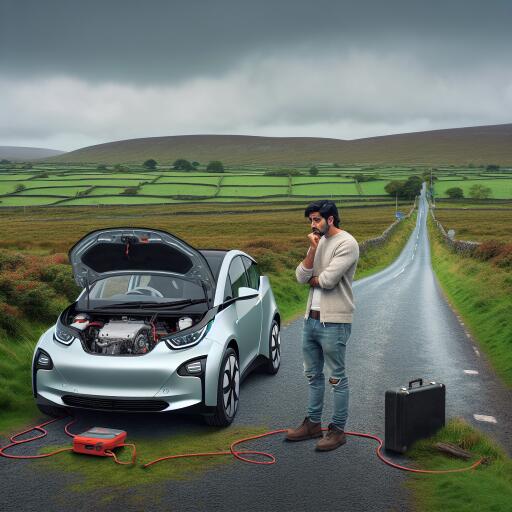
‘Stranded’ – Electric car driver left ‘in the middle of nowhere’ in Mayo after breakdown
A bank holiday escape along the Wild Atlantic Way turned into a 40-hour ordeal for an electric car driver in rural Mayo when a nearly new vehicle failed to start. Despite a manufacturer’s 24/7 “mobility guarantee” that promises to keep drivers moving with on-the-spot fixes, towing, hire cars and even accommodation, the support that followed fell far short of expectations.
Breakdown in remote Mayo
The incident began on a Sunday morning in west Mayo when the driver’s 10-month-old Volkswagen ID.3 refused to start. While the electrics, heating and radio still worked, the car itself would not engage. The location, south of Belmullet, posed an immediate challenge: the nearest large towns such as Ballina and Castlebar were more than an hour away, and Westport even further.
With the car stranded and local garages unwilling to handle electric vehicles, the owner turned to the brand’s roadside assistance line, which is operated by the AA. The initial response suggested a technician could arrive within 90 minutes and possibly fix the problem at the roadside.
Help that never arrived
The situation deteriorated quickly. Within an hour, the plan for an on-the-spot repair was dropped and a tow truck was deemed necessary. Later, the driver was told no tow would be available that day. When asking how the mobility guarantee would apply, the options offered were impractical for the location and time.
A rental car was proposed, but only from Knock Airport—117 km away—with the rental desk due to close within 90 minutes, a window that simply wasn’t achievable from Belmullet. No taxi to reach the depot was arranged, and no accommodation was offered. With worsening weather and no immediate solution, the driver described feeling completely abandoned: no fix, no tow, no taxi, no rental car and no shelter arranged.
The reality of rural infrastructure compounded the problem. Independent local garages were reluctant to touch an EV, and the distance to major service hubs made same-day support unlikely. The driver later reflected that without local contacts for shelter, the outcome could have been even more precarious.
A long route home
With no workable assistance in sight that day, the driver organized a multi-leg journey home the following morning: a lift to a nearby bus stop, a bus to Ballina, then a train to Dublin, followed by a taxi across the city. It was possible—but a world away from the promise of guaranteed mobility.
Slow recovery and apology
The ID.3 was eventually towed to a Volkswagen garage in Ballina on Tuesday evening, more than 48 hours after the breakdown. Even then, the diagnosis took another week amid confusion about which technician was qualified to assess the fault.
After the driver raised the experience with Volkswagen, the company issued an apology, acknowledging that the service delivered fell below its daily standards. The carmaker said the case was under investigation and that changes had been implemented to ensure 24/7 access to replacement vehicles through its breakdown partner, the AA. The driver, however, remained skeptical that such comprehensive support would truly be available at all hours in remote areas.
A caution for rural EV trips
The driver emphasized that this was not an indictment of electric vehicles in general—he still drives an EV and has no desire to return to petrol or diesel. But the episode highlights a potential gap between advertised mobility assurances and real-world delivery in rural Ireland, especially on weekends and bank holidays.
Large parts of the country—Mayo, Donegal, Kerry, much of Cork, Tipperary, Roscommon, Clare and other sparsely populated regions—can be 50 to 60 kilometres or more from the nearest dealer or rental location. Drivers tempted by ads to take their efficient, comfortable EVs on scenic bank holiday road trips may find that if something goes wrong, help could be hours—or days—away.
While Volkswagen says procedures have now been strengthened, this case serves as a reminder to EV owners planning rural journeys to double-check the practical details behind “mobility guarantees”: where the nearest tow and repair services are located, how replacement cars are sourced outside major towns, and what happens if a breakdown occurs late on a Sunday. For one driver in Mayo, the answers came too late—after a weekend break turned into a prolonged test of patience.