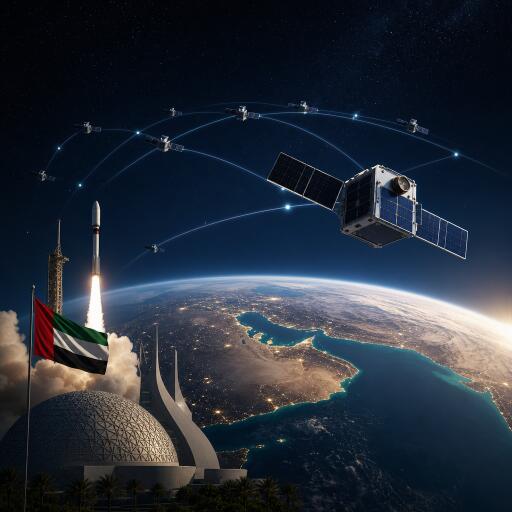
The UAE is putting a homegrown satellite constellation into orbit
The United Arab Emirates has rapidly expanded its off-planet ambitions, from flying astronauts to reaching Mars. Now it is taking a major step toward sovereign space capability with a homegrown commercial satellite constellation designed and built in Abu Dhabi.
Altair: AI-enabled, built in the UAE
Abu Dhabi-based Orbitworks is developing AI-enabled satellites that will form a 10-satellite Earth observation constellation called Altair. Built for uses ranging from environmental monitoring to defense and security, Altair’s first satellite is slated to launch in October. Orbitworks is a joint venture between Abu Dhabi’s Marlan Space and Loft Orbital.
Instead of downlinking vast volumes of raw imagery and sensor data for processing on the ground—a workflow that can take hours or longer—Altair satellites will process data in orbit using onboard AI. The goal is to deliver actionable insights to users almost instantaneously, narrowing the gap between data capture and decision-making. As one industry expert put it, virtually every serious satellite operator is now working to put AI on the spacecraft itself.
To make access more affordable, Orbitworks plans to offer Altair under a “constellation-as-a-service” model. Rather than each customer building and operating its own satellites, businesses, governments, and researchers can lease capacity and capabilities from the shared network. This approach aims to open advanced Earth observation to a broader set of users who might otherwise be priced out.
Scaling up manufacturing at home
Orbitworks is positioning itself as a manufacturer as well as an operator. Its 50,000-square-foot facility in Abu Dhabi is designed to produce up to 50 satellites per year, each weighing as much as 500 kilograms. The company says it is in discussions with prospective customers interested in leveraging this manufacturing capability, potentially making the UAE a regional hub for spacecraft production.
Leadership sees international partnerships as a way to attract global customers while keeping core capabilities domestic. While competitive offers from various markets were considered, the joint venture aims to balance cost, technology sharing, and market access in favor of building a sustainable UAE-led ecosystem.
Why sovereign constellations matter now
Around the world, countries are building or expanding sovereign satellite networks to reduce reliance on foreign providers and to safeguard national interests. SpaceX currently accounts for a dominant share of active satellites—about 69 percent by some industry estimates—while nations such as Canada and blocs like the European Union are advancing their own large-scale constellations.
Orbitworks frames Altair as a contribution to the UAE’s sovereign space capability, enabling the country to own critical data streams and to anchor high-value services domestically. This aligns with a broader pivot from primarily buying satellites and expertise abroad to nurturing a market-driven local ecosystem.
A fast-growing space economy
The global space market was estimated at roughly $224 billion in 2024, driven largely by satellite communications and Earth observation. In the Middle East and Africa, the market stood near $18 billion, with the UAE contributing an estimated 40 to 45 percent. Nationally, the UAE aims to double space-economy revenues and rank among the world’s top 10 space economies by 2031 as part of a post-oil diversification strategy.
Falling launch costs and the rise of AI are accelerating new commercial use cases—from monitoring critical infrastructure and supply chains to disaster response and climate tracking. The UAE has invested heavily to capture these opportunities, establishing space-focused institutions, a clear regulatory framework for commercial activity, and substantial funding mechanisms. A 3 billion UAE dirham National Space Fund is fostering cooperation between international and Emirati companies to build local know-how.
Even as the country pursues marquee missions—such as a planned journey to the asteroid belt in 2028—it has increasingly emphasized building sovereign space security infrastructure and commercial technologies with near-term economic impact.
Early customers and what comes next
Initial users are already lining up to tap Altair’s capabilities. The Abu Dhabi Maritime Academy plans to use real-time intelligence for port management and vessel traffic awareness. The Abu Dhabi Fund for Development intends to monitor projects remotely, improving transparency and efficiency. Orbitworks also cites participation from the French Space Agency—an endorsement the company sees as a sign of the UAE’s shift from a buyer of space services to a provider.
Looking ahead, Orbitworks is exploring funding for a major expansion that could add another 40 satellites to orbit, scaling Altair into a far more capable constellation. The company argues that combining in-country manufacturing, AI-enabled spacecraft, and an accessible service model will help the UAE capture a larger share of the growing space economy while reinforcing national resilience.
With Altair, the UAE is moving beyond high-profile missions to build enduring infrastructure in space—designed, assembled, and increasingly operated at home. If successful, this constellation could mark a new phase in the country’s space journey, where sovereign capability and commercial opportunity advance together.