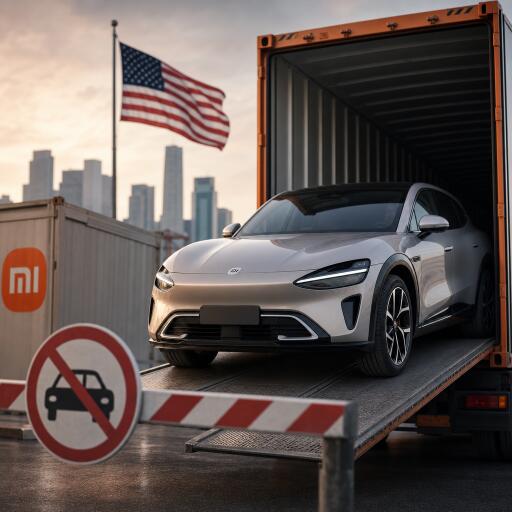
Xiaomi begins delivering an SUV U.S. buyers cannot legally get
Most car shopping comes down to budget. Lately, for many Americans, it also comes down to permission.
Four years of price creep have pushed family haulers out of reach. In August, the average new vehicle sold for about $50,089, and the midsize SUVs most households actually shop averaged roughly $50,315. Meanwhile, the family-friendly, three-row setup many people want—a vehicle that runs on electricity for weekday life but has gasoline backup for long trips—remains rare in the U.S. at a true family price. The closest mainstream answers here are full-size pickups averaging around $67,446, or electric SUVs that ask you to plan holidays around charging.
In China, that “what if” just showed up in driveways.
Meet the Xiaomi Skynomad
Xiaomi has begun deliveries of its Skynomad extended-range SUV lineup across dozens of Chinese cities, with prices starting at 209,900 yuan—about $31,300.
The Skynomad spans two sizes across four trims: the five-seat N70 and the larger N90, which offers a seven-seat layout and an outdoorsy Explorer Edition. Every version uses a 1.5-liter turbocharged gasoline range extender rated at 150 horsepower. It doesn’t drive the wheels; it feeds the battery, which drives the motors. With a full tank and full battery, combined range is quoted between 1,351 and 1,705 kilometers (about 840 to 1,060 miles).
Where it gets eye-opening is the standard kit. A roof-mounted lidar unit and high-compute driver-assistance hardware—headlined by a 700 TOPS chip—are included on every trim, enabling assisted driving on highways and in city traffic. Air suspension is standard on all but the base model. The front seats can swivel 180 degrees for lounge mode, and the top N90 can deploy an electric roof tent. Xiaomi sums it up as an SUV shape with an MPV-style cabin.
Sticker snapshot
- Skynomad N70 Pro (China): ~209,900 yuan (about $31,300)
- Skynomad N90 Max seven-seater (China): ~299,900 yuan (about $44,100)
- Average new midsize SUV in the U.S.: ~$50,315 (August)
- Average new EV in the U.S.: ~$54,813 (August)
Why U.S. buyers won’t get one
Tariffs are the first barrier most people think of. Chinese-built passenger vehicles face significant import duties, and separate measures target electric vehicles. The Skynomad’s extended-range setup complicates its classification, but that debate is increasingly beside the point.
A federal rule set to take effect for the 2027 model year bars “connected vehicles” from manufacturers owned by, or subject to the direction of, certain foreign governments. The concern centers on data, software, and communications systems in modern cars and the potential national security risks they pose. Under this rule, a company’s ownership—not where a specific car is assembled—drives eligibility. In practice, that closes the U.S. door to connected vehicles from Chinese-owned automakers, even if they were theoretically built on American soil.
The $31,300 question
At first glance, the Skynomad’s pricing looks like a manufacturing miracle. The context suggests something more strategic. Xiaomi’s smart EV and related initiatives have been operating at a loss as the company scales up, with margins compressing year over year even as deliveries grew strongly in the latest reported quarter. Then came further price aggression: launch stickers landed roughly 20,000 to 30,000 yuan below earlier presale figures—cuts in the 8% to 10% range—followed by an immediate surge of orders.
Xiaomi is a late entrant into China’s extended-range SUV arena, which is already crowded with established players and where the segment’s share has been slipping as pure EVs improve. That makes a compelling initial price less about fat factory efficiency and more about customer acquisition at scale—tuition, not profit.
Put differently: the wall protecting U.S. automakers isn’t just holding back cheap metal; it’s holding back a competitor willing to accept thinner per-vehicle economics to win households.
What this means for your next family SUV
No one in the U.S. is swapping a Highlander for a Skynomad next weekend. The pressure lands on the vehicles you can buy. When a $31,300 family SUV ships standard with lidar, high-compute driver assistance, and near four-figure combined range, it shifts expectations for what “well-equipped” looks like—globally.
Detroit and its rivals are already responding. Development roadmaps for lower-cost EVs and hybrids increasingly benchmark against Chinese cost structures rather than against premium EV leaders. The specification floor is moving: features once locked behind high trims or pricey option packages—advanced sensors, powerful onboard computing, air suspension, multipurpose interiors—are becoming table stakes elsewhere.
The number to watch isn’t just the sticker; it’s time. Xiaomi has been building cars for only a handful of years. If it can scale Skynomad volume while stabilizing margins, the playbook becomes clear: iterate fast, price hard, and let software and ecosystems do heavy lifting on value. That raises the bar for everyone—whether or not these specific vehicles ever clear U.S. customs.
Bottom line
Xiaomi’s Skynomad is the family hauler many American shoppers describe: three rows, electric-first daily driving, gasoline for the road trip, long range, and a tech-forward interior—at a price that undercuts most midsize SUVs sold in the U.S. It won’t be sold here under current rules, but its arrival matters anyway. It’s a live demonstration of how quickly the definition of “affordable and loaded” is evolving—and how fiercely global automakers will have to compete to keep up.