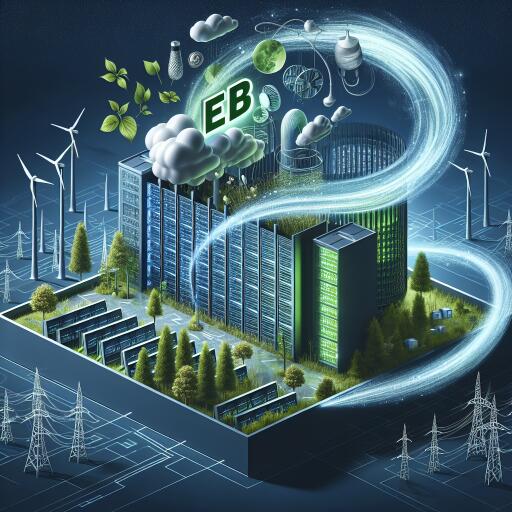
EDB Offers New Paradigm to Slash Data Center Emissions
EDB has introduced a suite of validated performance efficiencies within EDB Postgres AI (EDB PG AI) aimed at sharply reducing data center power consumption, cutting token usage, and establishing a new benchmark for “intelligence per watt” across enterprise AI deployments.
While AI energy discussions often focus on models and GPUs, EDB emphasizes the overlooked power draw at the data layer—the foundation every agent, model, and inference call depends on. According to the company, enterprises have limited control over model-side consumption, but they can meaningfully influence energy use and performance by optimizing data-layer operations.
A Two-Front Strategy for Efficiency
Infrastructure footprint: EDB PG AI helps reduce the number of servers and cores required to run enterprise applications. By consolidating and streamlining the database layer, organizations can lower overall data center power usage and decrease associated emissions.
Workload efficiency: The platform targets one of the most underappreciated drivers of AI energy cost—intensive data-layer tasks performed by autonomous and agentic systems. As agents continually create databases, adapt queries, and move data around the clock, the energy impact grows. EDB focuses on making search, retrieval, and vector indexing more efficient, recognizing that building and maintaining vector indexes is among the most resource-heavy activities in modern databases and scales directly with the number of agents in production.
Defining “Intelligence per Watt”
To help enterprises operationalize AI efficiency at scale, EDB PG AI introduces an “intelligence per watt” standard. This approach measures and improves how effectively infrastructure is used per unit of energy as autonomous systems generate more databases, pipelines, and queries over time. It reframes efficiency not only as an environmental priority but also as a core performance metric.
Three Principles at the Core
- Measure: Quantify energy and infrastructure cost per unit of AI output, extending validated methodologies to agentic, retrieval-augmented generation (RAG), and multi-agent workloads.
- Optimize: Reduce compute, storage, and network demand per AI operation via database consolidation, storage tiering, query acceleration, smarter vector indexing strategies, and token reduction.
- Govern: Maintain visibility and control over data-layer operations as autonomous agents rapidly create databases, indexes, pipelines, and queries, ensuring efficient and compliant behavior at machine speed.
Why It Matters for Enterprises
EDB reports that organizations prioritizing energy‑efficient data infrastructure are far more likely to achieve superior AI outcomes and stronger ROI. By demanding greater efficiency from the data layer, these companies maximize both performance and sustainability. In this view, “intelligence per watt” becomes a leading indicator of AI maturity—tying infrastructure decisions directly to business impact.
What Organizations Can Expect
- Lower server counts and core usage, reducing data center power draw and emissions.
- Reduced token consumption and network overhead for AI workloads.
- Faster search and retrieval, alongside leaner and more maintainable vector indexes.
- Consolidated databases and smarter storage tiers to optimize cost and performance.
- Stronger governance and observability across agent-driven data operations.
As agentic AI scales, the data layer becomes a decisive lever for energy and cost control. EDB PG AI concentrates on that lever—shrinking infrastructure needs, streamlining the most energy‑intensive data operations, and helping enterprises measure and improve intelligence delivered per watt. The result is a practical path to lower emissions and higher return on AI investments without compromising capability.