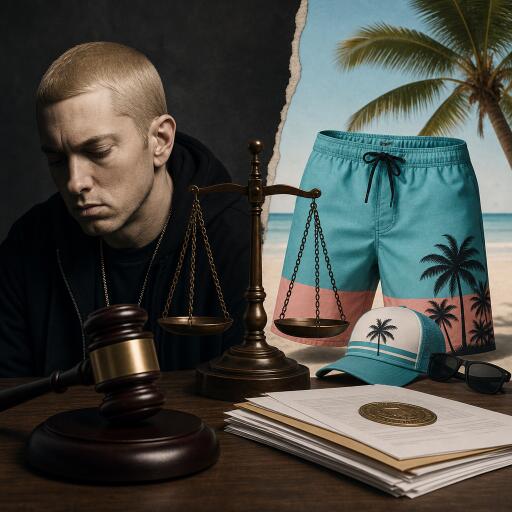
Eminem Loses Trademark Battle in Australia to Beachwear Brand Swim Shady, Ordered to Pay Company’s Legal Costs
Rapper Eminem has lost a trademark dispute in Australia against Swim Shady, a Sydney-based beachwear company, after the Australian Registrar of Trade Marks found he had not shown sufficient commercial use of his “Shady” branding in several merchandise categories. As part of the decision, Eminem’s team has been ordered to pay the company’s legal costs.
The ruling, handed down on July 1, determined that the “Shady” and “Shady Limited” trademarks were not used in Australia on clothing, footwear, headwear, bags, or leather goods during the relevant period. Eminem’s team submitted evidence such as tour merchandise, online sales figures, and social posts, but the adjudicator concluded that most references to “Shady” were tied to his performance identity and music persona rather than functioning as standalone trademarks for physical merchandise in the Australian market.
Only a small number of Australian sales were documented, and those occurred after the evidentiary window had closed. As a result, protection for the affected merchandise categories is set to lapse on August 1, unless the decision is overturned on appeal. Eminem retains rights to “Shady” for other categories, including music, entertainment, and electronics-related goods and services.
Trademark adjudicator Benjamin Goldsworthy acknowledged the strength of Eminem’s association with the Shady brand as a performer, but concluded that the level of proven use on the registered goods was relatively low. The decision emphasizes the distinction between branding connected to an artist’s identity and the commercial use required to maintain trademark protection on specific goods in a given market.
Swim Shady, founded in late 2024 by Jeremy Scott and Elizabeth Afrakoff, sells beach umbrellas, canopies, towels, swim bags, and shorts through more than 50 retail locations across Australia. The company’s trademark application was accepted in August 2025. Eminem’s team formally opposed the application two months later, arguing that “Swim Shady” was highly similar to his long-running alter ego, Slim Shady, and might mislead consumers into believing an affiliation existed.
Timing played a key role in the outcome. Although Eminem has held Australian trademark registrations for “Shady” and “Shady Limited” since 2002, his separate Australian application for “Slim Shady” was not filed until January 2025—after Swim Shady had launched and begun trading. This sequencing undercut arguments that the beachwear brand’s name would be confused with a previously registered “Slim Shady” mark in Australia.
Following the decision, Swim Shady co-founder Jeremy Scott said he and Afrakoff were pleased with the outcome and grateful for the careful review of the evidence. He described the ruling as an important milestone for the company while noting that further trademark proceedings remain.
Scott has previously characterized the dispute as a mismatch between a small startup and a global superstar, saying the company followed proper legal channels from the outset and felt compelled to defend its brand. “Defending Swim Shady has always been the only option for us,” the founders said in an earlier statement.
Eminem’s representatives have until July 22 to file an appeal, and it is not yet clear whether they will do so. The Australian action is just one part of a broader, multinational dispute. The artist has challenged Swim Shady’s trademark filings in several jurisdictions, including the United States, the United Kingdom, and Japan. In the U.S., Swim Shady secured registration in September 2025, and Eminem’s team subsequently initiated a cancellation proceeding that remains ongoing separately from the Australian matter.
Legal observers note that the Australian decision underscores a core principle of trademark law: registered marks must be actively used and commercially controlled in the relevant categories to retain protection. Jurisdictions such as the United Kingdom and Japan generally operate on a first-to-file basis, but even in those systems, rights can be revoked if a mark is not used over time, a process often referred to as cancellation for non-use or abandonment. While Eminem’s extensive “Shady”-branded merchandise in the United States may bolster his domestic position, comparatively limited activity tied to physical goods in other countries can leave marks vulnerable to challenge abroad.
For now, the ruling is a notable victory for Swim Shady, allowing the company to continue trading under its existing name and branding in the categories affected by the decision in Australia. The wider international disputes between the parties continue to unfold across multiple jurisdictions.