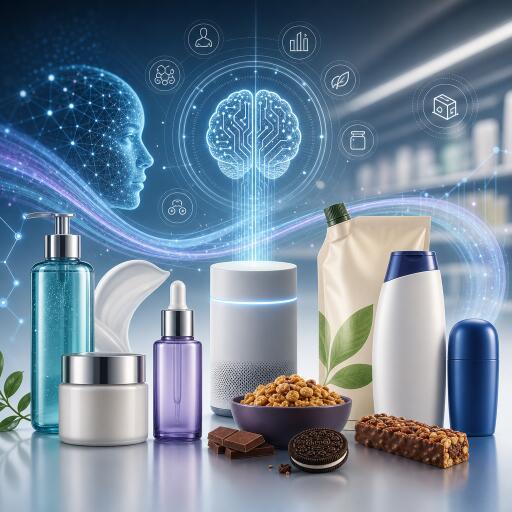
AI Transforms Consumer Products as L’Oreal, Nestle, Unilever and Mondelez Accelerate Innovation
Artificial intelligence is rapidly reshaping the consumer goods industry, enabling companies to develop products faster, improve formulations, reduce costs, and respond more quickly to shifting consumer preferences. Global brands including L’Oreal, Nestle, Haleon, Unilever, and Mondelez are increasingly integrating AI into research, product development, manufacturing, marketing, and supply chain operations to gain a competitive edge in a challenging market.
L’Oreal: Faster Beauty Innovation with AI
L’Oreal has emerged as a leading adopter of AI in beauty and personal care. The company uses machine learning to identify skincare molecules that can be repurposed for shampoos and to predict how ingredients will affect skin and hair before physical testing begins. This approach has helped speed up development timelines and reduce trial-and-error in the lab.
According to the company’s leadership, AI has enabled L’Oreal to create new products up to four times faster than before. Recent innovations include collagen-based shampoos designed to improve hair volume, reflecting how data-driven insights can translate into targeted consumer benefits.
L’Oreal’s AI transformation began about four years ago and has become integral to its research laboratories, aligning with a broader strategy to accelerate innovation and sharpen product-market fit. The company reported 2025 sales of €44.05 billion, an operating margin of 20.2 percent, and net cash flow of €7.2 billion—figures that underscore its capacity to invest in advanced capabilities.
Looking ahead, L’Oreal plans a ₹3,500 crore (€350 million) investment by 2030 in its Hyderabad beauty-tech Global Capability Centre, creating 2,000 roles across AI, engineering, and data science as it deepens its digital and research footprint.
Mondelez: AI-Generated Recipes and Quicker Launches
Food and snack manufacturers are also embracing AI to shorten product development cycles and fine-tune formulations. Mondelez International, owner of brands such as Cadbury and Chips Ahoy, uses AI to generate and evaluate new recipes, optimize ingredient combinations, and improve nutritional profiles—while also lowering production costs and strengthening supply chain resilience.
The company has already introduced AI-assisted products, including a gluten-free Golden Oreo, showing how machine learning can support both innovation and healthier offerings. Mondelez reports that AI is compressing research and development timelines significantly: processes that once took months can be completed in weeks, and projects that previously required years now finish within months. The company also notes that 60 percent of AI-generated biscuit recipes outperform conventional recipes on metrics like nutrition, sustainability, and production costs.
Nestle and Haleon: Scaling AI Across the Value Chain
Nestle has identified AI as a core pillar of its digital transformation, expanding deployment across research and development, manufacturing, supply chain management, sourcing, marketing, and cybersecurity. The objective is to raise productivity and accelerate innovation across global operations.
Haleon is similarly scaling AI across product development and business functions. Use cases include formulation optimization, demand forecasting, and process improvements that help bring products to market faster and with greater consistency and quality.
Unilever: AI in R&D, Factories, and Marketing
Unilever has made AI a central part of its business transformation, embedding it across product innovation, marketing, manufacturing, supply chain, and consumer insights. In product development, AI and machine learning help analyze consumer trends, identify new opportunities, and speed up formulation. The company reports that consumer insight generation is 60 percent faster, the time from concept to R&D brief has dropped from months to days, formulation cycles have fallen from five or six rounds to one or two, and claims generation is 75 percent faster.
Manufacturing is another major focus. Unilever is expanding AI-powered digital twins with more than 40 deployments planned over 18 months. Early results include a 10 percent increase in deodorant production capacity in the United States, nearly 30 percent less waste in mayonnaise production in Poland, and improved energy efficiency at its Haldia factory in India.
Unilever is also investing in AI-enabled marketing and commerce. Through a multi-year partnership aimed at building an AI-first digital backbone, the company is advancing agentic commerce, marketing intelligence, enterprise data platforms, and faster decision-making. In digital marketing, generative AI and digital twins are enabling creative production at scale—now thousands of assets are produced weekly, compared with only single digits over several months previously. AI-supported campaigns have generated strong consumer engagement, including billions of social media impressions for a major product launch and a significant share of new customers.
The Bigger Picture: Investment and Impact
The investment environment for AI is robust, with global private funding for artificial intelligence reaching hundreds of billions of dollars in 2024 and growing strongly year over year. A substantial portion of this capital is flowing into generative AI. Industry research indicates that many AI-leading companies allocate more than 20 percent of their digital technology budgets to AI initiatives—evidence that artificial intelligence has moved from experiment to core enterprise capability.
Across the consumer goods sector, companies are moving beyond traditional research methods toward data-driven product design and agile development. AI is helping teams iterate faster, improve sustainability and quality, reduce costs, and respond swiftly to changing preferences. From shampoos and cosmetics to snacks and healthcare products, artificial intelligence is reshaping how everyday goods are conceived, formulated, manufactured, and brought to market—accelerating innovation while elevating performance across the value chain.