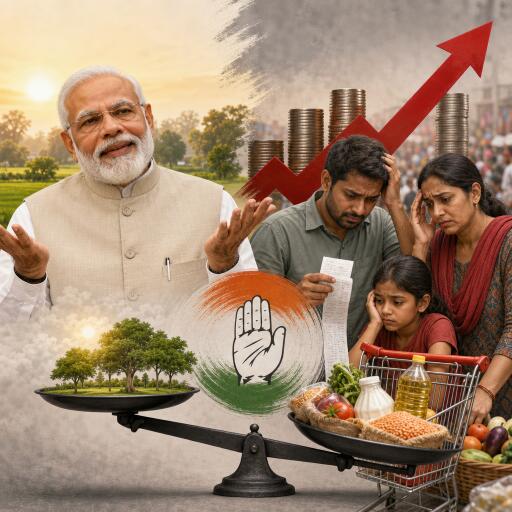
PM Modi keeps saying ‘Sab Changa Si’, but actually ‘Sab Mehanga Si’: Congress jabs Centre over inflation
Congress leader Jairam Ramesh on Monday accused the Centre of downplaying economic distress, asserting that while Prime Minister Narendra Modi projects that “all is well,” households are grappling with rising prices and stagnant or falling incomes. Playing on a popular phrase, Ramesh said, “The PM keeps saying सब चंगा सी (all is well), but actually सब महँगा सी (everything is expensive).”
Ramesh pointed to official inflation trends to underscore the squeeze on family budgets. He noted that Wholesale Price Index (WPI) inflation has hovered around the 10% mark for four consecutive months, keeping essential commodity prices elevated and intensifying the strain on crores of households. According to him, the persistence of high wholesale inflation shows that cost pressures are entrenched across key sectors.
He also cited data from the Centre for Monitoring Indian Economy (CMIE) to highlight the erosion of purchasing power. Inflation-adjusted wages have fallen by about 5.7% since April, he said, with rural India facing the sharpest setback. Rural wages, he added, have dropped by around 9% in real terms—and even nominal wages in rural areas have declined—compounding the hardship for households already dealing with higher living costs.
Ramesh’s remarks followed the release of the latest wholesale inflation figures. The WPI for all commodities stood at 110.8 in August 2026, with annual wholesale inflation rising to 9.92% year-on-year, as per official data from the Ministry of Commerce & Industry. This was a slight uptick from July 2026, when headline wholesale inflation was 9.78%. The all-commodities index edged up from 110.0 in the previous month, indicating sustained price momentum.
Breaking down the categories, fuel and power saw the steepest increase, with year-on-year inflation accelerating to 22.93% in August from 20.05% in July. This surge suggests that energy costs remain a key driver of overall inflation and can ripple into transportation, manufacturing, and household energy bills. In contrast, inflation in primary articles eased to 7.76% from 8.52% in the preceding month, providing some relief in categories like food and basic raw materials. Meanwhile, inflation in manufactured products inched up to 8.37% from 8.29%, reflecting continued cost push within industrial supply chains.
Economists often view the WPI as an early signal of price trends, since it captures movements at the wholesale and input levels. Elevated wholesale inflation can foreshadow broader price pressures if producers pass higher costs to consumers. Coupled with reports of falling real wages—particularly in rural areas where a large share of India’s workforce resides—the data points to a challenging backdrop for household incomes and consumption.
Opposition leaders, including Ramesh, argue that these indicators contradict optimistic narratives about the economy’s strength, especially for lower- and middle-income families. The combination of high inflation in energy and manufactured goods and declining real wages has, they contend, tightened budgets and reduced discretionary spending. Ramesh’s critique aims to draw attention to these pressures and to urge policy responses that can alleviate the burden on households.
The latest figures, he suggested, should prompt a renewed focus on measures to cool price rises and support incomes—particularly in rural India, where wage trends appear most adverse. As the inflation and wage data continues to unfold over the coming months, the debate over the health of the economy and the efficacy of government responses is likely to intensify.