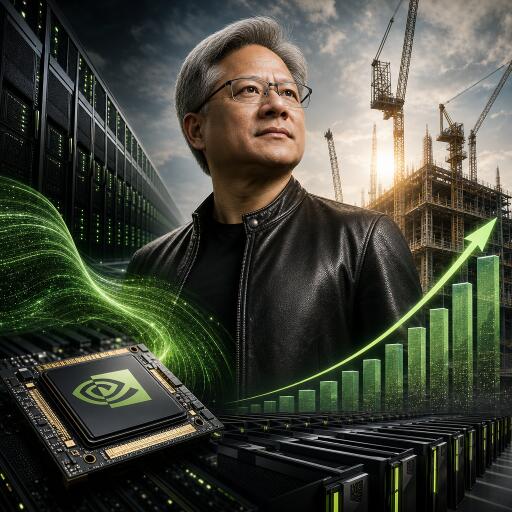
Jensen Huang’s Unwavering Bet: AI Infrastructure to Reach $4 Trillion as Nvidia Eyes Doubled Chip Sales
At a recent industry conference, Nvidia CEO Jensen Huang reiterated a bold projection he first made a year ago: annual global spending on AI infrastructure will reach $3 trillion to $4 trillion by 2030. He argued the past year’s momentum has validated that outlook, pointing to surging demand and rapid adoption of AI across sectors and geographies.
Recent results have added fuel to his case. Nvidia’s fiscal second-quarter revenue reached $96.2 billion, up 106% year over year, with data center revenue alone at $89 billion. Gross margins expanded to 75%. Those numbers arrived just weeks before Huang’s latest remarks, reinforcing the narrative that the AI buildout is accelerating rather than cooling.
Even so, investors are asking whether the market has already priced in such growth and whether real-world constraints—power, supply chains, and factory buildouts—can keep pace. Huang’s answer: yes, and he offered fresh signals. He expects Nvidia to sell roughly twice as many chips next year as this year, citing clear, measurable value from AI now coursing through economies worldwide and prompting nations and enterprises to scale up.
That sales trajectory sits above Nvidia’s longer-term guidance. The company’s outlook for fiscal 2028 implies around 70% revenue growth to nearly $673 billion, but management also acknowledges supply will be the limiting factor for several years. High-bandwidth memory and other components will remain tight through at least fiscal 2028, according to the company’s finance leadership.
Constraints haven’t slowed orders. Nvidia now sees $1 trillion in visible demand for its Blackwell and Vera Rubin platforms through 2027—double the $500 billion backlog cited a year earlier. Hyperscalers are on pace to spend roughly $800 billion in capex this year and about $1.3 trillion next year. While the usual giants continue to lead, the buyer base is expanding fast.
New demand is coming from emerging AI labs, sovereign initiatives, and traditional enterprises. Nvidia recently inked a major agreement to deploy an additional 2 million GPUs across 2027 and 2028. It has also assembled partnerships with large asset managers and infrastructure investors designed to channel more than $500 billion in private capital into AI data centers. Increasingly, Nvidia isn’t just shipping chips—it is helping coordinate financing, construction, and operations for what Huang calls AI factories.
These facilities are immense. A single gigawatt-scale AI factory can cost $50 billion to $60 billion to build. Under current conditions, Huang has suggested they can achieve payback in about a year. Market rental rates for earlier-generation H100 GPUs have climbed to around $16 per hour in some cases, up from roughly $5 a year ago. Prices and utilization continue to rise as AI models scale and broaden their use cases.
The AI spending flywheel is turning faster. Token generation rates have surged roughly 25-fold in under a year, and open models now account for nearly 70% of tokens produced, up from about 30%. More compute creates more capable models; better models unlock more economic value; and that value, in turn, justifies even more compute. The momentum is feeding on itself.
Skeptics warn of bubble risks, noting Huang’s $3 trillion to $4 trillion forecast exceeds many Street estimates for the entire AI sector. Some analysts still see hyperscaler capex peaking near $1 trillion by 2028. Yet Nvidia’s performance continues to stretch those assumptions. In the latest quarter, data center revenue for fiscal 2027 jumped 117% year over year, while net income rose 126% to nearly $60 billion.
Power remains the ultimate bottleneck. Beyond chips and memory, these AI factories require gigawatts of electricity, ample land, and years of permitting. Nvidia says industry visibility into these constraints has improved markedly. The company now works directly with utilities, real estate developers, and governments around the world—coordination that helps it guide for full-year growth as far as 18 months out, something it rarely did in the past.
The semiconductor industry itself is set to expand significantly. Huang argues two forces are at play: the emergence of a new computing layer purpose-built for AI, and the slowing of Moore’s Law. Traditional scaling no longer yields sufficient gains, driving demand for specialized accelerators. Customers are paying premium prices because the returns justify the expense.
Blackwell systems are priced around $25,000 per GPU, with the next-generation Vera Rubin platform near $40,000. These are not incremental upgrades; they target order-of-magnitude improvements in performance and efficiency. Enterprises report strong productivity and ROI in areas such as drug discovery, financial modeling, software engineering, and industrial automation, suggesting the technology has moved from experimentation to production.
Risks persist—geopolitical tensions, energy shortages, or a plateau in model performance could slow deployments. Huang acknowledges these possibilities but points to persistent signals of rising demand: growing rental rates for prior-generation hardware, expanding backlogs, and new customer categories emerging each month.
The economic framing is changing. For decades, compute was a cost center. Today, the most advanced AI infrastructure can be a revenue engine and a competitive moat. “Compute is revenue,” Huang has said, capturing the shift as AI factories become their own asset class, drawing capital from financial institutions and strategic commitment from nation-states treating them as critical infrastructure.
Nvidia sits at the center of this buildout, spanning chips, networking, software, and increasingly, financing. The company reported $216 billion in fiscal 2026 revenue, up 65%, with operating cash flow above $100 billion. It raised its dividend 25-fold and authorized $80 billion in additional share repurchases—moves that underscore conviction in its trajectory.
Whether the stock still offers upside depends on execution. Expectations are already enormous. But if Nvidia does double chip shipments next year and if AI infrastructure spending does climb toward $3 trillion to $4 trillion annually by decade’s end, the opportunity could outstrip today’s assumptions. The decisive variable isn’t whether AI matters—it’s how quickly the physical world can scale to meet the demand.
The next few years will be the real test: power, chips, capital, and talent must align at unprecedented scale. So far, each quarter has strengthened Huang’s argument. Doubling chip volumes in the near term. Trillions in infrastructure to follow. The figures sound astonishing—until you look at the ones already delivered.