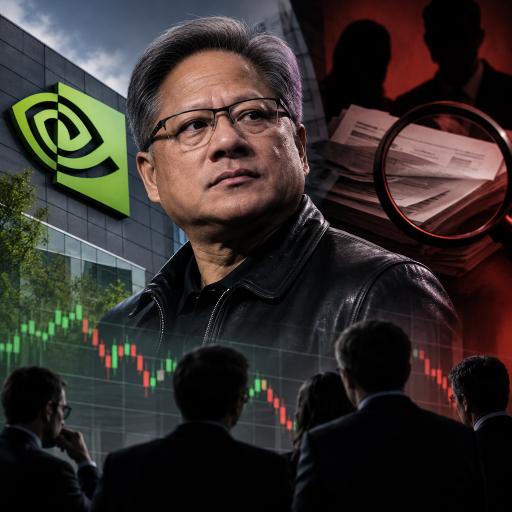
Nvidia’s Jensen Huang scandal: What it means for investors
Nvidia’s investment case remains supported by strong demand for artificial intelligence computing, but the company now faces increased governance and leadership risk. An independent investigation will determine whether the controversy is temporary or develops into a wider regulatory, national-security or succession issue.
- Governance risk has increased: There is currently no established evidence that sensitive information was disclosed, but investors should monitor the investigation.
- Succession matters: Jensen Huang’s importance to Nvidia has been a major advantage, yet the company’s dependence on its founder creates vulnerability.
- Caution may be appropriate: Holding Nvidia is different from aggressively buying a share-price decline while governance, geopolitical and AI spending uncertainties remain unresolved.
What happened at Nvidia?
Nvidia’s board has launched an independent investigation following reports that CEO Jensen Huang may have been targeted by a suspected foreign intelligence operation involving a woman whom US authorities reportedly suspect of gathering information for China.
Huang has acknowledged having a personal relationship with the woman. For shareholders, however, the central issue is not his private conduct. It is whether company secrets, strategically important technology or national-security information was compromised.
The board has said it currently has no reason to believe Nvidia information or US national security was compromised and has expressed confidence in Huang’s leadership. No evidence has been established at this stage that Huang disclosed sensitive material.
Nvidia shares fell 4.3% on 9 November while the wider technology sector advanced. The divergence suggests that investors were pricing in company-specific uncertainty rather than rejecting the broader AI investment theme.
Nvidia’s greatest strength is also a vulnerability
Huang co-founded Nvidia in 1993 and has shaped its technology strategy, software platform and major customer relationships for more than three decades. Nvidia went public in 1999 with a market value of about $563 million. By November 2026, it was valued at approximately $4.3 trillion after previously exceeding $5 trillion.
The company reported fiscal 2026 annual revenue of $215.9 billion, while its latest quarterly revenue reached $96.2 billion. Much of that growth came from demand for AI computing.
Huang’s early investment in accelerated computing and the CUDA software ecosystem helped create Nvidia’s competitive position. He also remains closely involved in strategic planning and relationships with customers and governments.
That influence creates key-person risk. Nvidia has an experienced management team, but it has not publicly identified a successor. An unexpected leadership change could raise questions about strategy, execution and customer confidence.
Could Huang be removed?
Nvidia’s board has the authority to replace its chief executive, but an investigation does not establish wrongdoing or make removal inevitable. The board has publicly supported Huang.
The more relevant issue for investors is whether Nvidia has sufficiently robust governance and succession plans to preserve stability if Huang becomes unable to continue leading the company.
China and national-security risks
Nvidia operates at the centre of the US-China technology rivalry. Its most advanced AI chips are considered strategically important, and their export is subject to national-security controls.
Huang has argued for retaining access to the Chinese market, while US policymakers have sought to limit China’s access to advanced computing. The allegations could produce closer examination of Nvidia’s China relationships, export-control compliance and internal safeguards—even if the investigation finds that no information was compromised.
Additional restrictions are not guaranteed. Nevertheless, Nvidia could face greater regulatory uncertainty, higher compliance costs and reduced access to an important market.
The controversy comes at a sensitive time for AI stocks
Investors are becoming more selective about AI-related investments. Attention is shifting from the construction of AI infrastructure toward whether companies can turn that spending into sustainable revenue, productivity gains and profits.
Nvidia remains central to data-centre expansion, but expectations are exceptionally high. Any slowdown in spending by hyperscale cloud companies could affect growth projections, even if overall demand for AI chips remains strong.
The market reaction also showed that enthusiasm for AI can continue while Nvidia faces company-specific pressure. On 9 November, AMD gained more than 13%, Micron rose about 6% and the broader semiconductor index climbed nearly 7%, while Nvidia declined.
Why the 17 November earnings report matters
Nvidia is scheduled to report earnings after the US market closes on 17 November. Investors will be watching:
- Demand and guidance: Whether major customers are maintaining AI infrastructure spending plans.
- Margins and competition: Whether Nvidia can preserve profitability as new products launch and competition from AMD and custom chips increases.
- China exposure: Whether export controls are limiting demand or future growth opportunities.
- Leadership stability: Any comments about governance or the independent investigation.
Strong earnings could confirm that Nvidia’s underlying operations remain healthy. However, financial performance may not remove the valuation discount associated with governance and geopolitical uncertainty.
Should investors hold, sell or buy the dip?
For long-term shareholders, the investigation alone may not be a reason to sell. Nvidia retains substantial advantages in software, networking, developer support and customer relationships.
However, a strong business does not make every decline an automatic buying opportunity. Investors considering buying the dip may prefer a gradual approach while awaiting the investigation’s findings and the next earnings report.
Portfolio concentration also deserves attention. Holding several semiconductor stocks or technology funds may provide limited diversification if they all depend on continued growth in AI infrastructure spending.
The bottom line
Nvidia’s investment thesis is not necessarily broken, but its risk profile has changed. The controversy highlights the company’s dependence on Huang and could increase regulatory scrutiny.
The investigation may end without material consequences, or it could affect governance, leadership continuity and commercial relationships. Until there is greater clarity, investors should distinguish between confidence in Nvidia’s long-term competitive position and expectations for its near-term share price.