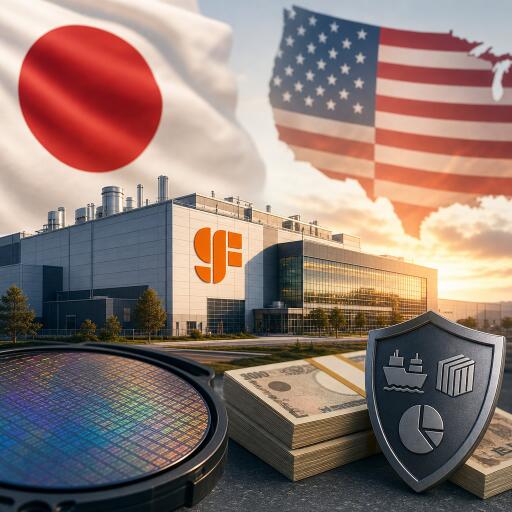
Japan considers buying GlobalFoundries US fab with tariff funds
Japan is in active talks to finance the construction of a US-based semiconductor manufacturing plant that would be operated by GlobalFoundries, with potential support ranging from ¥2 trillion to ¥3 trillion (about $12.8 billion to $19.3 billion). If finalized, it would be the largest single outlay under Japan’s $550 billion investment pledge tied to a bilateral trade agreement reached in July 2025.
What’s being discussed
Negotiations over structure and funding reportedly took place between September 14 and 15, though neither government has officially confirmed the plan. The contemplated investment aligns with a trade deal in which the United States lowered tariffs on Japanese imports—especially vehicles—to 15%, while Japan committed to channeling significant capital into the American economy by January 2029.
Within this framework, the proposed semiconductor project stands out for its scale and strategic importance. Japan’s public financing arm, the Japan Bank for International Cooperation (JBIC), is expected to play a central role in arranging and deploying capital for the facility.
Why GlobalFoundries
GlobalFoundries, listed on NASDAQ under the ticker GFS, is a leading producer of mature and specialty logic chips used across automotive, industrial, and consumer electronics markets. The company operates US fabs in Malta, New York, and Burlington, Vermont, and has long focused on technologies where demand is robust and supply has been tight, rather than competing in the race for the most advanced process nodes.
Following reports of the potential deal, GlobalFoundries shares rose more than 2% in premarket trading, reflecting investor expectations that new capacity could reinforce the company’s position in key end-markets.
A strategic pivot in Japan’s investment mix
Under the broader $550 billion pledge, Japan’s earlier commitments—around $109 billion—were concentrated in energy and critical minerals. Directing up to $19 billion toward a single semiconductor fab suggests a recalibration, signaling that chip production and supply chain resilience have moved higher on Tokyo’s priority list.
Such a project would also dovetail with efforts to deepen US–Japan industrial ties and diversify global semiconductor capacity, particularly in nodes crucial to automotive, industrial automation, and connected devices.
Timeline, location, and open questions
Key details remain unsettled. The site for the new US facility has not been announced, and the specific technology node it would target has not been disclosed. The timeline is a critical factor: the investment pledge carries a deadline of January 19, 2029. Given that building and ramping a fab of this magnitude typically takes three to four years, construction would likely need to begin soon to demonstrate material progress within the agreement’s window.
GlobalFoundries has already received US CHIPS Act funding to bolster domestic operations. Additional Japanese financing could accelerate expansion but may also raise questions about how multiple subsidies interact, including rules designed to prevent overlapping incentives and to promote transparency among international partners.
Potential impact on GlobalFoundries
For GlobalFoundries, the scale of the project would be significant relative to its financial profile. The company reported roughly $1.8 billion in revenue in its most recent quarter, making a $12.8 billion to $19.3 billion build-out transformative rather than incremental. New capacity focused on mature and specialty nodes could strengthen long-term supply commitments to automakers and industrial customers, while potentially enhancing geographic redundancy and supply security for US-based manufacturers.
What to watch next
- Official confirmation and terms from the Japanese and US governments.
- Selection of the fab’s location and announcement of the targeted process technologies.
- Clarity on how Japanese financing will complement existing US incentives without running afoul of subsidy coordination rules.
- Project milestones that align with the January 2029 investment deadline.
If finalized on the proposed scale, this initiative would underscore the deepening alignment between Japan’s investment strategy and US semiconductor policy, while positioning GlobalFoundries to play an even larger role in the global supply of mature-node chips that underpin critical industries.