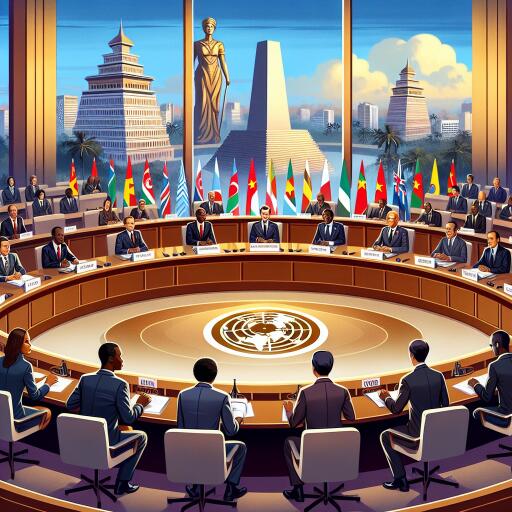
In Yaoundé, the WTO is playing its credibility
From March 26 to 29, 2026, Yaoundé will host the 14th Ministerial Conference of the World Trade Organization (WTO), the institution’s highest decision-making forum. It is only the second time this gathering takes place on African soil, after Nairobi in 2015. The meeting unfolds amid deep uncertainty: the repercussions of the war in the Middle East, fragmenting value chains, growing strategic rivalries, and a return of protectionism, reinforced by new U.S. tariffs. Yet the stakes are immense, as WTO rules still govern roughly 72% of global trade.
A crossroads for multilateralism
Yaoundé will bring together 166 members seeking to reduce tensions and reassert the value of a rules-based trading system. The goal is to restore confidence in multilateralism, keep it inclusive, and reaffirm the WTO’s core role as referee and guide for global commerce. Concrete outcomes will be difficult, but even a credible roadmap could stabilize expectations and demonstrate that negotiated solutions remain possible.
Reforming the WTO
Members are expected to consider a reform package aimed less at instant agreement than at setting a clear, time-bound roadmap. Priorities include decision-making practices, special and differential treatment (SDT) for developing members, and fairer competition. Years of gridlock—most visibly the Doha Round stalemate—have underscored the limits of a strict consensus culture that can enable vetoes.
Options on the table include diversifying decision-making methods, moving toward a “responsible consensus,” and even exploring a streamlined executive function to improve institutional agility. Plurilateral initiatives—where willing members advance without blocking others—are seen as complementary, provided they uphold multilateral coherence. Transparency is another pressure point, after episodes of unnotified arrangements in recent years.
The paralysis of the Appellate Body since 2019 heightened the urgency. A temporary appellate arbitration arrangement has helped some members maintain binding dispute settlement, but a durable multilateral fix is still needed. On SDT, the self-declared “developing country” status covers vastly different realities. Some advanced economies want more differentiation, pointing to the weight of major trading powers. Others warn that pruning SDT too aggressively would erode inclusiveness and limit policy space. China’s decision to forgo SDT in future agreements is noteworthy, though calls persist to extend this commitment retroactively. With several key members voicing reservations, consensus remains uncertain.
Digital trade: toward a structured global framework
Digital trade has outpaced governance. One proposal is to establish a Permanent Committee on Digital Trade—an institutional home within the WTO for rules and monitoring in the digital economy. Members must also decide the fate of the long-standing moratorium on customs duties for electronic transmissions, in effect since 1998 and last renewed in 2024, with a deadline tied to this conference or March 31, 2026.
Positions diverge. Some developing countries argue that lifting the moratorium could unlock revenue, but recent analyses suggest potential gains may be modest and the costs to competitiveness high. In contrast, many in Europe favor renewal and even permanency, arguing a tariff-free digital flow underpins innovation and cross-border services. Parallel talks under the Joint Statement Initiative on e-commerce continue, but differences over digital divides and infrastructure persist. Proposals range from a multi-year extension—possibly to 2028—to letting the moratorium lapse. As host, Cameroon pushes for a balanced approach that supports development while enabling digital transformation.
Subsidies for fishing
The “Fish 1” agreement, adopted at the 12th Ministerial Conference and in force since September 15, 2025, curbs the most harmful fisheries subsidies. It is tied to a follow-on “Fish 2” deal, which must be concluded within four years to strengthen the regime and avoid backsliding. The next step targets subsidies that drive overcapacity and overfishing—such as financing new or modernized vessels, fuel or bait support, income support, and loss-compensation schemes, including for activities beyond national waters.
The crux of the talks is SDT: how to tailor obligations to different levels of development and subsidy capacity. The United States favor tight disciplines with few exemptions, while many developing countries seek wider policy space to protect artisanal fishers and coastal communities. A carefully calibrated package could both conserve resources and recognize legitimate development needs.
Agriculture: cautious movement after years of deadlock
Agricultural reform has advanced haltingly since the early 2000s. The 2015 Nairobi decision eliminating agricultural export subsidies was historic, yet the most complex issues remain. In Yaoundé, a draft text aims to re-energize negotiations, promote a fairer and more market-oriented system, and address food security. It has been broadly welcomed as a workable basis for compromise, though it falls short of fully reflecting all national priorities. Some coalitions seek tweaks, while others—such as cotton-producing countries in Africa—argue their specific concerns need stronger recognition.
What is at stake in Yaoundé
Fault lines are deep: national interests, development strategies, food security priorities, and resource conservation are not easily reconciled. It would be easy to predict stalemate. Yet, as the saying goes, “international politics is tragic, but not desperate.” Even incremental steps—on dispute settlement restoration, a structured digital agenda, disciplined fisheries subsidies, or a pragmatic farm trade workplan—would signal that cooperation still delivers.
The Yaoundé conference is therefore a test of credibility. If members can outline concrete paths forward, they will reinforce trust in rules-based trade and show that, despite a turbulent geopolitical climate, multilateralism can adapt, include, and endure.