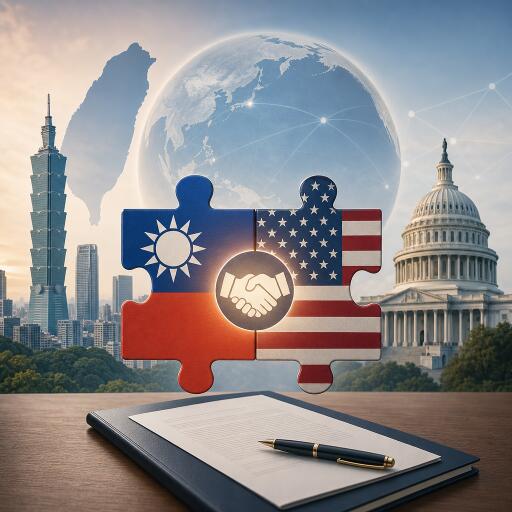
Long overdue tax agreement critical to Taipei-Washington relationship | Taiwan News | Jul. 6, 2026 18:54
Taiwan and the United States share one of the world’s most consequential economic relationships. In 2025, Taipei ranked as Washington’s fifth-largest trading partner, while the U.S. recently became Taiwan’s top partner. The two economies are increasingly intertwined through arms sales, semiconductors, and AI collaboration. Yet one glaring gap persists: the absence of a bilateral tax agreement to prevent double taxation.
Why the missing tax pact matters
Taiwan has double-taxation agreements with 34 countries. Not having one with the U.S. is an anomaly that burdens companies on both sides. Taiwanese officials estimate their firms can face an effective tax rate of up to 51% on U.S. profits. American investors in Taiwan confront a 21% withholding tax on Taiwan-source dividends. These frictions discourage investment, distort capital allocation, and add complexity at a time when both economies are trying to accelerate cooperation in critical industries.
The U.S.-Taiwan Expedited Double-Tax Relief Act is designed to close this gap by amending the U.S. Internal Revenue Code to extend tax relief comparable to standard U.S. treaty benefits to Taiwanese residents and businesses. Functionally, it would bring treatment closer to what exists with other major U.S. trading partners, reducing withholding rates, clarifying residency rules, and lowering the risk of double taxation.
A more urgent problem since 2022
The push for tax relief has grown sharper over the past few years. The global chip shortage underscored the need to boost two-way investment and resiliency in supply chains that run through Taiwan, catalyzing broader trade initiatives between the two sides. At the same time, Taiwan’s security requirements—heavily reliant on U.S. systems and support—have deepened the link between defense and economic policy. Meanwhile, trade and investment have expanded as firms diversify away from China, Taiwan moves up the value chain at the head of global supply networks, and its consumer market matures.
Business leaders and industry groups increasingly argue that a double-taxation solution, once a secondary issue, has become a priority. Removing tax barriers would allow capital to flow more efficiently into semiconductors, AI infrastructure, advanced manufacturing, and other strategic sectors where cooperation is intensifying.
Normalization and international integration
Beyond the immediate economic benefits, a tax agreement carries symbolic and systemic weight. Elevating Taiwan to treatment more closely aligned with other top U.S. partners would help normalize its role in international economic frameworks. That signal could encourage additional countries to deepen fiscal and commercial ties with Taiwan, further embedding it within global industry networks and institutional arrangements.
Such normalization matters. The broader and more formal Taiwan’s integration becomes, the less likely partners are to shy away from cooperation. This dynamic strengthens Taiwan’s position in global trade and technology ecosystems, supports diversified supply chains, and encourages cross-border projects in capital-intensive sectors where legal clarity is essential.
Security through economic interdependence
There is also a security dividend. A more tightly integrated Taiwan increases the global economic stakes of instability. Some estimates put the potential global cost of a conflict in the Taiwan Strait in the trillions of dollars. While a tax agreement is not a defense pact, it helps weave a denser web of mutual interests. In a world where formal security guarantees are limited, long-term economic interdependence can be a stabilizing force and a deterrent.
Fixing structural anomalies for both sides
The status quo creates structural distortions for both Taipei and Washington. For the U.S., it is strategically inconsistent to lack a tax framework with a top-five trading partner. For Taiwan, it is counterproductive to maintain fiscal frictions with the primary destination for its high-tech investments and the key source of its defense acquisitions.
Precedent also suggests the risks of signing such an agreement may be overstated. Taiwan already maintains dozens of tax treaties without provoking significant retaliation elsewhere. Aligning fiscal treatment with established practice would reduce uncertainty and improve the investment climate for companies planning major multiyear commitments.
In practical terms, the absence of an agreement raises the cost of doing business in precisely the sectors both sides seek to bolster. Semiconductor fabrication, AI compute buildouts, and other advanced systems require massive upfront investment and long payback horizons. Extra layers of withholding, unrelieved double taxation, and lack of clarity on tax residency or permanent establishment rules act as a quiet tax on strategic cooperation. The same applies to other critical supply chains—from drones to next-generation components—where trusted, “non-red” sourcing is a priority.
What a modern agreement should deliver
- Lower and clearer withholding rates on dividends, interest, and royalties to reduce financing costs and encourage cross-border capital flows.
- Mutual recognition of residency and permanent establishment rules to prevent overlapping tax claims and disputes.
- Relief from double taxation through credits or exemptions, enabling predictable after-tax returns.
- Dispute resolution mechanisms and information exchange to improve compliance and reduce administrative friction.
- Provisions that reflect today’s realities in services, IP, and digital trade.
Momentum and the path ahead
The incentives to act are clear. Both economies benefit from removing a self-imposed barrier to strategic investment. Bipartisan support for Taiwan remains robust, and there is growing recognition that tax normalization is overdue. While the legislative path can be lengthy, the convergence of economic needs, security considerations, and business advocacy has created a window for progress.
Passing a double-tax relief framework would not only improve the bottom line for companies; it would also codify a higher standard in the Taipei–Washington relationship. In doing so, it would promote growth, strengthen resilience in critical technologies, and reinforce a network of interests that contribute to stability in East Asia. After years of delay, the case for action is stronger than ever—and the costs of inaction increasingly hard to justify.