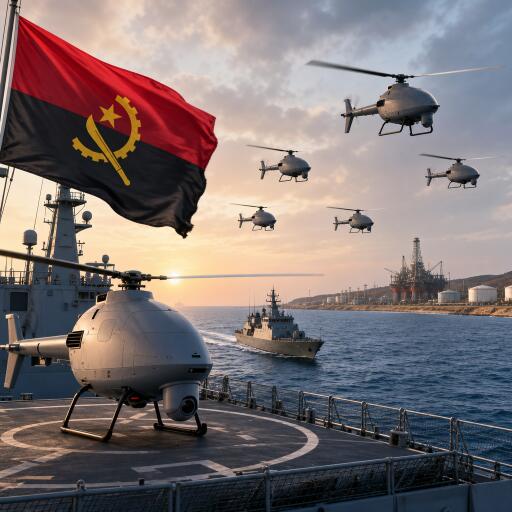
Angola Deploys Six Naval Drone Helicopters to Guard Its Maritime Economy
Angola has taken a major step in strengthening maritime security with the delivery of six HT-100 Naval unmanned helicopters from Swiss manufacturer ANAVIA. Officially handed over to the Angolan Navy (MGA) on September 2 after a series of trials and validations, the drones are part of a broader naval modernization effort designed to protect vital offshore energy assets, secure fisheries, and enhance port operations.
Key points
- Six HT-100 Naval unmanned helicopters delivered, complete with electro-optical/infrared sensors and maritime control stations.
- Oil remains the backbone of Angola’s economy, accounting for 94% of exports and 60% of fiscal revenue.
- Port activity is rising: the Port of Luanda handled roughly 17.8 million tonnes of cargo in 2025, with ship calls up 23% year-on-year to 4,059 between January and September; oil-support calls rose 45%.
What the HT-100 Naval brings to the fleet
Compact but capable, the HT-100 Naval is purpose-built for at-sea operations. It has a maximum takeoff weight of 120 kilograms and can carry up to 60 kilograms of payload and fuel. A 15 kW turbine engine supports flights of up to six hours, giving commanders the ability to sustain long-duration missions without committing crewed aircraft or diverting patrol vessels.
In its naval configuration, the drone can cover up to 600 kilometers. A radar-guided autonomous landing system enables safe recoveries on moving decks, even in rough sea states—an essential feature for reliable operations from ships. The delivered package includes stabilized electro-optical and infrared sensors for day/night surveillance, plus maritime control stations to manage missions, data, and fleet integration.
Enhanced operations and safety at sea
By shifting routine and extended surveillance to unmanned platforms, the Angolan Navy can expand its intelligence, surveillance, and reconnaissance (ISR) coverage with fewer risks to personnel. The drones can patrol wide areas, identify suspicious vessels, monitor offshore infrastructure, and cue surface or manned air assets only when needed. This improves responsiveness, reduces operating costs for manned platforms, and helps optimize limited naval resources.
Safeguarding a maritime economy
Angola’s economy is deeply tied to the sea. Petroleum accounts for the overwhelming share of exports and a majority of fiscal revenue, underscoring the need to protect offshore production and logistics corridors. But the stakes extend beyond hydrocarbons. Fisheries contribute about 3% of GDP and provide direct employment to more than 150,000 people. For 2025, authorities set a target of 723,419 tonnes of fish products, aiming to cover 96% of domestic consumption—making the fight against illegal, unreported, and unregulated fishing a national priority.
Ports and logistics are also accelerating. The Port of Luanda handled nearly 17.8 million tonnes of goods in 2025, while the Port of Lobito processed about 1.85 million tonnes. Luanda recorded 4,059 ship calls between January and September 2025, up 23% year-on-year, including 2,187 oil-support vessel calls—a 45% surge. Unmanned aerial surveillance helps safeguard these flows by deterring maritime crime, monitoring anchorages and approaches, and supporting rapid incident response.
Part of a $1.2 billion naval upgrade
The HT-100 Naval systems are one element of a larger modernization program worth about $1.2 billion. Three BR71 MK II corvettes are slated to bolster the fleet, with the first ship—the NRA Ekuikui II—launched in Cherbourg, France, on March 4, 2026. These surface combatants, together with the new drone capability, will give Angola better reach and persistence across its exclusive economic zone.
This modernization is designed to work in concert with Angola’s National Maritime Surveillance Coordination Center in Luanda, inaugurated in 2024. The center coordinates the protection and sustainable exploitation of maritime resources, secures sea lines of communication, and integrates information streams to guide patrols and enforcement operations.
Outlook
With the HT-100 Naval drones entering service, Angola is positioned to extend surveillance coverage, quicken interdiction against illicit activities, and improve safety across offshore energy sites, fisheries, and shipping lanes. As the corvettes come online and data flows through the national coordination center, the country’s maritime domain awareness should strengthen further—supporting economic growth, safeguarding livelihoods, and reinforcing sovereignty at sea.