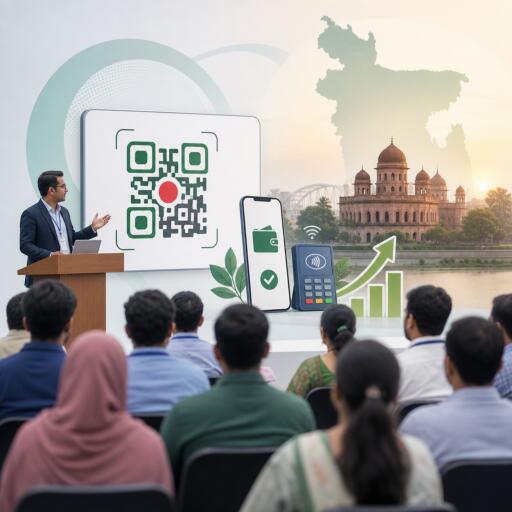
Workshop on Bangla QR held in Rajshahi to promote cashless Bangladesh
Bangladesh Bank organized a workshop on Bangla QR in Rajshahi to accelerate the expansion of an integrated digital payment ecosystem and advance the country’s shift toward a cashless economy. The event focused on increasing adoption among small and medium enterprises, enabling merchants to accept fast, secure, and interoperable digital payments.
Hosted at the training centre of Bangladesh Bank’s Rajshahi office, the workshop was supported by the International Finance Corporation (IFC), with BRAC Bank serving as the lead bank. Participants received hands-on guidance on using Bangla QR, which allows customers to pay through any participating bank or mobile financial service app by scanning a single, standardized QR code.
Organizers emphasized that broader use of Bangla QR will extend digital payment facilities across the country and encourage small entrepreneurs to embrace cashless transactions. They noted that interoperable QR acceptance can simplify checkout, reduce cash handling risks, and create a more seamless experience for both customers and merchants.
The workshop was attended by Executive Director of Bangladesh Bank’s Rajshahi office Mohammad Badiuzzaman Didar as chief guest, with BRAC Bank’s Additional Managing Director and Head of SME Banking Syed Abdul Momen present as special guest. The session was chaired by A.N.M. Moinul Kabir, Director of Bangladesh Bank’s Payment Systems Department-1.
Other attendees included Director of Bangladesh Bank’s Rajshahi office Md Nazim Uddin; Additional Directors Md Parwez Anzam Munir and Mohammad Moin Uddin; Joint Director Jewel Majumder; and BRAC Bank’s Head of Merchant Acquiring, Khairuddin Ahmed. Senior officials of Bangladesh Bank, representatives of IFC, and local businesspeople also participated.
Why Bangla QR matters
- Interoperability: A single QR standard works across participating banks and mobile financial applications, reducing fragmentation for merchants and customers.
- Security and trust: Digital transactions help minimize risks associated with cash handling and promote transparent financial practices.
- Ease of use: Simple scanning enables quick, contactless payments, improving checkout speed and customer convenience.
- Financial inclusion: Wider acceptance helps extend modern banking services to small and micro businesses nationwide.
- Cashless momentum: Reduced dependence on cash supports efficient, traceable, and resilient commerce.
Speakers underscored that Bangla QR is a cornerstone of a modern, cashless economy, offering safer and smoother transactions while lowering operational frictions for merchants. They urged businesses to adopt the technology promptly to align with the national drive toward digital payments and to meet changing consumer expectations.
As the lead bank for the workshop, BRAC Bank highlighted its ongoing commitment to expanding digital transactions and supporting merchants with interoperable payment acceptance. The initiative in Rajshahi reflects a collaborative effort among regulators, financial institutions, and development partners to scale secure, inclusive, and efficient digital commerce across Bangladesh.